


The seller had already signed the last page and capped his pen when he remembered the cat.
“There may still be one animal at the property,” Miles Calder said.
Noah Bennett looked up from the stack of closing papers. Across the conference table, Miles had the distracted impatience of a man who believed every room should move at his speed. His wool coat was folded over one arm, his phone lay faceup beside the deed, and the title agent had already begun gathering copies into a blue folder.
Noah waited for the rest of the sentence. When it did not come, he asked, “What kind of animal?”
“My wife’s cat.” Miles glanced toward the sleet needling the office windows. “Long-haired. Gray and white.”
“At the cabin?”
“That’s what I said.”
The title agent stopped shuffling paper.
It was March 6. The cabin sat nearly sixty miles north of Duluth, at the end of an unplowed private road near the edge of the Superior National Forest. Noah and his wife, Erin, had spent two months studying inspection reports and repair estimates before agreeing to buy it. The low price made sense only because Miles needed a fast sale; his wife had suffered a major stroke in September, and the medical bills had become, as he put it, “a liquidity problem.”
Noah leaned forward. “When was someone last there?”
Miles checked his phone, not the calendar on the wall. “November.”
For a moment, the only sound in the room was the heater ticking beneath the window.
“You left a house cat at a seasonal cabin in November?” Noah asked.
“I left food.” Miles slid his phone into his pocket. “There’s a covered gazebo behind the house. She used it all summer.”
“Did anyone check on her?”
“My wife was in intensive care.” His voice sharpened, though Noah had not raised his. “I was dealing with neurologists, insurance, rehab placement, and a business that did not stop because my personal life became inconvenient. I could not make a hundred-and-twenty-mile trip every week for a cat that refused to come near me.”
The title agent looked down at her hands.
Noah knew there were people who reached for anger when shame got too close. He also knew shame did not feed an animal.
“Is the cat inside the house?” he asked.
“No. The place is winterized.”
“Is the property fenced?”
“Partly. Look, she may have gone somewhere else. She may not even be alive.” Miles stood and buttoned his coat. “The property is yours as of noon. If she’s there, do whatever you think makes sense.”
He said it with the tired finality of a man transferring an old appliance. Then he took his folder, thanked the title agent, and walked out into the gray morning.
Noah remained seated long enough to count four months without trying. November. December. January. February.
The title agent spoke first. “Do you want me to call animal control?”
“They’d still have to reach her.” Noah was already pulling out his phone. “And the road isn’t open.”
Erin answered on the second ring.
“We own the cabin,” he said.
“That was fast.” Her voice brightened. “Did you get the gate code?”
“Yes. Erin, there’s a cat up there.”
He heard a cupboard close on her end. “What do you mean, up there?”
“The seller left his wife’s cat when he closed the cabin for the season.”
The pause that followed was small but complete. “Is she alive?”
“I don’t know.”
Noah stood. “I’m going now.”
He drove home only long enough to change into insulated pants, pull his snowshoes from the garage rafters, and pack a duffel with towels, hand warmers, a flashlight, work gloves, and the soft-sided carrier Erin had bought years earlier for an elderly tabby they had lost to kidney disease. Erin filled two thermoses and found the emergency veterinary hospital in Duluth that stayed open around the clock.
“Call before you start down the private road,” she said, pushing a fleece blanket into the carrier. “And call when you reach the cabin.”
Noah nodded, though both of them knew cell service thinned to nothing past the county highway.
Erin caught his sleeve before he turned away. “Don’t assume the worst until you see it.”
“I’m trying not to.”
“No, you’re preparing for it. That’s different.” She pressed the truck keys into his palm. “Bring her back if she’s there.”
The drive north took almost two hours. Sleet became snow beyond Two Harbors, soft at first and then thick enough to erase the shoulders of the road. By the time Noah turned onto Pine Spur Road, the last plowed track ended in front of a row of locked mailboxes. Beyond them, the private lane disappeared beneath drifts that rose in smooth white backs between the trees.
He parked, strapped on the snowshoes, and checked the map in the closing folder. The cabin lay a little more than a mile in. Under ordinary conditions, it would have been an easy walk. In wind-packed snow, carrying a duffel and an empty pet carrier, it became a slow argument with the ground.
The forest absorbed sound. Snow caught in the spruce branches and released in soft collapses. Once, Noah stopped because he thought he heard a cry, but the noise came again from high in a birch—a black-capped chickadee scolding him for standing beneath its branch.
“Fair enough,” he muttered, and kept moving.
His shirt was damp under his coat when the first cabins appeared. They stood dark and sealed along the lakeshore, summer places abandoned to winter. Deck chairs were stacked behind windows. Boats slept beneath white tarps. No chimney smoke moved above the roofs.
Lot numbers were nailed to posts beside each drive, most of them half-buried. Noah found the Calders’ property by the rusted number 18 fastened to a metal gate. The chain had frozen into a ridge of snow, and the combination lock resisted his gloves until he warmed it between both hands.
The gate swung inward with a groan.
There were no tracks in the yard except the needle marks of birds and a shallow line where something small had moved beneath the porch. The cabin itself was a low cedar structure with green shutters and a screened porch facing the lake. Noah called once, then again.
“Kitty?”
The word sounded foolish and thin in the open air. Nothing answered.
He unlocked the back door. Inside, the cabin smelled of cold wood, drained pipes, and the stale mineral odor of rooms shut for months. Every cupboard stood open the way people left them after winterizing. A dusting of dead flies lay along one window. There was no food, no litter box, no water dish, and no sign that a living thing had been inside since fall.
Noah searched anyway. He checked under beds, behind the couch, inside the laundry closet, and beneath the kitchen sink. In the mudroom he found three pale hairs caught on the edge of a woven mat. He pinched them between his fingers and felt his chest tighten.
Outside, the chickadee landed on the porch rail. It tipped its black head toward him, then lifted away toward the back of the property.
The gazebo stood beyond a collapsed raspberry patch, nearly hidden under snow-laden cedars. Cedar boards enclosed half of the octagonal structure; weathered screens wrapped around the rest. One panel had split near the frame, leaving a narrow gap at ground level. A cat could have passed through it. So could wind, mice, and everything winter carried.
Noah forced a path across the yard. The gazebo door was swollen shut, and he had to shoulder it twice before the latch gave. Cold, sour air drifted out.
He aimed the flashlight inside.
The beam found an overturned plastic bowl, a litter pan filled with frozen leaves, and a large bag of dry food torn open along one seam. Only dust remained in the bottom. Brown pellets had lodged in cracks between the floorboards, too small even for the birds to bother with.
Against the far wall sat a gray felt cat bed shaped like a cave. Noah crouched beside it, held the flashlight near the opening, and saw nothing but a clump of old fur pressed into the back seam.
His first feeling was relief. It lasted less than a second.
An army-green blanket lay on the bench beside the bed. Frost had hardened its edges, but the center rose in a low, uneven mound. Noah stared at it while his mind tried to make the shape into folded fabric, a nest of leaves, anything that did not breathe and therefore could not have stopped.
The chickadee slipped through the broken screen and landed on the floor. It pecked once near the empty food bag, then hopped onto the bench beside the blanket.
Noah removed one glove.
“Please,” he said quietly.
He peeled the blanket back.
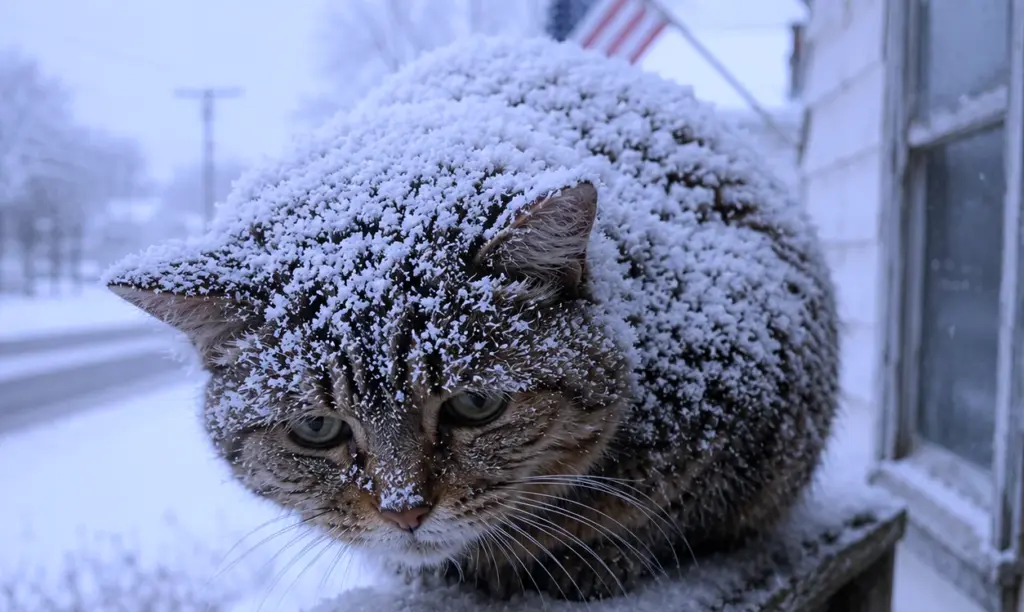
The cat underneath looked almost colorless in the winter light. Long gray-and-white fur had fused into dirty ropes along her sides. Her body was so thin that her hip bones made sharp corners beneath the coat. Frost clung to the whiskers around her nose, and one front paw was curled against her chest as though she had tried to hold the last of her warmth there.
Noah pressed two bare fingers to the fur below her ear.
Cold.
He closed his eyes. In that instant he saw Miles Calder’s clean cuffs, his capped pen, the casual tilt of his head when he said she may not even be alive. Noah gripped the bench with his other hand until the wood bit into his palm.
Then something moved beneath his fingertips. Not the cat. Not at first. Only one strand of fur stirring near her nose. Noah bent closer and held his own breath. A thread of air touched his skin…
To read the rest of the story – CLICK the NEXT button 👇👇👇