


The grizzly had the rope between his teeth when I opened my eyes. Each pull drove the knot deeper beneath my ribs. One of his front paws rested against the pine beside my shoulder, close enough that a small shift would have put four claws through my jacket. His breath rolled over my face—warm, damp, edged with the smell of crushed berries—and mine came back in shallow sips because somebody had tied me too tightly to breathe any other way.
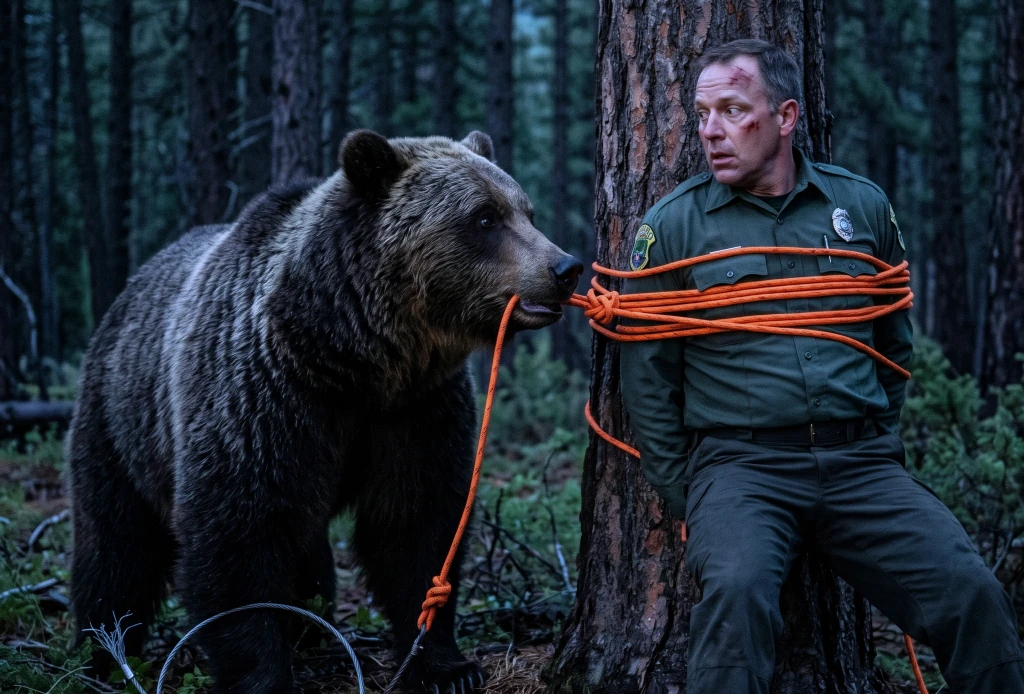
For several seconds, I understood only pieces. Cold bark against the back of my skull. Blood dried hard behind my left ear.
The orange climbing rope crossed my chest, waist, thighs, and ankles. My right hand had gone numb; my left wrist burned whenever I tried to move it. Beyond the bear’s shoulder, the last daylight lay in thin gray bands between the firs.
Then the rest came back.
My radio was gone. So was my phone, my sidearm, and the duty belt that identified me as a state conservation officer. The men who had taken them had left my canvas field pack under a fern twenty feet away, either because it looked worthless or because they had been in a hurry. They had also left me in a closed drainage above Coldwater Pass, miles from the nearest occupied cabin, with night dropping fast and a six-hundred-pound grizzly studying the rope at my throat.
The bear released the knot and lifted his head. He was a mature male, dark across the shoulders, with a broad muzzle and one ear nicked along the rim. Pine needles clung to his coat. Mud darkened the claws on his right paw, and when he breathed, a thin string of saliva caught the fading light.
I stopped testing the rope.
Nineteen years in the field had taught me what people usually learn too late: a bear does not have to look angry to kill you. It does not need a grudge, a reason, or the theatrical warning humans expect from danger. Distance is what keeps mistakes survivable, and there was less than a foot between his nose and my cheek.
“Easy,” I whispered. His ears tipped forward.
The word came out rough enough that it hardly sounded human. Still, he watched my mouth.
His nose moved once along my collar, then over the dried blood near my temple. He did not flinch from the smell. He lowered his muzzle to the rope again and closed his teeth around the strand that pinned my right shoulder.
I braced before he pulled.
Pain flashed white behind my eyes. The rope tightened across bruised ribs, then rasped against bark as the bear twisted his head. Fibers popped—not many, but enough for me to hear them.
He let go when I groaned. That pause frightened me more than blind aggression would have.
He had reacted to the sound—not like a trained animal and not with anything I was willing to call kindness, but with attention. He stood over me, breathing hard, as if the problem in front of him was not my body but the thing holding it in place.
My name is Eli Warren. In Alder County, Idaho, most people knew me as the officer who checked tags at dawn, answered livestock calls at midnight, and remembered which men had already been warned about bait piles, illegal traps, and closed roads. I had never enjoyed making enemies, but I had learned not to confuse being liked with doing the job.
Dean Rusk used to understand that distinction. So did Luke Danner.
We had grown up within five miles of one another. Dean taught me how to skip a flat stone across Huckleberry Creek.
Luke’s mother fed all three of us after football practice because my dad worked late and Dean’s house was rarely quiet enough for homework. We stood together at Luke’s father’s funeral, then again at mine. For years, friendship felt less like a choice than a fact of the landscape.
The country changed around us. So did we.
Dean turned his father’s small guiding business into a profitable outfitter operation. Luke repaired diesel engines and picked up seasonal work for him. At first the violations were the kind men dismiss over coffee: an elk taken across a boundary, a client whose tag did not match the animal, a carcass reported in the wrong unit.
Then antlers began moving through private buyers. Bear parts disappeared. Trail cameras showed trucks entering closures at night.
For seven months, I built the case without putting their names in my mouth unless I had to. I checked dates, fuel receipts, photographs, and tips from people who would not testify unless they knew I could protect them. Some part of me kept hoping the evidence would lead somewhere else.
That afternoon, it led straight to Dean’s truck.
Fresh tire marks crossed a berm on an old Forest Service spur above Coldwater Pass. The drainage beyond it had been closed to motor traffic for grizzly recovery work, and the rain had preserved the tread pattern cleanly. I called in my location, asked another officer to start my way, and followed on foot.
I should have waited.
The thought had been clear even then. But fifty yards beyond the berm, I found blood on the grass and a length of broken cable half-buried in mud. Farther in, something heavy had torn through the brush. The marks were fresh, and the cable carried the same crude green paint I had documented at two illegal snare sites that summer.
I kept going because an animal was hurt, because evidence was disappearing with every minute of rain, and because familiarity can make a man careless in ways fear never does.
Dean stepped from behind a spruce before I reached the clearing.
I remember his face more clearly than the blow. He looked tired, almost disappointed, as if I had forced him into an unpleasant chore. Luke stood several feet behind him, pale beneath his ball cap. On the ground between them lay a coil of cable, a rifle case, and a plastic tote with the lid snapped shut.
“Walk back out,” Dean said. “Pretend you missed the tracks.”
I told him to put his hands where I could see them. Luke said my name. Not loudly. It sounded like a warning meant for all three of us.
Then Dean smiled without humor. “You always did need to be the one decent man in the room.”
Something struck the side of my head.
When awareness returned, I was on my knees with my arms pulled behind me. Luke was arguing that they had already gone too far. Dean told him there was no halfway left. I tried to turn, and a boot drove me forward into the needles.
They tied me with rope from Dean’s guiding truck. Dean cinched the last knot himself, then removed my gear piece by piece. Luke stood near the edge of the clearing, looking anywhere except at me.
“He’ll freeze,” Luke said.
“Maybe,” Dean answered. “Maybe a bear finds him first. Either way, nobody asks why he followed us alone.”
Before they left, Dean crouched until we were eye level. The boy who had once split his last sandwich with me was still somewhere in the arrangement of his features. That made what he said worse.
“You should’ve let the mountain keep its secrets, Eli.”
Now one of those secrets was breathing against my face.
The grizzly bit the shoulder rope again. He pulled sideways this time, using the tree for leverage. The outer braid opened with a dry tearing sound, and my right arm dropped an inch before the remaining strands caught. Blood rushed into my fingers in hot, needling waves.
“Good,” I breathed before I could stop myself.
The bear stared at me.
I knew better than to praise him. I knew better than to assign intention where instinct was enough. Yet the word had come from the same place as prayer: not belief, exactly, but need.
He shifted his weight, and I saw that he was not moving cleanly. His right hind leg touched the ground and lifted again. Something thin trailed through the needles behind him, making a faint metallic scratch.
A broken snare cable was cinched above his paw.
The loop had cut through fur and swollen the flesh beneath it. One end had snapped from its anchor, but the locking piece still held, tightening each time the bear stepped.
The blood on the trail had been his. Dean and Luke had not merely been moving contraband through the closure. They had set a cable for a protected grizzly, and the animal had torn himself loose before they could return.
The bear followed my gaze and swung his head toward the injured leg. A low sound moved through his chest. Then he looked back at the orange rope crossing my body.
For the first time, his behavior made a terrible kind of sense.
He knew pressure. He knew restraint. He knew the smell of cable, blood, and panic. He did not have to understand knots or rescue to recognize another living thing fixed to the ground by something made by men.
He hooked a claw beneath the rope across my chest.
The tip caught my jacket and lifted both fabric and cord away from my skin. I held completely still.
He brought his mouth down, bit where the gap opened, and pulled. The strand snapped halfway through. His muzzle brushed my wrist, and the movement turned his body just enough for the last gray light to reach his left side.
A pale scar curved behind his front leg.
It was not a clean line. It widened near the ribs, narrowed under the shoulder, then vanished into dark fur. I knew every uneven inch of it because five years earlier I had washed gravel from that wound while a half-starved cub fought me with the last strength in his body.
My heart struck once, hard enough to hurt.
No. The North Fork held dozens of grizzlies. Scars repeated. Human memory was eager to make patterns when death stood close.
Then the bear leaned in and sniffed the inside of my right wrist, where two small white marks crossed the vein. Cub teeth. A bite I had never bothered explaining to anyone who asked.
I said the name I had no right to expect him to remember.
“Huck?”
The grizzly went still. The rope slid from his mouth, and his nicked ear turned toward me.
For one long breath, he searched my face. Then he gave a short, breathy huff—the same impatient sound a twenty-pound cub had made inside my field coat—and closed his jaws around the knot at my chest…
To read the rest of the story – CLICK the NEXT button 👇👇👇