


The fourth pair of men’s underwear turned up in my husband’s laundry basket on a Tuesday night. Not the soft cotton shorts I bought in bulk because they were easy to slide over his hips. Not the hospital briefs Ruth used when she changed his sheets. These were fitted boxer briefs, dark burgundy, expensive, and still carrying the faint chemical warmth of another man’s body.
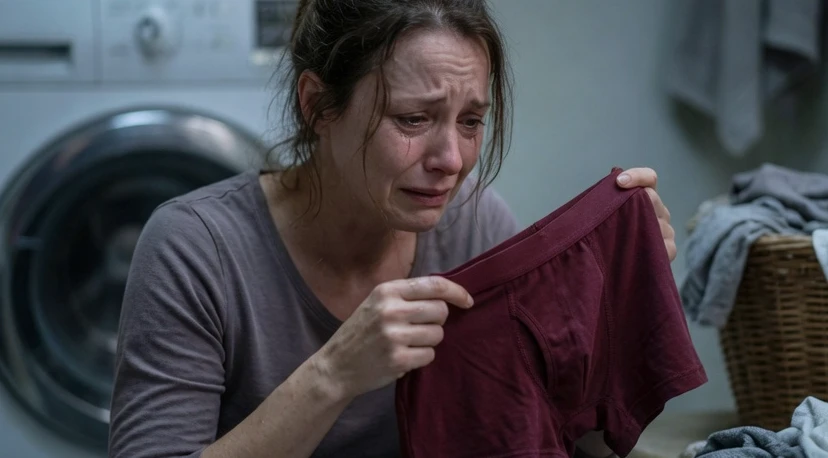
For almost a full minute, I stood in the laundry room with the washer open and the house humming above me, holding that piece of fabric between two fingers like it might burn through my skin. My husband, Ethan, had not walked, spoken, dressed himself, or even turned his head on command in six years. According to every chart in the thick medical binders stacked beside our bed, he existed somewhere between sleep and silence, kept alive by feeding tubes, monitors, medication schedules, and the kind of private care that costs more than most people’s homes.
So why did his laundry smell like cologne and cigarette smoke?
I did not scream. That surprised me later. I did not run upstairs, shake his shoulders, or demand an answer from a man who had not answered me since the accident. I folded the underwear once, very carefully, and slipped it into the pocket of my blazer.
Then I washed my hands until the water ran hot.
Our house sat inside Briar Glen, a gated community outside Columbus where every lawn looked trimmed by ruler and every porch light came on at dusk. When Ethan and I bought it, he called it our “grown-up house,” the place we would fill with noisy children and muddy sneakers. After the crash, I turned the primary bedroom into a private medical suite and the rest of the house into a museum of things we had once planned to become.
The bedroom was always too clean. It smelled of antiseptic wipes, lavender detergent, plastic tubing, and the mild soap I used on Ethan’s skin every evening after work. I had fired two nurses in the first year because they treated him like furniture. Ruth stayed because she talked to him like a person.
Ruth Bennett was sixty-two, widowed, practical, and kind in a way that never asked to be admired. She cooked, cleaned, helped with Ethan’s daily care, and reminded me to eat when I forgot. She had come from a small town near Athens and still said grace before lunch even when she was alone.
That night, she was in the kitchen scraping carrots into a pot of chicken soup when I walked in.
“Ruth,” I said, keeping my voice level, “did anyone come by today?”
She looked up, startled. “Dr. Hale stopped in around one, same as always. The pharmacy courier dropped off a package. Why?”
“No one else?”
“No, ma’am.” Ruth wiped her hands on her apron, her forehead folding with concern. “Did something happen?”
I watched her face. Ruth could not lie about a Christmas present without turning red. Her eyes stayed clear and worried.
“I just thought I smelled smoke upstairs,” I said.
“Oh, honey, no. I would’ve noticed.” She shook her head. “You know I don’t allow smoking anywhere near him.”
I knew. I also knew Ruth did not wear men’s cologne, did not buy $80 underwear, and did not have a reason to hide anything in Ethan’s laundry.
After dinner, I climbed the stairs with a bowl of warm water and fresh towels. Ethan lay exactly where I had left him that morning, head tilted slightly toward the window, lashes resting against his cheeks. He was still handsome in the cruel way preserved things can be handsome. His dark hair had silver at the temples now, and his jaw had sharpened over the years, but the shape of the man I married was still there. That was what made caring for him both sacred and punishing.
I sat beside him and touched his forehead. “I’m home,” I whispered, as I always did.
His eyelids did not move.
Six years earlier, on our anniversary, our SUV had gone off a rain-slick county road in Hocking Hills. I remembered the scream of tires, Ethan shouting, his hand grabbing the steering wheel, the violent white flash when the guardrail gave way. I walked away with bruised ribs and a cut on my shoulder. Ethan did not wake up.
His mother, Diane, never forgave me. She said it quietly at first, then loudly, then often enough that I began to say it to myself before she could. You were driving. You came home whole. My son came home like this.
So I paid for everything. The specialists. The equipment. The private nurses. The experimental therapies. The foundation Dr. Vanessa Hale suggested we start because “purpose helps families survive long-term care.” I signed checks until numbers stopped meaning anything, because every dollar felt like an apology.
Vanessa arrived the next morning with her white coat draped over one arm and her leather medical bag in the other. She was thirty-eight, polished, calm, and just warm enough to make you grateful without ever becoming familiar. She had been Ethan’s neurologist since the second year after the accident, though she had known him before me through medical school friends. At least, that was how she had phrased it when she first introduced herself.
“His oxygen levels look good,” she said, checking the monitor. “No changes overnight?”
I stood near the doorway, coffee untouched in my hand. “None that I saw.”
Vanessa adjusted the blanket over Ethan’s chest with the smooth confidence of someone who knew exactly where everything belonged. For the first time, I noticed the scent that rose when she leaned over him. Sandalwood. Musk. Not hers. Something clung beneath her clean medical perfume, faint but familiar enough to turn my stomach.
“Claire?” she asked.
I blinked. “Sorry. I didn’t sleep well.”
“You never do.” Her smile was sympathetic, professional, almost tender. “You can’t keep carrying this alone.”
The kindness landed wrong. Maybe because of the underwear in my locked desk drawer. Maybe because of the way her hand lingered half a second too long near Ethan’s wrist.
For three days, I watched everything.
I checked Ruth’s trash bags, the side doors, the delivery logs, the security camera by the front gate. Nothing. No unknown men entered the house. No one stayed late except Vanessa, who had a key because emergencies did not respect business hours. I told myself there had to be a reasonable explanation. Laundry service mix-up. Pharmacy courier. Something brought in by mistake.
Then, at 2:04 a.m. on Friday, the bedroom camera went black.
I had installed it the day before inside a small digital clock on the dresser, after convincing myself it was for Ethan’s safety. I told myself any wife in my situation would do the same. The camera faced the bed, the monitors, the doorway, and most of the built-in wardrobe that covered the far wall.
From midnight to 2:03, Ethan lay still. Ruth came in once to check his blanket and left. The room settled into blue darkness.
At 2:04, the feed fractured into gray static. It stayed that way for exactly forty-seven minutes.
When the picture returned, the room looked almost the same. Almost. Ethan’s left hand, which had been resting palm-down on his abdomen, now hung over the side of the bed. His fingers were curled, not limp, as if they had recently gripped something and let go.
I sat upright in bed, the phone glowing in my hand.
For years, I had trained myself not to hope over every twitch. Doctors had explained reflexes until the words became knives. A finger movement did not mean awareness. A swallow did not mean recovery. A tear did not mean grief.
But this was not a twitch.
Someone had moved in that room while the camera was blind, and whoever it was knew exactly when to disappear.
The next afternoon, I told Ruth and Vanessa I had to fly to Denver for an emergency meeting. Our development company had a hotel project in trouble, I said. Foundation issues. Angry investors. I packed a suitcase in front of them, printed a fake itinerary, and let a car service take me to the airport.
I never went inside.
At the rideshare drop-off, I walked through one terminal door and out another, then took a cab to a cheap motel eight miles from home. I changed into jeans, a black hoodie, and sneakers, left my suitcase with the front desk, and waited until the sky turned the color of old metal.
At 11:30 p.m., I walked back into Briar Glen through a service path behind the retention pond.
It had rained earlier. The grass soaked through my shoes, and mosquitoes rose from the hedges in whining clouds. I crouched behind the boxwoods across from our house, watching the windows. Every room was dark except the primary bedroom, where a faint amber night-light glowed behind the curtains.
At 1:17 a.m., a black Lexus rolled without headlights to the rear service gate of the townhome next door.
That house had been empty for as long as I could remember. The listing sign had faded from navy to gray. Ruth used to complain that raccoons were nesting under the back deck.
The driver’s door opened. Vanessa stepped out.
She was not wearing scrubs. Her hair fell loose over a cream-colored coat, and she moved quickly, with no uncertainty, no glance around like a visitor. She unlocked the rear gate of the “empty” townhome with her own key and slipped inside.
My body went cold in stages.
First my hands. Then my arms. Then the place beneath my ribs where grief had lived so long it had become part of my anatomy.
I waited ten minutes. Fifteen. The bedroom light stayed low. No one came out. My phone buzzed in my pocket with a notification from the camera: signal lost.
The old oak beside our balcony had been planted the year after we moved in. Ethan had wanted it removed because the branches scraped the gutters. I had begged him to keep it because I liked the shade on summer mornings. That night, soaked and shaking, I grabbed the lowest branch and pulled myself up.
Bark tore at my palms. My sneaker slipped once, banging my shin hard enough to make my eyes water, but I kept climbing. At the balcony rail, I eased one leg over and pressed myself against the brick, afraid to breathe too loudly. The curtains were not fully closed. A thin opening ran between them, no wider than two fingers.
I leaned toward it.
At first, I saw only the bed, the monitors, the white sheet turned back. Then Ethan moved. My husband, who had not lifted his own head in six years, pushed himself upright, swung both feet to the floor, and sat on the edge of the bed…
To read the rest of the story – CLICK the NEXT button 👇👇👇