


At first, Owen Mercer thought the shape against the cabin door was a drift. Then the drift lifted its head. His headlights caught one dark eye, a rim of ice along an ear, and the rounded belly of a dog so close to giving birth that the truth of it seemed impossible. She was pressed against the threshold as if she had spent the storm waiting for a door that would not open. A green nylon strap ran from beneath the frozen fur at her neck to the porch railing.
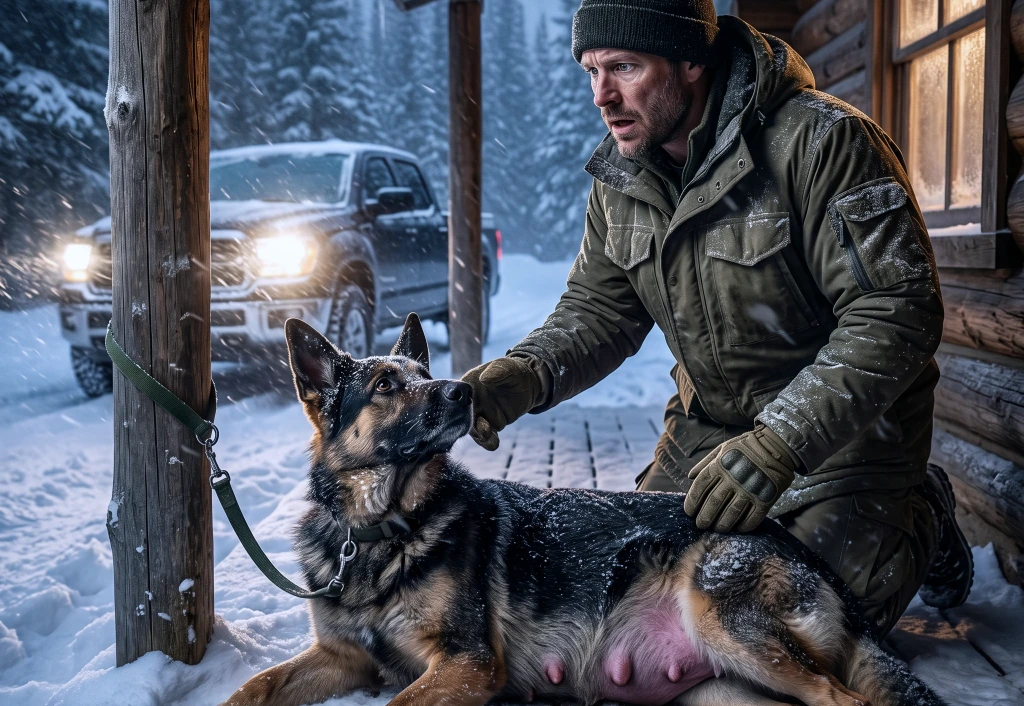
Owen killed the engine and was out of the truck before the wind could rock the door shut behind him. Snow came at him sideways, hard enough to sting the narrow strip of skin above his scarf. He crossed the yard in six deep steps, dropped to one knee, and laid two gloved fingers against the shepherd’s ribs.
For several seconds, he felt nothing. Then came a shallow flutter, followed by another.
“Easy,” he said. “I’ve got you.”
The words were habit more than reassurance. At thirty-eight, Owen had spent most of his adult life in places where calm had to be chosen before it could be felt. He was an active-duty Navy SEAL chief on twelve days of leave, and he had driven into the eastern Cascades because the cabin had belonged to his father and because avoiding it for another winter had begun to feel like a kind of cowardice.
He had expected frozen pipes, mouse droppings, and the stale quiet of a place no one had entered since the funeral. He had not expected a pregnant German Shepherd tied to the porch.
The strap had been looped twice around a spindle and cinched with a plastic buckle. It was not tangled. It was not caught. Someone had fastened it there.
Owen drew the folding knife from his pocket and cut the webbing several inches from her neck, preserving the knot. The dog did not flinch at the blade. That frightened him more than a snap or a growl would have.
He slipped one arm beneath her chest and the other behind her hind legs. Ice had stiffened the outer coat, but beneath it he could feel a weak reserve of heat. She was heavy with pregnancy and dead weight, yet when he lifted her, one front paw scraped once across the porch as though some part of her still believed she had to stand.
Inside, the cabin was only a few degrees warmer than the storm. Owen shouldered the door closed, laid her on two wool blankets in the center of the room, and resisted the impulse to drag her toward the stone fireplace. Cold injuries punished impatience. He built a small fire first, then filled two metal bottles with warm—not hot—water and wrapped them in towels before placing them near her chest and hips.
The dog’s eyelids trembled. Frost softened along her muzzle and turned to beads of water that gathered at the ends of her whiskers.
Owen pulled off his gloves and checked her gums. Pale. Her pulse was fast and thin beneath his fingers. When he rested his palm against the curve of her abdomen, something moved away from the pressure.
He held still. A second movement followed, smaller but unmistakable.
“More than one,” he murmured.
The cabin’s cell signal had always been unreliable, and the storm had reduced it to nothing. Owen took the satellite communicator from his pack, triggered the emergency connection, and gave county dispatch the shortest accurate version of what he had found: adult female shepherd, late pregnancy, severe cold exposure, conscious but barely responsive, intentionally restrained outside.
The dispatcher kept him on the line while she reached the veterinarian on call. Static crackled, then a woman’s voice came through, clear and level.
“This is Dr. Maya Chen. Tell me exactly what you’ve done so far.”
Owen did. She interrupted only to clarify the temperature of the water bottles and the distance from the fire.
“That’s right,” she said. “Slow warming. Keep her dry, keep her quiet, and don’t make her drink. Can you count her breaths for thirty seconds?”
He watched the dog’s ribs and reported the number. Maya asked about gum color, abdominal tightening, discharge, and whether the dog could lift her head. The questions came without drama, each one narrowing the danger into something measurable.
“Her ears are badly iced,” Owen said. “No bleeding. The paws are rigid, but I’m getting some flexion.”
“Don’t rub the ears or feet. Let circulation return gradually. And watch her belly. Extreme stress can trigger labor.”
Owen glanced down. “How soon?”
“There’s no useful answer to that yet. Five hours, five minutes, or not at all. I’m trying to get a plow and a deputy headed your way, but the pass is closed below the ridge.”
“I understand.”
“Do you?” Maya asked, not unkindly. “Because if she starts delivering before I get there, you’re the help.”
Owen looked at the dog, at the ice melting into his father’s old blankets, and at the movement pressing faintly beneath her skin.
“Then tell me what to prepare.”
While Maya listed clean towels, a box, dry heat sources, and signs that would require intervention, Owen moved through the cabin with the practiced efficiency of someone who knew that preparation was a form of mercy. He found a plastic storage bin, lined it with a folded flannel sheet, and set it several feet from the hearth. He boiled water, cleaned a pair of scissors, and placed fresh towels where he could reach them without leaving the dog.
Only after the immediate work was done did he examine the cut strap. The webbing was industrial grade, dark green beneath the snow. Near the buckle, almost hidden by a crease, black letters had been stamped into the fabric: BWD-17.
Around the dog’s neck, the fur was compressed in a narrow band. The skin beneath was rubbed but unbroken. There were similar pressure marks under her belly, as if she had spent long hours secured in a transport sling or cramped against restraint.
She had been cared for once. Her nails were trimmed. Her coat, beneath the ice, was clean and dense. This was not an animal that had wandered for weeks through the mountains.
Owen photographed the strap, the knot, and the marks before touching anything else. His father had spent twenty-five years with volunteer search and rescue and had taught him early that weather did not destroy the truth all at once. It erased it by degrees.
The thought brought an old image with it: his father at this same door, shaking snow from a red jacket, leaving the porch light burning because a hunter or hiker might see it from the ridge. Owen had turned that light off after the funeral and had not been back to replace the bulb.
The dog shifted. Her nails scratched softly against the floor, and her head came up less than an inch.
Owen moved beside her, careful not to crowd. “You can stay down.”
Her gaze found him. It was not grateful; animals in pain did not owe anyone gratitude. It was watchful, exhausted, and still deciding whether he belonged among the dangers.
He slid a shallow bowl of water near her muzzle. She did not drink, but after a moment she touched the surface with her tongue. The effort seemed to cost her. Her head lowered again, this time against the toe of his boot.
For the next two hours, the storm pressed against the cabin and the fire slowly changed the room. Owen rotated the wrapped bottles, blotted meltwater from the dog’s coat, and reported her breathing to Maya every twenty minutes. Color returned by small degrees to her gums. The rigid line of her back softened. Once, beneath his hand, a puppy kicked hard enough to make the skin jump.
“That’s good,” Maya said through the speaker. “Movement is good.”
“She hasn’t tried to stand.”
“I don’t want her to. Let her body spend energy on warming.”
Near two in the morning, the wind dropped so suddenly that Owen noticed the silence. The dog noticed something else.
Her head lifted. One ear tried to rise and failed, but a low sound gathered in her chest. It was not loud enough to be called a growl. It was the first warning she had given since he found her.
She was looking toward the side window.
Owen turned off the lantern and waited. The fire threw a dull orange pulse across the room. Beyond the glass, the snow reflected enough light to show the trunks of the nearest pines and the dark line of the woods beyond them.
Nothing moved.
He stayed still for a full minute, then another. The dog’s sound faded, but her eyes remained fixed on the window.
Owen checked the door latch, took the flashlight from his pack, and stepped onto the porch. The air had cleared enough to see twenty yards. New snow lay smooth across the steps—except along the side of the cabin, where a set of boot prints cut from the tree line to the window and back.
They were sharp-edged. They had been made after the worst of the storm passed.
He followed them only far enough to confirm direction, then stopped before trampling the trail. A motion camera was strapped to a pine overlooking the drive, one his father had used to watch elk. Owen removed the memory card and carried it inside.
The old laptop took too long to start. When the files finally opened, most were blurred by snow. Owen moved frame by frame until the porch emerged through the white.
At 4:11 p.m., a white utility truck backed toward the cabin. One man carried the shepherd while another wrapped the green strap around the railing. Neither approached the door. At 2:37 a.m.—forty-six minutes after Owen lit the fire—the truck returned. The final image showed one of the men standing at the side window, his face close to the glass, looking directly at the blanket where the dog lay…
To read the rest of the story – CLICK the NEXT button 👇👇👇