


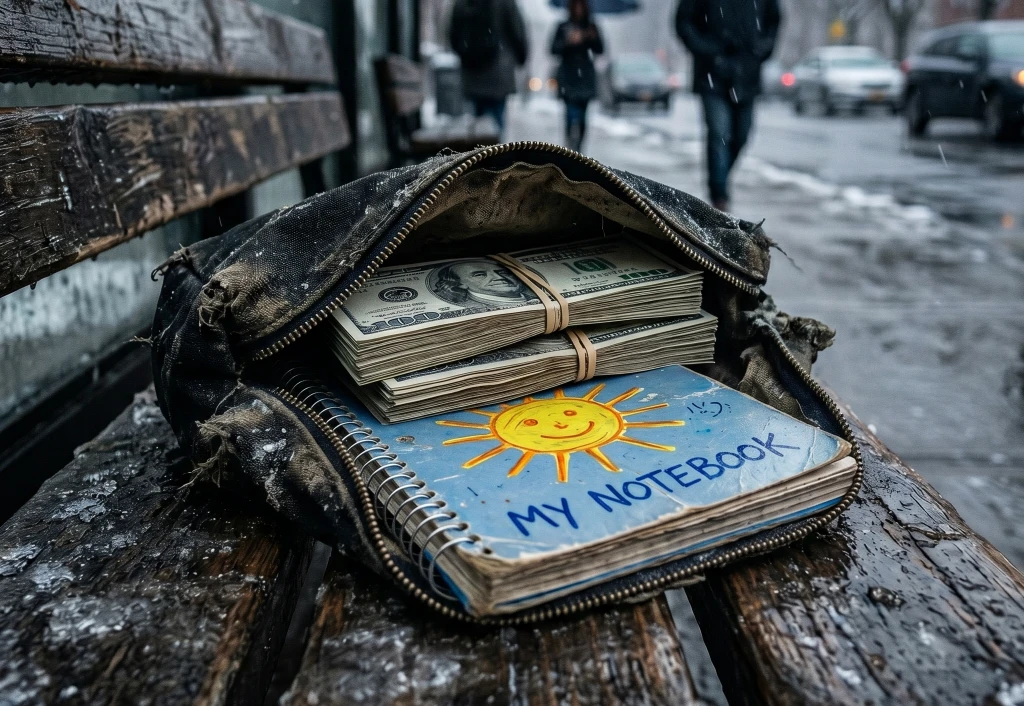
The black canvas pouch sat on the bus bench with its zipper open just far enough for Eleanor Mercer to see the corner of a hundred-dollar bill. She stopped beneath the scratched plexiglass shelter on Alder Street, one glove raised against the sleet. The 6:52 bus was due in four minutes. Across the road, a bakery truck backed toward a loading dock, beeping into the dark, and somewhere behind the row houses a dog barked twice.
No one was running toward the bench. No one was calling out.
Eleanor walked six steps past it anyway. Then she turned around.
The pouch was scuffed at the corners and damp along the bottom. It had the kind of short wrist strap men used to carry bank deposits or tools, and it was heavy enough to pull at her shoulder when she lifted it. She looked beneath the bench, checked the sidewalk, then glanced toward the intersection. The only other person in sight was a city worker spreading salt near the crosswalk.
Inside were nine thick bundles of cash and one smaller bundle, all held with ordinary rubber bands. Beneath them lay a child’s spiral notebook with a yellow sun drawn on the cover in marker. There was no driver’s license, no bank card, no receipt, and no name.
Eleanor closed the zipper at once.
Her furnace had begun making a grinding sound three nights earlier. The repair company had quoted her $1,860 if the blower assembly could be saved and considerably more if it could not. She had $684 in checking, ten days until payday, and a daughter in Chicago who asked every Sunday whether she needed money.
Eleanor always said no.
The bus rounded the corner, brakes sighing. She let it pass.
Her father had driven a bread truck through western Pennsylvania for thirty-seven years. He had never offered much advice, but one sentence had stayed with her long after his hands were still and the old route had been given to somebody else.
“Anything you take from somebody else’s bad day comes home with you.”
As a teenager, Eleanor had thought that sounded like one of his gloomy country sayings. At sixty-two, widowed for nineteen years and employed by the Millhaven Public Library for nearly three decades, she understood exactly what he had meant. Some things cost more after you spend them.
The police station was three blocks away. By the time she reached it, sleet had collected in the seams of her coat and her fingers ached from gripping the pouch.
A desk officer with tired eyes looked up from his coffee. “Can I help you?”
“I found this at the Alder Street bus shelter.” Eleanor placed the pouch on the counter. “There’s cash inside. A lot of it.”
The officer straightened. “How much?”
“I didn’t count it.”
He called for Sergeant Nolan, a broad-shouldered woman with silver threaded through her dark hair. They took Eleanor into a small interview room, asked where the pouch had been, what time she had found it, and whether she had seen anyone nearby. Sergeant Nolan counted the money twice while another officer watched.
“Nine thousand three hundred dollars,” she said at last.
The figure settled between them.
Eleanor thought of the furnace. She thought of her winter boots, whose soles had begun to split, and the dental crown she had postponed since August. She thought of walking through the grocery store without adding prices in her head.
Sergeant Nolan slid a property receipt across the table. “There’s a notebook too. You look through it?”
“No.”
“Most people would have.”
“It wasn’t mine to read.”
The sergeant studied her for a moment, then signed the bottom of the form. “Most people bring us the wallet after the cash is gone. You brought the cash and left the mystery.”
“I imagine the owner can solve it.”
Eleanor folded the receipt into her purse and walked the rest of the way to work, arriving thirty-eight minutes late.
Gail Simmons, who had shared the acquisitions office with her for fourteen years, was waiting beside three unopened cartons of new books. “You missed the staff meeting. Judith wants an explanation in writing.”
“I’ll give her one.”
Gail took one look at Eleanor’s wet coat and pale face. “What happened?”
Eleanor should have known better than to tell her. By ten-thirty, everyone in the library knew.
“You found how much?” Gail whispered, though whispering did nothing to reduce the force of her disbelief.
“Nine thousand three hundred.”
“And you turned it in?”
“I gave it to the police.”
“That is what turning it in means, Eleanor.” Gail lowered herself into the chair opposite the cataloging computer. “Your furnace sounds like a cement mixer. You could have fixed it, replaced your boots, and still had enough left to visit Claire.”
“With somebody else’s money.”
“With money sitting alone at a bus stop.”
Eleanor opened the first carton. “Money doesn’t become lonely, Gail. People do.”
Gail stared at her, annoyed by the answer and, Eleanor suspected, by the fact that she could not dismiss it. At lunch, she set a bowl of tomato soup beside Eleanor’s keyboard without comment.
The reactions continued all day. Denise from the reference desk said she would have thought of her grandchildren. Marcus from maintenance said he hoped he would have done the same thing but was glad he had not been tested. Zoe, the youngest employee, asked what would happen if the police kept it.
“That would be their decision,” Eleanor said. “Mine happened at the bus stop.”
By closing time, she was tired of being treated as either a saint or a fool. She had not felt noble when she lifted the pouch. She had felt cold, late, and briefly afraid of how easy it would be to walk in the other direction.
At home, the furnace started with a metallic shudder. Eleanor stood over the vent until warm air touched her ankles, then went to the kitchen and made tea. Her apartment was clean but worn: flowered wallpaper in the hall, a table her husband had refinished the year before he died, and a refrigerator covered with old magnets from places they had once promised to revisit.
Claire called at eight.
“You sound tired, Mom.”
“Busy day.”
“Is the furnace still making that noise?”
Eleanor looked toward the hallway. “It’s running.”
“That wasn’t my question. I got my quarterly bonus. Let me send you something.”
“No, sweetheart. Keep it.”
“You always say that.”
“And you always ask.”
Claire was quiet. “One of us has to change eventually.”
Eleanor smiled, though her daughter could not see it. “Tell me about work.”
After they hung up, she opened the refrigerator and considered the half carton of eggs, a heel of bread, and a container of cottage cheese nearing its date. Nine thousand three hundred dollars could have made the next few months soft around the edges. It could have turned emergencies into errands.
She pictured herself handing a stack of bills to the furnace technician. The image should have felt like relief. Instead, she imagined a stranger searching the bus shelter on hands and knees, checking beneath slush and cigarette wrappers while the morning traffic went by.
Before bed, she set the police receipt beside the furnace estimate on the kitchen table. The two sheets seemed to belong to different versions of her life: one in which an unexpected stack of cash solved every practical problem, and one in which the money remained attached to the person who had lost it. Eleanor folded the estimate and put it back in the drawer. She left the receipt on top, not as proof that she was good, but as proof that the choice had been real.
The furnace groaned once after midnight. Eleanor pulled the quilt higher and slept well anyway.
On Tuesday, Gail announced that if nobody claimed the pouch, Eleanor should ask whether it could eventually be returned to her.
“You found it,” Gail said. “There must be a rule.”
“There are always rules.” Eleanor stamped an invoice and moved it to the paid stack. “That doesn’t make every outcome right.”
On Wednesday, the story reached two regular patrons and the director of the community arts center. One called Eleanor admirable. The other called her “a little touched.” Neither description seemed useful.
Late Thursday afternoon, Sergeant Nolan called the acquisitions desk.
“We have an owner,” she said. “He named the exact amount, the denominations, the red stitching inside the left pocket, and the notebook. He reported it missing Monday morning.”
Eleanor felt something in her chest loosen. “Good.”
“He asked for your contact information. I told him I’d need your permission.”
She hesitated only because she disliked giving her number to strangers. Then she remembered the yellow sun drawn on the notebook.
“You can give it to him.”
Daniel Brooks called at 5:41. His voice was low and rough, as if he had spent several nights without sleep.
“Ms. Mercer, I don’t know how to thank you over the phone. Could my daughter and I come by? Just for a few minutes.”
Eleanor gave him her address.
At home, she wiped an already clean kitchen counter, straightened the crocheted runner on the table, and put store-bought cookies on a plate. She changed out of her housecoat and into a blue sweater Claire had sent for Christmas. At 7:14, someone knocked.
The man at the door looked younger than his voice. He was perhaps thirty-seven, thin beneath a worn work jacket, with cracked knuckles and shadows under gray eyes. Beside him stood a girl of eight in a purple coat one size too large. Copper-colored hair escaped from her knit cap, and she held the sun-covered notebook tightly against her chest.
“I’m Daniel,” the man said. “This is Emma.”
Eleanor stepped aside. “Come in. You must be freezing.”
They removed their shoes carefully and followed her to the kitchen. Emma looked at the shelves in the hallway, the silent cuckoo clock, and the bowl of library pencils Eleanor had forgotten to put away.
“You have a lot of books,” she said.
“I work with them.”
Daniel sat at the table but did not touch the tea Eleanor poured. His hands remained wrapped around the mug as if he needed its warmth to hold him upright.
“I practiced what I was going to say,” he began. “None of it sounds right now.”
“You don’t owe me a speech.”
Emma placed the notebook on the table. Her father glanced at it, then at her.
“Did you read any of this?” the girl asked Eleanor.
“No. I only saw the sun on the cover.” – Emma’s fingers rested on the bent spiral binding. “Then you don’t know what you gave back…”
To read the rest of the story – CLICK the NEXT button 👇👇👇