


The bottle rolled across the rubber mat until it touched the blind bear cub’s front paw. He did not sniff it, bat it away, or make the thin, impatient squeal he had managed on his first night at North Fork Wildlife Recovery Center. He only drew his legs tighter around his ribs and kept breathing in small, uneven pulls.
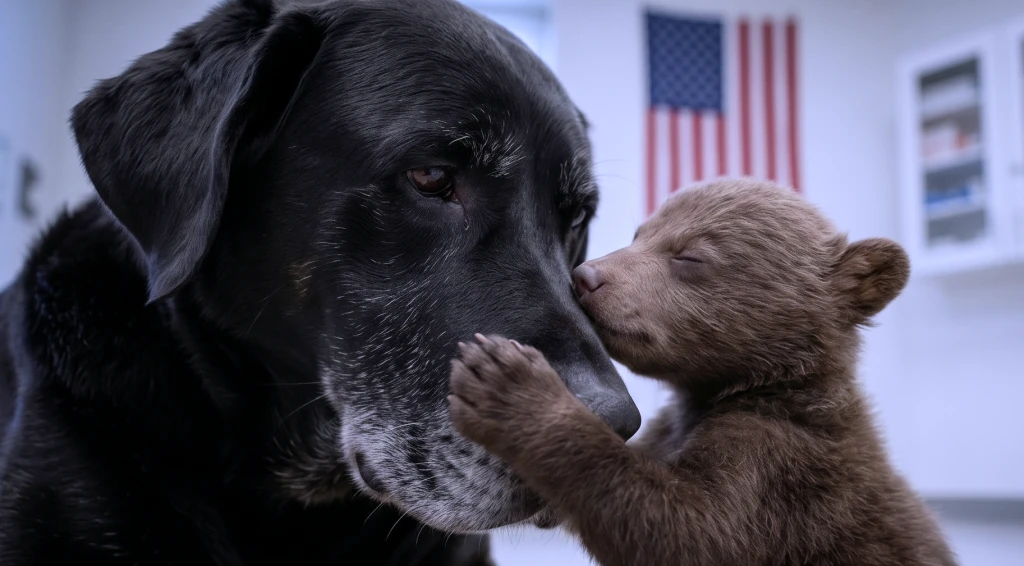
Dr. Mara Bell watched from the open doorway of the quarantine room. The warmed formula was leaving a pale stripe across the floor, and June Alvarez, the senior rehabilitator, was still kneeling beside the cub with one hand suspended in the air. Neither woman moved to retrieve the bottle.
“He swallowed half an ounce at two,” June said. “Nothing since.”
Mara glanced at the clock above the sink. It was 7:18 on a late-March morning, and snowmelt dripped steadily from the metal roof. Outside, ravens argued over breakfast scraps near the flight pens. Somewhere beyond the clinic, an adult black bear struck a hollow log against the fence of his temporary enclosure. The whole center sounded awake except for the six-pound animal at June’s knees.
They had named him Ash because soot-dark fur covered his back and shoulders, though the name felt too sturdy for what remained of him. He was roughly seven weeks old. A state wildlife officer had found him in a den cut into a north-facing slope, pressed against his dead mother while sleet blew through the exposed entrance. Someone had shot the sow and dragged her halfway out before abandoning the carcass when a truck came along the logging road.
By the time Ash reached North Fork, infection had scarred both corneas beyond repair. Antibiotics had brought down his fever, and fluids had kept his kidneys working, but medicine had not touched the terror underneath. He recoiled from hands, ignored recordings of a nursing sow, and turned his face from every bottle. Even the scent of bedding from a calm female bear had driven him farther into the corner.
June lowered her hand and sat back on her heels. “His temperature dropped again.”
Mara crossed the room and crouched, careful not to block the heat lamp. The cub’s sides fluttered beneath sparse fur. When she placed two fingers against the inside of his hind leg, his pulse came hard and fast, but he did not struggle. That frightened her more than claws would have.
A wild cub should have fought her.
Mara had spent twenty-three years treating animals that wanted nothing to do with her. She had reset an elk calf’s broken leg while it kicked through sedation and removed barbed wire from a bald eagle that tried to take a piece of her thumb. Resistance was not ingratitude. It was proof that some part of the animal still expected a future.
Ash had stopped expecting anything.
At eight, the clinical team gathered in the break room behind the surgery suite. A pot of coffee had burned down to a bitter inch, and damp jackets hung from every chair. Dana Brooks, North Fork’s operations director, placed Ash’s lab sheet in the center of the table beside a blank humane-euthanasia authorization.
No one touched either page.
“His glucose is unstable despite the fluids,” Dana said. “His weight is down another four ounces. We can place a feeding tube, but repeated restraint and sedation come with their own risks, and we still don’t have a long-term plan for a cub who panics at every contact.”
Mara read the numbers twice, though she had drawn the blood herself. “He’s nonreleasable. We already knew that.”
“That isn’t the question.” Dana’s voice stayed gentle. “The question is whether we’re helping him live or asking his body to keep going because we’re not ready to stop.”
June stared at the authorization form. Cole Jensen, the lead keeper, rubbed his palms over the knees of his work pants. The night technician looked as if he had not blinked since coming off rounds.
Mara understood the argument. A sanctuary could care for a blind bear, but only if he survived long enough to reach one and learned to eat without being terrorized by every human hand. At the moment, each intervention bought hours while deepening the fear that kept him from feeding.
“How much time are you asking for?” Dana said.
“Forty-eight hours.”
June looked up sharply. “For what?”
“I don’t know yet.” Mara hated how thin the answer sounded. “But his infection is responding. His organs aren’t failing beyond recovery. I’m not signing that form while the part we can’t measure is the part killing him.”
Dana leaned back. She had worked beside Mara long enough to know when persistence had become useful and when it had become vanity. “Forty-eight hours,” she said at last. “Then we meet again, and we make the decision from the animal in front of us, not the one we want him to become.”
Mara nodded. She folded the authorization once and slid it beneath Ash’s chart.
The next ten hours produced nothing except colder coffee and another rejected bottle. Mara changed the bedding arrangement, lowered the lights, and moved the speaker that played sow vocalizations to the hallway so the sound would not surround him. Cole sat on the floor and read equipment invoices in a flat, steady voice. June warmed formula to three different temperatures and offered it from two nipple shapes.
Ash turned away from all of them.
Near dusk, Mara stood at the scrub sink with her hands under running water long after the soap was gone. Through the half-open door, she could see Cole sitting beside the cub’s pen. He had placed the bottle within reach and rested his forearm on one knee, making no attempt to touch Ash.
“Come on, little man,” he murmured. “You don’t have to like us. Just take enough to be mad tomorrow.”
The cub’s ear moved toward the voice, then flattened again.
That small response followed Mara into the parking lot. She sat behind the wheel of her old Subaru without starting it, listening to sleet tick against the windshield. On the passenger seat lay a sealed bag containing a square of fleece from Ash’s bedding, removed for laundry and kept because she had been too tired to throw it in the bin.
Her phone buzzed with a message from Ellie Ramirez at the county animal shelter. It was not about Ash. Mara had repaired a spaniel’s fractured pelvis there the previous week, and Ellie was asking whether she could review another dog’s blood work when she had time.
The message ended with a sentence Mara read three times.
He’s physically healed, but he’s fading anyway.
Twenty-five minutes later, she pulled into Bitterroot County Animal Services, a low concrete building behind the public works garage. The outdoor runs had gone quiet in the cold, but anxious barking rolled through the interior kennels. Ellie met her at the side door wearing rubber boots and a red knit cap.
“You didn’t have to come tonight,” Ellie said.
“I was still at work.”
Ellie looked past her at the dark parking lot. “That is not the same thing.”
Mara almost smiled. “Show me the dog.”
They passed the adoption wing and entered the medical corridor, where the barking softened to a distant, uneven pulse. The last kennel held a large black dog with a graying muzzle and the broad chest of a Labrador mixed with something heavier. He lay on a folded moving blanket facing the cinder-block wall.
“This is Hank,” Ellie said. “Nine, maybe ten. He belonged to Walt Dempsey, a retired county surveyor who lived alone above Rock Creek.”
In January, a windstorm had brought down a dead pine across Walt’s workshop. A neighbor found him the next afternoon. Hank had been lying against the old man’s body in the snow, too weak to stand and still refusing to let the deputy close. Animal control eventually moved him with a catch pole and a blanket.
“He had frostbite on two pads, a deep cut along his shoulder, and nothing else serious,” Ellie continued. “The wounds are healed. His blood work is good. But he eats only when I hand him one piece at a time, and some days he won’t do that. He watches every pair of work boots that comes down the hall.”
Mara crouched outside the kennel. Hank did not look at her, though one ear turned toward the sound of her knee touching the floor. His water was fresh. A bowl of chicken and rice sat untouched near the gate.
“Has he shown aggression since intake?” she asked.
“Not after the first day. Mostly he disappears without going anywhere.”
Mara knew exactly what she meant. The body remained in the room, but attention withdrew from every offer the world made.
Ellie unlocked the kennel and went inside. She sat near Hank’s hindquarters, broke a piece of chicken into smaller bits, and held one beneath his nose. After several seconds, he took it with careful lips. He did not chew until she offered the next.
“He worked with Walt,” Ellie said. “Not formally trained, but he rode in the truck, walked property lines, carried flagging tape in a canvas pouch. The neighbors said the two of them were together every day for eight years.”
Mara watched the dog swallow. Ten miles away, a cub who had never learned the shape of safety was curling himself around an empty stomach. Here, an old dog had known safety so completely that its disappearance had taken the rest of the world with it.
The resemblance was emotional, not medical. She knew better than to turn grief into a diagnosis or imagine that one wounded animal could repair another through sentiment alone. A domestic dog could frighten a wild cub into cardiac collapse. A bear cub, even a small one, could slash an eye or trigger prey drive. There were disease risks, handling risks, and ethical questions stacked behind every hopeful thought.
Still, Mara could not stop looking at the way Hank’s ear tracked Ellie’s breathing.
“What makes him stand?” she asked.
“Nothing I’ve found.”
“Leash?”
“He lets me put it on. Then he lies there.”
“Other dogs?”
“He turns away.”
Mara reached for the sealed bag on the floor beside her. She had carried it in without deciding why. “I want to try a scent only. The bag stays closed unless you say yes.”
Ellie studied her face, then the bag. “What kind of scent?”
“Black bear cub.”
For a moment, Ellie said nothing. “That sentence needs more explanation.”
Mara gave it. She described Ash’s condition, his blindness, the rejected feedings, and the authorization waiting under his chart. She did not present the idea growing in her mind as a plan. It was not one yet. It was a question with sharp edges.
When she finished, Ellie looked at Hank. “He used to run bears off Walt’s trash shed.”
“That may end this before it starts.”
“And if it doesn’t?”
“Then we still don’t do anything fast.” Mara held the bag by one corner. “We watch his posture. We stop at the first sign of fixation, fear, or arousal. Tonight, all I need to know is whether the smell reaches him.”
Ellie moved to Hank’s collar and rested two fingers beneath it, not restraining him but ready. Mara opened the outer seal and drew out the fleece square just far enough for the air to pass over it.
Hank’s nostrils moved.
His head lifted from the blanket so suddenly that Ellie pulled in a breath. The dog stared toward Mara, not at her face but at the dark cloth in her hand. His ears came forward. His body remained low, yet something in him had returned to the room.
Mara held still. “Easy.”
Hank inhaled again. There was no growl, no stiff-legged advance, no hard focus of a dog preparing to chase. His expression changed in a smaller way, the skin above his eyes drawing together as if the scent carried a question he could not place.
Then the dog who had not crossed his kennel for anyone in nineteen days pushed himself to his feet.
He walked to the gate, stopped inches from Mara, and pressed one broad paw against the wire. A low, uneven sound left his throat—not a bark, not quite a whine—and he kept his nose pointed toward the piece of fleece from the cub who would not eat…
To read the rest of the story – CLICK the NEXT button 👇👇👇