


At 6:43 on a wet October morning, the blind bear cub stopped swallowing. Dr. Leah Morgan knew because she had two fingers against the soft groove beneath his jaw. The bottle nipple rested between his teeth, and a bead of formula trembled on his lower lip, but the small muscles in his throat never moved. After a few seconds, he turned his face into the crook of his foreleg and made himself as round and unreachable as he could.
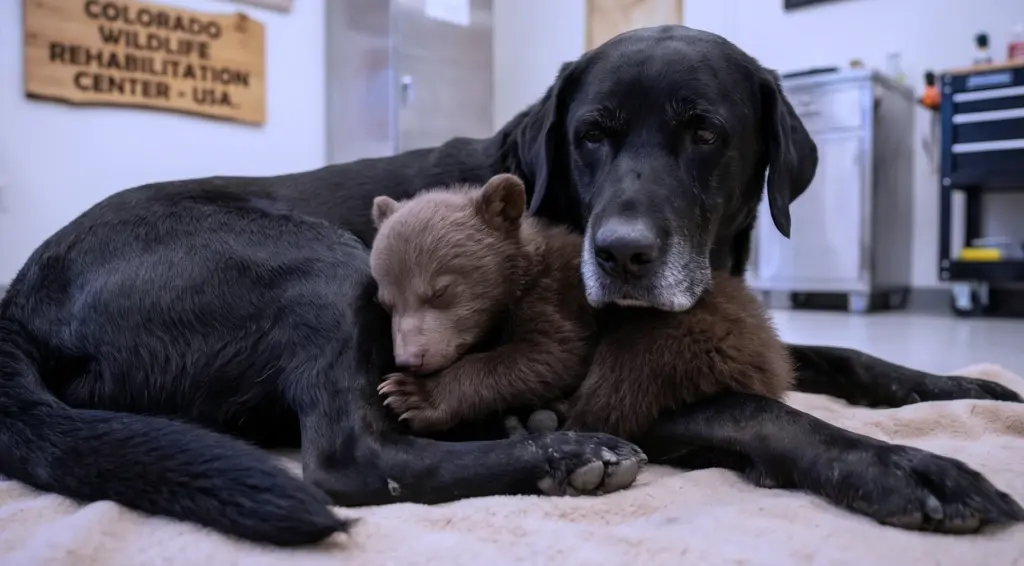
Owen Reed lowered the bottle. He had been kneeling on the concrete for almost half an hour, one knee dark with moisture from the fresh bedding. “That’s it,” he said quietly. “He’s done with me.”
The cub’s name was Cedar, though he had been found beneath a fallen spruce, not a cedar tree. One of the transport officers had chosen the name on the drive to Blacktail Wildlife Recovery Center, perhaps because giving him one felt like a promise. He was estimated to be seven weeks old and weighed less than nine pounds. At that age, a healthy American black bear cub should have been loud, hungry, and difficult to hold. Cedar barely seemed to occupy the fleece nest beneath the heat lamp.
Both of his eyes were clouded beyond repair. His mother had been shot illegally and left in a logging ravine; infection ulcerated Cedar’s corneas during the days he spent alone beside her. By the time state wildlife officers found him, the damage had gone too deep for surgery. Antibiotics had brought down the fever. Fluids had kept his kidneys working. Nothing had persuaded him that the world beyond his forelegs was safe enough to enter.
Leah watched his ribs lift in shallow steps. Behind her, rain ticked against the metal roof of the quarantine building. The rest of the center had already begun its morning racket—ravens scolding over feed carts, a recovering bobcat striking the wire when a keeper passed, juvenile bears knocking branches through their water troughs. Cedar’s room remained so quiet that Leah could hear the heat lamp hum.
Tess Alvarez, the senior keeper, stood at the door with the morning chart pressed to her chest. “His temperature’s down another half degree,” she said. “Blood glucose was forty-eight before Owen came in.”
Leah took her hand away from the cub. His skin felt cool beneath the sparse fur. “Start another small fluid bolus. No restraint unless we have to.”
“We’ve been saying that for three days.” Tess did not sound argumentative. She sounded tired. “Every time we touch him, his heart rate goes through the roof. Every time we leave him alone, he folds back up and disappears.”
Leah knew. They had tried darkness, recorded nursing sounds, warmed blankets, an adjoining pen scented by a calm adult female. They had tried different formulas and different nipples, feeding positions, voices, and hours. Cedar had accepted a few ounces during his first night, when fever and exhaustion may have dulled his fear. Since then he had refused nearly everything offered voluntarily.
Repeated force-feeding was not a solution. His vitals were unstable, sedation carried its own risk, and every struggle pushed him further into the same panic that was shutting down his appetite. Medicine had corrected the things a laboratory could measure. It had not reached the place where the cub had decided not to respond.
Owen set the bottle in a stainless-steel bowl. “He turned his ear when I came in.”
Tess looked at him. “He turns his ear at every door.”
“No. Toward my boots. Just for a second.”
Leah glanced back at Cedar. He had tucked his muzzle so deeply beneath his paw that only one nostril showed. A clear drop gathered there, swelled, and fell into the bedding.
“Put it in the chart,” she said.
At eight, the senior staff met in the center’s break room, a narrow space that smelled of damp coats and coffee burned down to tar. Dana Pierce, the operations director, had placed Cedar’s lab results in a row across the table. Leah did not need to read them again. The downward arrows beside glucose, body temperature, and urine output had been in her head all morning.
Dana capped her pen. “We need to discuss the humane endpoint.”
No one moved. Through the wall came the squeal of a cart with a bad wheel, followed by the hollow clang of a bucket being set down.
“He’s not dying from the infection anymore,” Dana continued. “He’s dying because he won’t take nutrition, and we don’t have a safe way to keep forcing it. We can support him for another day or two. That doesn’t mean we should.”
Tess stared at the table. Owen rubbed a thumb across a scrape on his knuckle. They had all signed those forms before. Wildlife rehabilitation made room for extraordinary recoveries, but it also required people to recognize suffering that had become an experiment in postponement.
Leah looked at the cub’s intake sheet. In the margin beside the 4:00 a.m. entry, the night technician had written: lifted head at sound of hallway footsteps. The note was small and medically useless. Leah kept returning to it anyway.
“Give me until tomorrow evening,” she said.
Dana’s eyes narrowed. “For what?”
“I don’t know yet.”
“That’s not an answer.”
“It’s the honest one.” Leah slid the paper back toward the center of the table. “If he has not swallowed voluntarily by six tomorrow, I’ll sign. No more extensions.”
Dana studied her for a long moment. “Thirty-four hours.”
Leah nodded, and the meeting ended without relief. Leah returned to rounds, cleaned and rebandaged an eagle’s injured wing, reviewed radiographs from a young fox struck by a car, and answered three calls she could not remember afterward. At noon, the county animal shelter coordinator called about an unrelated case, a hawk that had been caught inside a warehouse. Just before hanging up, Maya Brooks said, “You work with animals that stop eating, right?”
Leah leaned back in her chair. “Sometimes.”
“We have a dog in medical hold. Eight years old, maybe Lab and shepherd. His owner died at home three weeks ago. Deputies found the dog lying against him. He’ll take food from my hand, but that’s about it. I’ve never seen an animal wait so hard for someone who isn’t coming.”
The sentence stayed with Leah after the call ended.
By late afternoon, the rain had thickened into a silver sheet over the yard. Leah left Tess with instructions to call at the slightest change, then drove forty minutes south in the center’s aging utility vehicle. The Red Valley County shelter sat behind a road-maintenance depot, its low concrete buildings washed pale by years of weather. Barking rolled across the parking lot before she turned off the engine.
Maya met her inside wearing blue scrubs under a yellow rain jacket. “I didn’t mean for you to come all the way down here,” she said.
“I was already thinking about the drive.”
“That sounds like something a person says after making a bad decision.”
“Probably.”
They passed the adoption wing and entered a quieter medical corridor. At the last kennel, Maya stopped. A large black dog lay on a folded blanket with his back against the cinder-block wall. White hairs had begun to gather beneath his chin, but the rest of his coat was dense and glossy. He raised his eyes when Leah approached, then let them settle again on the closed door across from him.
“This is Boone,” Maya said. “He belonged to Everett Shaw, a retired trail surveyor. They lived in a cabin outside the county line. Everett had an aneurysm. The medical examiner thinks it was immediate.”
Boone’s front paws were crossed with almost formal neatness. One nail was worn shorter than the others, as if he had spent hours scraping at something. A stainless-steel bowl near the gate held untouched kibble.
“Did he see the body removed?” Leah asked.
“He wouldn’t let the paramedics near at first. Not aggressive exactly. He stood over Everett and shook. Animal control had to use a catch pole because nobody could get a leash on him.” Maya crouched outside the kennel. “He was house-trained, knew hand signals, rode in trucks, stayed close off leash. Everett’s sister said he followed that man through a thousand miles of backcountry. Now he listens every time boots come down the hall.”
A kennel attendant pushed a cart through the distant doorway. Boone’s ears rose. His head came up, and for one breath his whole body seemed to gather itself. Then the wheels squeaked instead of footsteps approaching, and he lowered his muzzle to his paws.
Leah sat on the floor outside the gate. She did not call his name or reach through the wire. After several minutes, Boone turned his head enough to look at her. His expression held no plea and no challenge. It was the blank endurance of an animal conserving himself for a return that made no sense to anyone but him.
Maya handed Leah a piece of kibble. “He might take it.”
Leah held it on her open palm. Boone watched. He did not move.
“Same problem?” Maya asked.
“Not the same.” Leah thought of Cedar folding around his blind face. “Close enough to hurt.”
Her phone vibrated. Tess had sent a ten-second video from quarantine. The image was mostly fleece and the edge of the heat lamp, but the sound was clear: Cedar giving a thin, breathy cry after a fluid injection, then falling silent.
Boone’s head snapped up.
Leah froze with the phone in her hand. Maya straightened beside her.
The video ended. Boone pushed himself to his feet for the first time since Leah had entered the corridor. He came to the gate slowly, his nose working, and stared at the black screen. Leah played the clip again.
At the cub’s second cry, Boone pressed his muzzle between the links. A low sound moved through his chest—not a growl, but a rough, questioning hum. Then he lifted one paw and placed it against the wire directly below Leah’s phone.
Maya whispered, “He hasn’t crossed that kennel for anyone.” Leah looked from the dog’s paw to his alert ears. For the first time all day, she could see a next step. It was reckless, incomplete, and nowhere near approval. She stood. “I need to borrow Boone…”
To read the rest of the story – CLICK the NEXT button 👇👇👇