


The pig stopped eating before Helen Whitaker dropped the feed scoop. A hard pressure tightened beneath Helen’s breastbone and crept toward her left shoulder. She caught herself against the stall door while the metal scoop struck the concrete, scattering cracked corn around her boots. Mabel lifted her muddy snout from the trough. A few yellow kernels clung to the bristles around her mouth, but she made no move to eat them.
“Don’t look at me like that,” Helen said. “I’m fine.”
At sixty-eight, Helen had developed a private system for deciding which pains deserved attention. A cut that would not stop bleeding qualified. So did a fever over one hundred degrees and anything involving a visibly broken bone. A tightness in the chest after carrying two feed buckets did not.
She waited until the pressure eased, then bent for the scoop.
Mabel left the trough and pressed her snout against Helen’s knee.
“You’re supposed to be a pig, not a nurse.”
Mabel grunted and stayed where she was.
Outside the barn, the late-October wind swept dry leaves across the yard of the Whitakers’ small farm outside Ash Creek, Pennsylvania. The farmhouse sat back from a two-lane county road, its white paint graying beneath the windows and one gutter sagging over the kitchen porch. There were eleven acres altogether, though most of them were steep, wooded, and good for little besides deer, wild turkeys, and arguments about whose turn it was to clear fallen branches.
Helen loved every acre.
She and Frank had bought the place two years earlier after living for fourteen months with their daughter, Laura, in a split-level house outside Pittsburgh. Laura had never asked them to leave. Neither had her husband, and their granddaughter, Emily, had cried when the moving truck came.
Still, Helen had felt herself slowly disappearing there.
Her favorite chair became the place where clean laundry waited to be folded. Her blue coffee mug migrated to a high shelf because it did not match Laura’s set. Meals were planned around soccer practices, work schedules, and everyone’s allergies. Helen helped, cooked, cleaned, and smiled, but every useful thing she did belonged to somebody else’s life.
The farm had given her work that was hers again.
At first, Frank had called it a retirement project. Helen began with six laying hens and a garden no bigger than their old living room. Then came two goats, a larger chicken coop, and Mabel.
Mabel had arrived in a laundry basket during their first winter.
Their neighbor, Hank Dobbs, had found the piglet cold and barely moving after the sow rejected her. He had carried her to Helen because everyone within five miles already knew that Helen could not look at a hungry creature without trying to feed it.
“She may not make the night,” Hank had warned.
Frank had looked at the tiny animal wrapped in a stained towel and then at Helen. “She’s not staying in the kitchen.”
“She’ll freeze in the barn.”
“Three nights,” he had said.
Mabel remained beside the woodstove for twelve.
Helen fed her warmed formula from a bottle every three hours, sleeping on the couch so she would hear the weak cries from the basket. On the fourth morning, the piglet stood on unsteady legs. By the end of the week, she recognized Helen’s footsteps. By spring, she followed Helen across the yard with the devotion of a dog and the appetite of a farm animal that had never forgotten being hungry.
Now Mabel weighed close to two hundred pounds. She could open the feed-room door with her snout, distinguish the sound of Helen’s truck from Frank’s, and appear from the far end of the pasture whenever Helen called her name.
Frank respected her intelligence. He simply refused to confuse intelligence with permission.
“A barn animal belongs in a barn,” he said whenever Mabel wandered onto the porch. “That’s not cruelty. That’s civilization.”
Helen usually told him civilization could survive a little mud.
She collected the spilled corn while Mabel watched, then finished the afternoon feeding more slowly than usual. The pressure had gone, but a faint ache remained under her left arm. She blamed the weather, the feed sacks, and the stubborn window in the upstairs bedroom that she had wrestled shut that morning.
Anything was easier to believe than the alternative.
Her phone rang as she crossed the yard. Laura’s name appeared on the screen.
Helen almost let it go to voicemail. Then she imagined her daughter calling again, followed by a text, followed by Frank being asked whether Helen had fallen into the well they did not own.
“Hello, sweetheart.”
“You sound out of breath.”
“I’ve been working.”
“That’s what you always say.”
Helen smiled despite herself. “Because you always call while I’m working.”
Laura was silent for a moment. “How cold is it getting tonight?”
“Upper thirties.”
“And you have enough wood?”
“Plenty.”
It was not exactly a lie. They owned plenty of wood. Most of it was stacked across the driveway beneath a corrugated metal roof rather than inside the box beside the stove.
Laura continued, “Emily’s asking whether you’re coming for Thanksgiving.”
“Of course we are.”
“You could come earlier. Stay a few weeks.”
“We have animals.”
“Hank can check the animals.”
“Hank is seventy-four and has animals of his own.”
“What happens when it snows? Or the driveway ices over? Mom, you’re twenty-five minutes from the nearest ambulance on a good day.”
Helen stopped near the porch. Mabel came up behind her and stood so close that Helen felt the pig’s breath against the back of her coat.
“We didn’t move here because we dislike you,” Helen said.
“I know.”
“We needed our own place.”
“I know that too.”
The answer was gentle, but Helen heard the hurt beneath it. Laura had never forgiven herself for feeling relieved when her parents moved out. Helen had never admitted how relieved she had been to leave.
“I’ll call you Sunday,” Helen said.
“Promise?”
“I promise.”
After the call, Helen remained beside the porch until the cold seeped through her sweater. Mabel nudged her hand, searching for the apple slices Helen sometimes carried in her pocket.
“Your timing is terrible,” Helen told her.
Frank came around the side of the barn carrying a screwdriver and the rusted remains of the front-gate latch. At seventy, he still moved with the compact, deliberate energy he had possessed during thirty-six years as a maintenance mechanic. Retirement had taken away his time clock but not his need to repair something before breakfast.
“This thing finally gave up,” he said. “I tied the gate with baling twine until I can get a new latch tomorrow.”
Helen looked toward the entrance. The gate was closed but not secured, a red loop of twine holding it against the post.
“Tomorrow,” she repeated. “The official day of all farm repairs.”
“You want it fixed tonight, I’ll skip work.”
“No, you won’t.”
Frank studied her face. “You all right?”
“Why does everyone keep asking me that?”
“Who’s everyone?”
“Laura. The pig. Now you.”
“The pig asked?”
“She has expressive eyes.”
Frank glanced at Mabel. “She has an expressive appetite.”
Helen started toward the house, but he touched her elbow. His hands were rough and warm.
“You’re pale.”
“I pulled something carrying feed.”
“Sit down.”
“I have been sitting down for most of my adult life. I’m making dinner.”
“You worked in a school cafeteria. You stood ten hours a day.”
“Then I’ve earned the right to decide when I need a chair.”
Frank’s mouth tightened. Helen knew the look. He wanted to argue, but his shift at Merritt Lumber began in forty minutes, and he still had to change his boots.
“I can call Jim,” he said.
“Because I’m tired?”
“Because you’re stubborn.”
“That condition isn’t new.”
He did not laugh. “Phone stays in your pocket tonight.”
“Yes, sir.”
“And don’t wrestle any bears.”
“Only if they criticize my complexion.”
Frank gave her one last doubtful look before going inside.
By five-thirty, he was dressed in his brown work coat and carrying a dented thermos. The night security job at the lumber mill was supposed to have lasted one winter, just long enough to pay for the new roof. Then the well pump failed, the barn needed wiring, and the truck required a transmission. Frank still worked three nights a week, insisting that a man could be retired without becoming decorative.
At the mudroom door, he looked into the nearly empty wood box.
“I forgot to bring a load in.”
“We have enough until morning.”
“Not if the temperature drops.”
“I’ll keep the stove low.”
Frank set down the thermos. “I’ll get it now.”
A horn sounded from the road. Jim Merritt had begun picking Frank up on nights when deliveries left Frank’s truck blocked behind the barn. The horn sounded again, shorter this time.
“Go,” Helen said. “He hates waiting.”
“I’ll be back at six.”
“I expect breakfast.”
Frank kissed her forehead, then paused as though checking her temperature with his lips.
“Phone,” he said.
“In my pocket.”
It was on the kitchen counter.
Helen watched through the window as he hurried down the driveway, untied the gate, and climbed into Jim’s pickup. He pulled the gate closed behind him, but the twine slipped from his gloved hand and fell against the post.
Helen noticed. She also noticed that the pickup was already turning onto the road.
She told herself she would secure it after dinner.
At six, darkness settled across the farm. The kitchen windows reflected the room back at her, making the house seem sealed inside a black field. Helen ate half a bowl of soup, washed it down the drain when nausea rose unexpectedly, and added two small pieces of wood to the stove.
The box was emptier than she had realized.
She considered leaving it alone. The house would remain warm for several hours, and there were electric heaters upstairs. Then she pictured Frank returning after dawn, tired from walking the mill yard, and finding the stove cold because she had been unwilling to carry six logs across a driveway.
Helen put on her coat.
Mabel was waiting outside the barn when Helen crossed the yard. The pig fell in beside her, hooves making soft, steady sounds in the damp soil.
“Back to bed,” Helen said.
Mabel continued walking.
The covered woodpile stood beyond the inner yard gate, twenty yards from the porch. Helen untied the baling twine and pulled the gate open. Mabel stopped at the threshold.
For all her bad habits, she understood boundaries. Frank had trained her with patience, stern words, and occasional pieces of toast. She would follow Helen anywhere inside the farmyard, but she had never crossed the front gate without a lead.
“Stay,” Helen said.
Mabel watched as she stepped through.
Helen selected six pieces of split oak, arranging them against her chest. The first stab of pain came when she straightened. It was sharper than before, not a band this time but a crushing weight that drove the air from her lungs.
One log fell.
Helen tried to draw a breath. The pressure spread into her shoulder, down her left arm, and up toward her jaw.
The remaining wood slipped from her hands and struck the ground around her boots.
She understood then.
“Frank,” she tried to call, though he was miles away.
The name emerged as little more than air.
Helen took one step toward the house. Her knees folded before she reached the gate.
She struck the wet ground on her side. For a few seconds, she could see the porch light beyond the yard and the open kitchen window above the sink. Her phone sat beneath that window, charging beside the fruit bowl.
Mabel came through the gate.
The pig circled Helen once, snorting hard. She pushed her snout beneath Helen’s shoulder, then against her cheek. When Helen did not respond, Mabel caught the cuff of her coat between her teeth and pulled.
Helen felt herself move perhaps an inch.
“Mabel,” she whispered.
The pig released the sleeve and let out a high, piercing squeal. She ran toward the porch, turned, and came back. Again she pushed at Helen’s shoulder. Again there was no response.
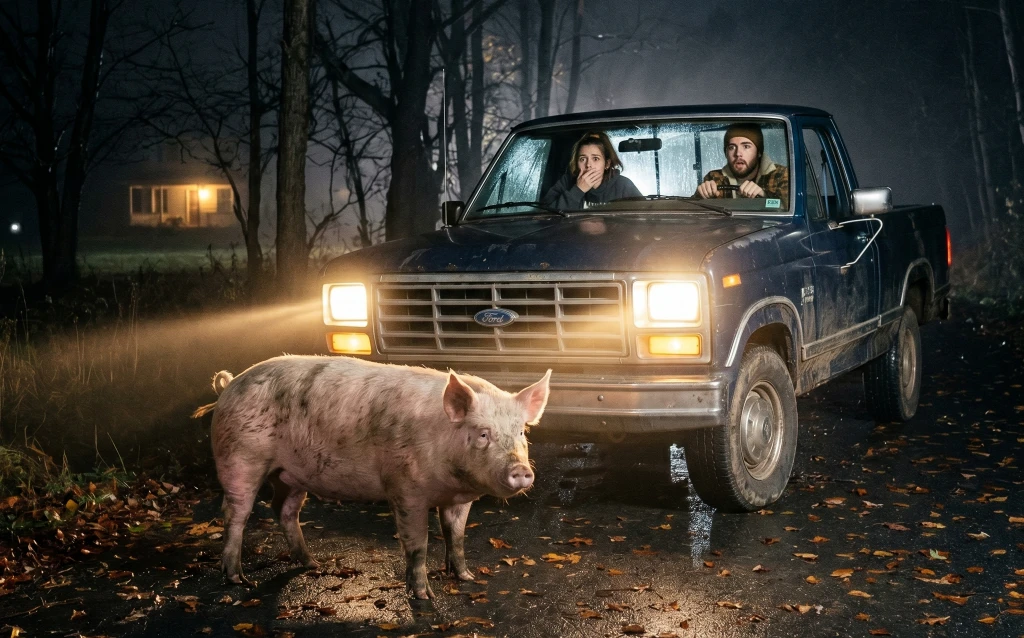
A pair of headlights appeared between the bare maple trees along the county road. Mabel lifted her head. She had never gone beyond the gate without Helen. This time, she ran straight toward the headlights…
To read the rest of the story – CLICK the NEXT button 👇👇👇