


The line was halfway down the page, typed in capital letters:
FOUND ALIVE IN HAY STORAGE OUTSIDE PINE HOLLOW.
Eli Carter read it three times before he remembered to breathe.
Across the small records room, Emma Reed stood with one sneaker wedged against the door. She was eleven, one year older than Eli, and had appointed herself lookout because, in her words, he had the survival instincts of a grocery-store goldfish.
“Hurry,” she whispered. “Ms. Alvarez isn’t going to argue with that copier forever.”
Eli lowered his face toward the open file. His annual review had been scheduled for that morning, but his caseworker had stepped into the hall when the office copier jammed. She had left his folder on the table beside a yellow legal pad.
Eli knew he was not supposed to read it.
He also knew adults had been reading it for nine years.
Below the sentence about the hay storage were three more lines:
Reporting party: Ruth Mercer.
Relationship to child: Possible maternal grandmother.
Last known address: 81 Larkspur Road, Pine Hollow, Kentucky.
Eli touched the name with one finger.
He had been told there was no family available to take him. He had been told his mother could not care for him, that the county had searched, and that sometimes records from a child’s first year were incomplete.
No one had ever told him there was a grandmother.
“Write it down,” Emma said.
Eli copied the address on the inside cover of his spelling notebook. His hand shook so badly that the eight looked like a pair of crooked circles.
The copier stopped grinding in the hall.
Emma pulled open the door. “Move.”
They had barely returned to their chairs when Laura Alvarez came back carrying a stack of warm pages. She was a small woman with dark hair and a voice that could become gentle or official without changing volume.
“Sorry about that,” she said. “Bridgeway’s copier has declared war on the county.”
She sat behind the desk, unaware that Eli’s world had shifted while she was gone.
For the rest of the meeting, he heard almost nothing. Ms. Alvarez talked about school attendance, his new reading plan, and the foster family in Lexington that had asked to review his profile. Eli stared at a water stain on the ceiling and thought about a woman named Ruth Mercer.
At the end, when Ms. Alvarez closed the folder, he forced himself to ask.
“Who’s Ruth?”
Her hand stopped on the cover.
Emma looked at him sharply.
Ms. Alvarez did not pretend she had misheard. She folded her hands on the desk and studied him for a moment.
“Where did you see that name?”
“In my file.”
“Eli—”
“Is she my grandmother?”
Ms. Alvarez exhaled through her nose. “She may be. The original report was never fully verified.”
“Why not?”
“The records are complicated. Your mother used more than one last name, and your case moved between counties when you were very young. Ruth Mercer was hospitalized shortly after you entered care. By the time the state tried to contact her again, the address was no longer considered reliable.”
“It’s right there.”
“It was right there nine years ago.”
“So call her.”
“I can request the archived documents and ask Mercer County to reopen the family search.”
“When?”
“It won’t happen today.”
Eli looked at her. Adults often said not today when they meant stop asking.
“Is she alive?”
“I don’t know.”
“Did she know where I was?”
“I don’t know that either.”
The answers were honest, which somehow made them worse.
On the way back to the residence wing, Emma walked beside him without speaking. Bridgeway House was a converted brick school building near the edge of Riverbend. It held fourteen children, two overnight staff members, a kitchen that always smelled faintly of bleach, and a recreation room where the television remote disappeared at least twice a week.
Eli had lived there for twenty-two months.
That was longer than he had lived anywhere else.
In the stairwell, Emma finally said, “She didn’t say Ruth was your grandmother.”
“She didn’t say she wasn’t.”
“She said the address was nine years old.”
“It could still be hers.”
“It could be a gas station now.”
Eli stopped on the landing. “Why do you always do that?”
“Do what?”
“Make everything sound bad before it happens.”
Emma looked through the narrow window in the fire door. Outside, a delivery truck was backing toward the kitchen entrance, its alarm beeping steadily.
“Because then it hurts less when it is bad.”
She pushed through the door before he could answer.
That night, Eli took the spelling notebook to the small maintenance room beside the boiler closet. Cal Jennings, Bridgeway’s evening custodian, was replacing the batteries in a flashlight. He had worked at three different county children’s facilities over twenty-seven years and claimed to remember every child who had ever hidden a frog in a laundry hamper.
“Pine Hollow,” Cal said after Eli showed him the address. “Haven’t heard that name in a while.”
“You know it?”
“Little place east of Mason Junction. Farms, a church, maybe a store if it hasn’t closed.” He studied Eli’s face. “Why are you asking?”
“My file says somebody named Ruth Mercer found me there.”
Cal lowered the flashlight.
For several seconds, the only sound in the room was the boiler humming behind the wall.
“You remember her?” Eli asked.
“I remember the story.”
Eli sat straighter.
Cal pulled over a metal chair. “I was working nights at the old intake center when they brought you in. You were little. Fourteen months, maybe.”
“Who brought me?”
“A county social worker. But an older woman came with you in the ambulance. She was pale as copy paper and kept telling everybody you had family.”
“Ruth?”
“I suppose it was.”
“What happened to her?”
“She collapsed before sunrise. Heart trouble, they said. Later I heard she’d had a stroke.”
“Did she come back?”
“No.”
The word landed between them.
Cal looked sorry, but Eli did not want sorry. He wanted an explanation that made the woman in his file different from all the adults who had promised to visit and then disappeared.
“Maybe she couldn’t,” he said.
“Maybe.”
“Maybe she wrote.”
Cal rubbed his jaw. “There were letters for a while. I remember seeing envelopes with your first name and the wrong last name. The office kept sending them to the county because nobody knew where they belonged.”
“What wrong last name?”
“Mercer, I think.”
Eli closed the notebook slowly. “My name is Carter.”
“That’s the name your mother gave the hospital.”
“My mother had a reason.”
He said it automatically. He had been saying some version of it since he was old enough to understand the word abandoned.
Cal did not agree or argue. He only looked at the address again.
“Let Ms. Alvarez handle this,” he said. “Pine Hollow’s farther than it looks on a map.”
Eli nodded.
Then he went upstairs and told Emma they were leaving Saturday morning.
They had twenty-three dollars between them. Eli had saved ten from a birthday card sent by a church volunteer. Emma had seven dollars hidden inside an empty deodorant tube and another six in quarters from doing other children’s laundry chores.
The county bus cost eight dollars each to Mason Junction. The schedule showed Pine Hollow in smaller print beneath it, which Eli took to mean the bus continued there.
Emma pointed out that they would have only seven dollars left.
“We’ll figure out the way back after we find her,” Eli said.
“That is the kind of plan people make right before the news calls them ‘missing juveniles.’”
“You don’t have to come.”
Emma stared at him as though he had insulted her.
“Obviously I have to come. You’d get into a van marked FREE PUPPIES before breakfast.”
Before dawn on Saturday, they dressed in the dark. Eli packed two peanut-butter sandwiches, a bottle of water, his spelling notebook, and the blue plastic comb he carried from placement to placement. Emma brought an extra sweatshirt, three granola bars, and a small flashlight.
She also left a note beneath her pillow.
We are safe. We went to find Eli’s grandmother. We will call by noon. Please don’t throw away our stuff.
They climbed through the laundry-room window at 5:42 a.m.
The bus station occupied one corner of a pharmacy parking lot. By the time the Route 14 bus arrived, the sun had begun lifting over the rooftops, turning the windows orange.
The driver looked at them twice.
“You two riding alone?”
“My sister’s meeting us,” Emma said.
“Where?”
“Mason Junction.”
The lie came out smoothly enough that Eli wondered how often Emma had needed lies to sound safe.
The driver took their money and pointed them toward the back. Eli sat beside the window and watched Riverbend disappear behind warehouses, gas stations, and low wooded hills.
At first, the trip felt like freedom. No staff counted heads. No one told them to lower their voices or keep their shoes out of the aisle. Emma opened a granola bar and split it exactly in half.
Then the houses thinned, and Eli began seeing long stretches of pasture. Fences climbed ridges and vanished into trees. Every mailbox made him wonder whether Ruth Mercer’s name might be painted on the side.
At Mason Junction, the bus pulled into the lot of a closed feed store.
The driver opened the doors.
“End of the line.”
Eli stayed seated. “We’re going to Pine Hollow.”
“Not on Saturdays, you’re not. That extension ended last year.”
“But it’s on the schedule.”
“That schedule’s older than both of you.” The driver glanced toward the empty lot. “Where’s your sister?”
Emma answered before Eli could. “She had car trouble.”
The driver did not believe her. He took out his phone, and Emma grabbed Eli’s sleeve.
“We should go.”
“Hold up,” the driver said.
They were already through the doors.
They cut behind the feed store, crossed a narrow road, and followed a faded sign pointing toward Pine Hollow. Eli knew the driver would call someone. That meant the time they had borrowed was shrinking.
The first mile was easy. The second was not.
By late morning, the air had become thick and windless. Emma tied her sweatshirt around her waist and stopped talking. Eli’s water bottle was nearly empty when clouds gathered over the hills.
“You said three miles,” Emma muttered.
“The sign said three.”
“We’ve walked at least nine.”
“You say everything is nine miles.”
“Because you say everything is almost there.”
Thunder rolled beyond the ridge.
They reached a split in the road. One branch curved toward a row of distant houses. The other passed an overgrown field and an old hay shed with a sagging roof.
Eli checked the notebook. Larkspur Road was supposed to be to the east, but the sky had darkened so quickly that he could no longer tell which direction was east.
Rain struck the dust in large, separate drops.
Emma pointed at the shed. “There.”
They ran as the storm opened over them.
The structure was deeper than it looked from the road. Square hay bales had been stacked along one wall, filling the air with the dry, sweet smell of grass and dust. Rain hammered the metal roof, and water dripped through holes near the back.
Emma leaned against the bales, breathing hard. “When we get found, I’m telling Ms. Alvarez this was entirely your idea.”
“It was your idea to come.”
“It was my idea to keep you alive while you did something stupid.”
A sound came from behind the hay.
Both children froze.
It was not a growl. It was the scrape of claws against wood, followed by a low, tired whine.
A gray muzzle appeared between two bales.
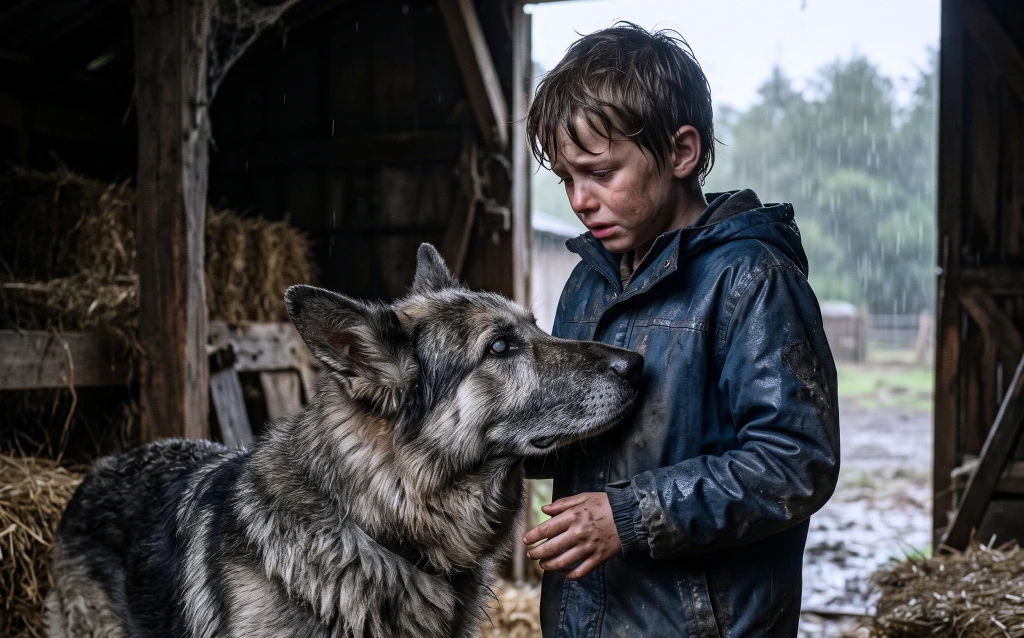
The animal that stepped into the open was larger than any dog Eli had seen up close. Its coat was silver and black, its chest narrow beneath thick fur. One ear stood straight while the other bent at the tip, and a cloudy film covered part of its left eye.
Emma moved behind Eli. “That is a wolf.”
“It has a collar.”
“Wolves can steal collars.”
The dog sniffed the air. Then it walked toward Eli with the slow stiffness of an old animal.
Eli held out his hand.
The dog smelled his fingers, his wrist, and the sleeve of his jacket. Its body suddenly trembled. It pressed its nose against Eli’s chest and released a sound so soft it was almost a sigh.
Then it licked his hand.
Eli found the metal tag beneath the fur.
BOONE
R. MERCER
81 LARKSPUR ROAD
He showed Emma.
Neither of them spoke.
Boone turned toward the storm, looked back once, and walked out of the shed.
The children followed.
The rain softened after a few minutes, though water continued streaming from the trees. Boone led them along the edge of the field, through a gap in a wire fence, and onto a narrow road lined with sycamores.
At the end stood a small wooden house painted blue.
The paint had peeled around the porch steps. White trim framed the windows, and a metal wheelchair ramp ran along one side. Boone climbed the ramp and scratched at the front door.
It swung inward.
“Hello?” Eli called.
No one answered.
Boone disappeared into the house, then returned, whining. He circled Eli once and hurried back inside.
Emma gripped Eli’s sleeve. “We should wait outside.”
“What if someone needs help?”
“What if someone has a shotgun?”
From somewhere inside came a faint voice.
“Boone?”
The children stepped through the doorway.
The living room smelled of menthol ointment, old fabric, and the soup simmering in a slow cooker. Family photographs covered one wall. A hospital bed stood near the far window, and an elderly woman lay propped against several pillows.
Boone hurried to her, placed his front paws beside the mattress, then looked back at Eli.
The woman squinted through the dim room.
“Who did you bring me?” she asked.
Eli moved closer. His wet shoes squeaked against the floor.
“Are you Ruth Mercer?”
Her fingers tightened around the blanket.
“My name is Eli,” he said. “Eli Carter.”
The old woman stared at him for so long that Emma shifted nervously beside the door. Then Ruth looked down at the dog. Her voice broke on his name. “Boone,” she whispered. “You found him again…”
To read the rest of the story – CLICK the NEXT button 👇👇👇