


At 1:47 in the morning, Caleb Whitaker watched his daughter-in-law cross the frozen yard carrying a blue feed bucket against her hip. Emma had left the farmhouse without turning on a single light. She wore Noah’s old canvas jacket over her pajamas, and her boots had not been laced all the way. She moved quickly past the equipment shed, past the dark cattle pens, and straight toward the quarantine barn.
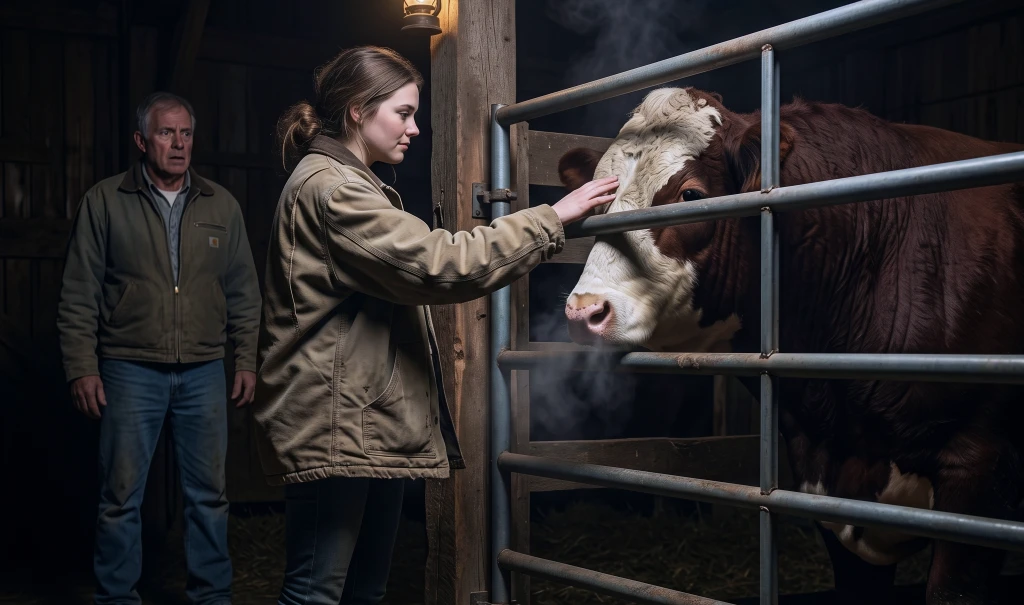
Caleb sat up in bed.
Beside him, Ellen slept beneath the quilt, one hand resting in the empty space where his shoulder had been. The old farmhouse creaked as the heat kicked on, but Emma did not look back.
There was only one animal in the quarantine barn.
The bull that had nearly put a man in the hospital twelve hours earlier.
Caleb pulled on his jeans and followed her.
That morning, the bull had arrived in a livestock trailer from a ranch two counties north. Caleb had paid twelve thousand dollars for him after studying his pedigree, watching three polished sale videos, and speaking twice with the seller.
In the videos, Holloway 214 had stood beneath bright auction lights with his head high and his dark red coat brushed until it shone. His face was white, except for a thumb-shaped patch of brown beneath his left eye. The seller had described him as “spirited but manageable.”
The driver who delivered him had used different words.
“He likes his space,” the man had said while refusing to climb into the trailer.
Caleb had noticed that warning. He had simply decided it meant the bull was nervous from the trip.
The Whitaker farm needed new genetics. Their last breeding bull had injured a hip and been retired, and Caleb had spent months searching for the right replacement. Holloway 214 was young, registered, and built like a concrete wall. If the animal was half as productive as his bloodlines suggested, he could improve the herd for years.
The bull came backward out of the trailer, hit the ground, and spun before anyone could close the alley gate.
Ray Mercer, Caleb’s foreman, barely made it behind a steel panel. Travis Cole, the youngest hired hand, was not as fast. The bull struck a gate with his shoulder, knocking it sideways and throwing Travis into a rail.
For several seconds, no one moved.
Then Travis rolled onto his knees, clutching his ribs.
The bull stood at the end of the alley, blowing clouds of steam from his nostrils. His eyes flashed white each time a man shifted his weight. When Ray lifted a sorting paddle, the animal lunged again, hard enough to bend a hinge.
“Drop it,” Caleb ordered.
Ray lowered the paddle.
The bull stopped, but he did not settle. His muscles trembled beneath his hide, and a strand of saliva hung from his mouth.
Caleb got Travis to urgent care. Nothing was broken, but the doctor ordered him off work for several days and warned that the bruising would get worse before it improved. Caleb paid the medical bill, arranged for someone to drive Travis home, and returned to find Ray standing outside the quarantine barn.
“I’m not asking anybody to go in there,” Ray said.
“You shouldn’t have to. We’ll feed him from the service alley.”
“He charged the hay rack.”
“He’s scared.”
“He’s eighteen hundred pounds, Caleb. Scared can kill a man just as fast as mean.”
Caleb had no answer for that.
He called Dr. Lena Ortiz, the large-animal veterinarian who handled most of the Whitaker herd. She agreed to come at seven the next morning. Until then, she told them to keep the barn quiet, use solid barriers, and make no attempt to touch or move the bull.
At supper, Caleb described the day while Ellen pushed a bowl of mashed potatoes toward him.
Emma sat across from him, breaking a biscuit into pieces without eating any of it. She had been living in the Whitaker farmhouse for almost three months, yet she still waited until everyone else had served themselves before putting food on her plate.
“What happens if the vet can’t find anything wrong?” Ellen asked.
Caleb rubbed his forehead. “I’ll give him a day or two to settle. If nobody can safely handle him after that, I’ll call the seller.”
“And if the seller won’t take him back?”
Caleb hesitated.
Emma’s fingers stopped moving.
“We can’t keep a bull that tries to tear through every gate,” he said. “At some point, he’ll hurt somebody. If I can’t return him, I’ll have to send him to a livestock processor.”
The biscuit crumbled in Emma’s hand.
Caleb saw it, though he pretended not to.
“What did he look like?” she asked.
“The bull?”
She nodded.
“Dark red. White face. Big shoulders. One brown mark under his eye.”
Emma lowered her gaze. “Did the seller call him anything?”
“Just his registration number. Holloway 214.”
She said nothing more.
Caleb had been suspicious of Emma from the first day Noah brought her home.
Not because she had done anything dishonest. That was the part he did not like admitting, even to himself. She had simply arrived with too little luggage, too few explanations, and a history that sounded too cruel to be entirely true.
Noah said they had met eight months earlier at a farm-supply store in West Plains. Emma had been comparing milk replacers for a sick calf, and Noah had offered an opinion she quickly corrected. They began talking whenever their paths crossed, then meeting deliberately.
Caleb and Ellen knew none of this until Noah announced that they were engaged.
Two weeks later, Emma’s stepfather ordered her off his property. Noah moved their courthouse wedding forward and brought her to the Whitaker farm twelve days before leaving for National Guard training.
Caleb had argued with him in the machinery shed.
“You don’t know her well enough to marry her.”
“I know how she treats people who can’t do anything for her,” Noah replied. “That tells me more than knowing what movies she likes.”
“You’re leaving. You’re asking your mother and me to live with a stranger.”
“I’m asking you to give my wife a room until I come home.”
“You’re trying to rescue her.”
Noah’s face tightened. “Maybe you should ask her what she wants before deciding what I’m doing.”
The next morning, Noah and Emma married at the county courthouse. There were no flowers except a grocery-store bouquet Ellen bought on the way. Noah wore a clean blue shirt, and Emma wore a borrowed cream dress. Caleb stood beside them for a photograph, though his expression made it clear he was attending out of duty rather than joy.
Since Noah’s departure, Emma had worked as if she believed a bed and a place at the table had to be earned every morning.
She rose before Ellen, gathered eggs, swept the porch, folded laundry, and found chores no one had assigned to her. When Ellen told her to rest, Emma smiled and discovered something else that needed doing.
She never complained. She also never asked for anything.
Even Scout, Noah’s aging German shepherd, had accepted her. The dog distrusted almost everyone outside the family, but on Emma’s second night in the house, Caleb found him asleep beside her bedroom door.
Caleb had begun to soften toward her.
Still, when he saw her sneaking across the yard in the middle of the night, his first thought was not that she might be in danger.
It was that she might be deceiving them.
Perhaps she had arranged to meet one of the hired men. Perhaps Noah had been a convenient way off her stepfather’s farm, and now that he was gone, she had grown tired of pretending.
The thought was ugly, but Caleb carried it with him as he crossed the yard.
The temperature had dropped below twenty degrees. Frost silvered the grass, and the mud beneath his boots had hardened into ridges. He kept far enough behind Emma that she would not hear him.
She slipped through the side door of the quarantine barn.
Caleb reached it less than a minute later.
Inside, one dim security light burned above the feed room. The bull’s stall stood beyond two reinforced gates and a narrow service alley. Caleb heard a hoof scrape against concrete, followed by a low, vibrating bellow.
Then Emma whistled.
It was not loud. Three soft notes, the second higher than the first.
The barn went still.
Caleb moved closer and saw her standing outside the inner gate. She had set the blue bucket down and was holding one hand between the bars.
The bull emerged from the shadow.
His head was lowered, and his breath came hard. A length of broken rope still hung from the halter the transporter had left on him. When Emma raised her fingers, the animal took another step.
Caleb’s chest tightened.
“Emma,” he whispered.
The bull spun toward the sound.
His shoulder struck the gate with a crash that shook dust from the rafters. Caleb stumbled backward, but Emma did not scream. She gripped the outer rail and spoke in a calm voice.
“Easy. Easy, Benji. It’s just a voice.”
The bull tossed his head.
She whistled again.
For several seconds, he stared past her at Caleb. Then the tension in his neck eased. He returned to the gate, pushed his white forehead between the bars, and stood there breathing.
Emma touched the brown patch beneath his eye.
“That’s my boy,” she murmured. “You still remember.”
Caleb could not move.
The bull that had charged two experienced cattlemen now stood with his eyes half closed while Emma rubbed the base of his ear through the gate.
“Don’t come any closer,” she told Caleb. “He doesn’t know you.”
“How do you know him?”
Emma turned.
In the weak barn light, she looked younger than twenty-three. Her face had gone pale, but her hand remained on the bull’s forehead.
“Because his name isn’t Holloway 214,” she said. “His name is Benji.”
The bull exhaled into her palm.
Caleb looked from the animal to the woman his son had married.
“I raised him from a bottle,” Emma said. “And you bought him from Wade Holloway, didn’t you?”
Caleb felt the cold enter him despite the closed barn doors. Wade Holloway was her stepfather…
To read the rest of the story – CLICK the NEXT button 👇👇👇