


At 10:14 on a wet Saturday morning, Atlas let an orange fall from his hand. The fruit struck the concrete ledge, rolled through the grass, and stopped beside the viewing glass. Atlas did not look down. The enormous silverback was staring beyond his own reflection at a six-year-old girl in a yellow raincoat.
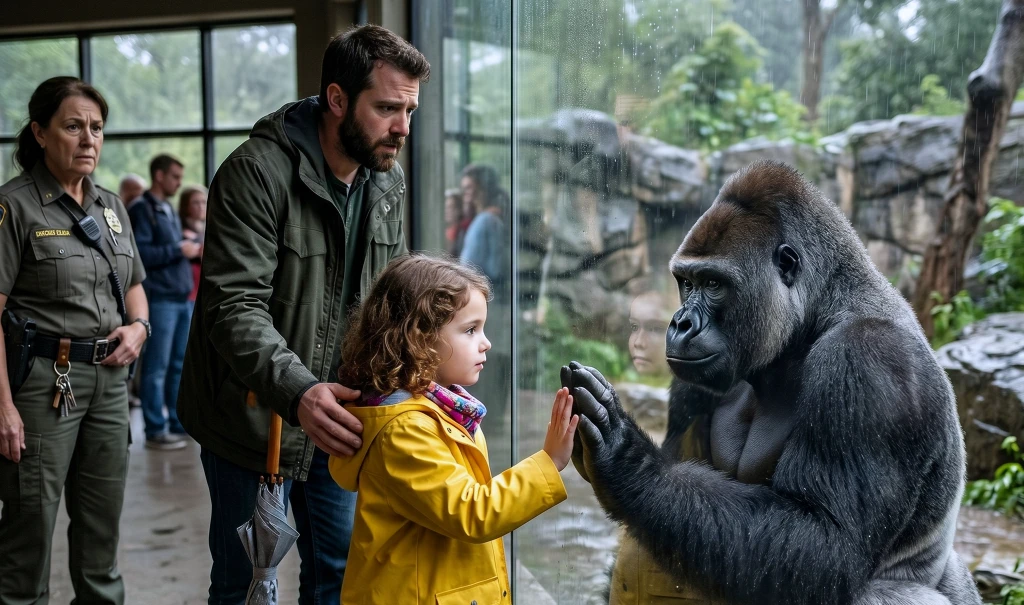
Sam Dorsey noticed because Atlas never dropped food.
For twenty-four years, Sam had worked in the great ape habitats at Riverbend Zoological Park in Ohio. He knew the difference between a gorilla glancing at a bright color and one tracking movement. He knew the rigid shoulders that preceded a warning display, the quick sideways look that meant a younger male was testing patience, and the deep, compressed silence of fear.
This was none of those things.
Atlas sat perfectly still near the far side of the habitat, one broad hand resting in the damp grass. The other gorillas had stopped eating too. Two females gathered beneath the artificial rock ledge while the youngest member of the troop climbed halfway onto his mother’s back and watched.
They were not alarmed by Atlas. They appeared to be waiting for him.
Sam followed the silverback’s gaze.
The girl stood close to the glass without touching it. Rain had darkened the shoulders of her coat, and one side of her brown hair was escaping its braid. Her father stood behind her with a folded zoo map in one hand and a paper cup in the other.
There were at least thirty visitors around them, yet Atlas seemed unaware of everyone else.
“Marcus,” Sam said quietly.
The security officer near the entrance looked over.
“Stop people from crowding the glass.”
Marcus glanced toward Atlas and immediately lowered the radio he had been raising. “You seeing something?”
“I’m trying to.”
The first phones were already out. A teenager whispered that the gorilla was looking at the little girl, and the observation moved through the visitors faster than any official announcement could have. People stepped closer, then hesitated when Atlas slowly lifted his head.
The girl’s father noticed the growing attention. He set down his coffee and placed a hand on her shoulder.
“Willa, let’s give him some room.”
She did not move.
“Willa.”
“He heard me,” she said.
Her father bent closer. “You didn’t say anything.”
Willa looked through the glass and hummed three soft notes.
The sound was barely audible beneath the ventilation system and the murmur of the crowd. It rose, paused, then fell. She repeated it once, not like a song performed for an audience but like something she had done many times without thinking.
Atlas stood.
The people nearest the glass backed away together. One woman caught her son by the hood of his sweatshirt. Marcus moved between the crowd and Willa, while Sam’s hand closed around the radio clipped to his belt.
Atlas did not charge. He did not slap the ground or lift his chest.
He walked.
Each movement was deliberate. His knuckles sank into the damp earth as he crossed the habitat, his eyes fixed on Willa. When he reached the grass beside the glass, he stopped and lowered himself until his face was near hers.
Willa’s father pulled gently on her shoulder.
“Come on, sweetheart.”
“He isn’t mad,” she said.
“We don’t know that.”
“I do.”
Sam stepped closer but stayed outside Atlas’s direct line of sight. The silverback’s mouth was relaxed. His hair was not raised, and there was no tension around his eyes. What unsettled Sam was not danger. It was the precision of Atlas’s attention.
“Willa,” Sam said, keeping his voice even. “Can you take one step back for me?”
She turned her head just enough to see him. Her eyes were serious, but she did not appear frightened.
“Will he think I’m leaving?”
The question stopped Sam.
“No,” he said after a moment. “One step won’t mean that.”
Willa obeyed. Atlas leaned forward, following the small change in distance, then settled again.
Her father looked at Sam. “Is this normal?”
“No.”
The answer came out before Sam could soften it.
The man’s face tightened. “Then why aren’t we moving her?”
“Because Atlas is calm. Pulling her away suddenly could change that.”
It was not a complete explanation, but it was the honest one. Sam had managed mock charges, fights within the troop, failed introductions, and emergency separations. He had never seen Atlas study a visitor as if searching for something beneath the person standing there.
Willa raised her right hand.
Her father caught her wrist before she reached the glass. “No touching.”
Willa looked up at him. “Mom said not to tap. She said I should put my hand down flat and wait.”
Sam felt the back of his neck go cold.
“What did you say?”
Willa’s father turned toward him. For the first time, Sam saw fear in the man’s expression that had nothing to do with Atlas.
“She’s remembering a story.”
“What story?”
“Not here.”
Atlas released a low breath that fogged a small patch of glass. Willa’s father slowly let go of her wrist, though his hand remained close.
She placed her palm against the barrier.
For several seconds, Atlas did nothing. Then he lifted one hand and rested his knuckles against the other side.
His hand was wide enough to cover Willa’s head. Hers looked impossibly small beneath its shadow, five fingers spread against glass that neither of them could cross.
Nobody spoke.
A phone lowered. Then another. Even the children appeared to understand that the moment had become different from the quick spectacle their parents had expected to record.
Atlas leaned nearer. His nostrils widened as he breathed, and his eyes moved from Willa’s face to her wrist.
A narrow blue cord was looped there, braided around a small silver bead.
Sam forgot the crowd. He forgot the radio in his hand and Marcus standing beside him. He saw a concrete quarantine room lit by a portable work lamp, rain streaming down a service door, and a young woman sitting on an overturned bucket with a blue cord around her wrist.
Three notes, hummed into the dark.
Sam stepped closer.
“Where did she get that bracelet?”
Willa’s father covered it with his fingers. “It belonged to her mother.”
“What was her name?”
The man looked toward Atlas before answering. “Rachel Hart.”
Sam’s breath left him.
Willa turned back to the silverback. “Mom said you were bigger now.”
Atlas’s eyes remained on her.
Sam pressed his radio. “Control, close the great ape viewing hall. Bring Elena and Dr. Patel. No public announcement yet.”
The response came through in a burst of static. “Is there a safety issue?”
“Not at the moment. We need the room cleared without rushing anyone.”
Marcus began directing visitors toward the exit. Some protested, while others lingered with their phones raised. Sam barely heard them. Rachel Hart’s name had opened a door he had kept shut for nearly eighteen years.
She had been twenty-seven then, stubborn and exhausted, with cheap coffee in one hand and that blue bracelet tied around the other wrist. She had sat outside Atlas’s recovery room during the worst night of his life because every time she stood to leave, the injured young gorilla dragged himself toward the mesh.
Sam had not seen her since before Atlas became a silverback.
He had not even known she had a child.
When the last visitors were moved into the corridor, only Sam, Marcus, Willa, and her father remained in front of the glass. Atlas had not shifted. Behind him, the rest of his troop had begun eating again, apparently satisfied that whatever required their attention no longer required action.
Sam crouched a few feet from Willa.
“Did your mother tell you his name?”
She nodded. “She told me about the storm and the room with no windows.”
Her father closed his eyes briefly.
“Did she tell you to sing those notes?”
“She used to sing them when I couldn’t sleep.” Willa examined Atlas’s face. “She said they helped him too.”
“Willa,” her father said gently, “that’s enough.”
She lowered her hand.
Atlas kept his knuckles against the glass.
Willa’s expression changed. Until then, she had seemed calm in the uncomplicated way children sometimes were when adults had not yet persuaded them to be afraid. Now her mouth tightened, and she looked suddenly younger.
“Does he think I’m her?”
Sam had spent his career warning people against easy stories about animal behavior. A gorilla could associate a sound with feeding, a uniform with a familiar keeper, or a particular room with a painful procedure. Recognition did not necessarily mean remembrance in the human sense. Similarity did not prove grief, love, or longing.
But Atlas had abandoned his breakfast for a child he had never met. He had crossed the habitat after hearing a pattern no keeper had used in years. He had focused on a bracelet Sam remembered from a night the animal should have had every reason to forget.
“I don’t know what he thinks,” Sam said. “I know something about you got his attention.”
Willa considered that answer and appeared to accept it.
The service door opened behind them. Dr. Priya Patel, Riverbend’s senior veterinarian, entered with the zoo director, Elena Park. Sam held up one hand before either could speak.
“Give him another minute.”
Elena surveyed the empty public hall, then the silverback beside the glass. “We already have videos online.”
“I figured.”
“Why was the area cleared?”
Sam looked at Willa’s father. The man gave a small nod.
“Because her mother was Rachel Hart.”
Priya’s face showed no recognition, but Elena’s did. She had worked in administration rather than animal care when Atlas first arrived.
“The veterinary resident?” she asked. “From the confiscation?”
“Yes.”
Elena looked at Willa’s bracelet, then at Atlas. “That can’t be what this is.”
“I didn’t say it was.”
Willa’s father picked up the small backpack he had left beside a bench. His hands shook as he opened the front pocket.
“My name is Noah,” he said. “Noah Hart. Rachel died eleven months ago.”
Sam looked at Willa, who was watching Atlas instead of the adults.
Noah continued. “Before she died, she made me promise I would bring Willa here after her sixth birthday. No appointment, no call to the zoo, no warning. She said we were supposed to stand where any other family would stand and let Atlas decide whether anything happened.”
Elena folded her arms. “She expected this?”
“She said she didn’t expect anything.”
Noah took a cream-colored envelope from the backpack. Its corners had softened from being handled, and the seal was still intact.
“She told me I would know whether to deliver this.”
“To whom?” Sam asked. Noah turned the envelope over. Across the front, in blue ink Sam had not seen in fourteen years, were the words: For Sam Dorsey, if Atlas is still alive…
To read the rest of the story – CLICK the NEXT button 👇👇👇