


At 2:17 on a Monday morning, a man in a windowless office changed Mara Quinn’s status from ACTIVE to LOST AT SEA. The satellite image on his center monitor showed a broken research vessel drifting through black water south of the Aleutian Islands. Its stern had disappeared. Fuel burned in a thin orange line along the waves, and one section of the hull rolled slowly in the winter storm.
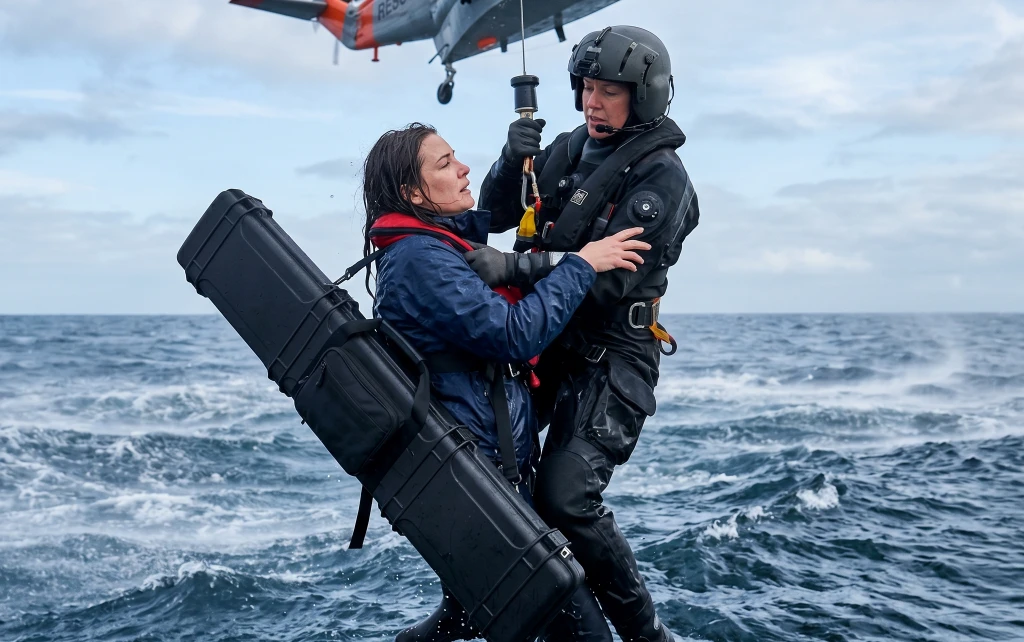
A small figure was still clinging to it.
The analyst enlarged the image until the pixels blurred. “She’s moving.”
His supervisor leaned over his shoulder. He wore a white shirt with the sleeves neatly folded and had a glass of bourbon in one hand. The room was kept cold to protect the servers, yet no one inside wore a jacket.
“For how long?”
“Hard to tell. The suit bought her some time.”
“What about the package?”
“No signal.”
The supervisor watched the figure vanish behind a swell. When the wreckage rose again, Mara was still there, one arm hooked over the hull and the other wrapped around a long black object secured to her body.
“Coast Guard coverage?” he asked.
“The storm pushed their search corridor east. Our drift model gives her less than a two-percent chance of being found.”
“And of surviving?”
The analyst glanced at the water temperature displayed in the corner of the screen.
Thirty-eight degrees.
He did not answer.
The supervisor set down his glass and closed the live feed. “Then recovery is unnecessary.”
A confirmation window appeared. He clicked it without reading.
Forty-six hours later, the ocean returned her.
Commander Nathan Cole was sitting behind the pilots of a Coast Guard MH-60 Jayhawk when Lieutenant Jenna Walsh saw something move beneath the cloud break.
“Debris, two o’clock,” she said.
Nathan leaned toward the side window. They had been searching for survivors from a missing fishing vessel, not the wreck marked on yesterday’s drift reports. The patch of ocean below them was nearly empty, gray water folding into gray sky, but a jagged slab of composite hull floated between the swells.
At first he saw nothing alive.
Then a hand slid across its surface.
“Take us down.”
Walsh banked the helicopter. “That wreck isn’t from our assigned vessel.”
“I know.”
As they descended, the crew chief opened the cabin door. Wind filled the aircraft with a hard mechanical roar, and freezing spray spun beneath the rotors.
Chief Owen Briggs clipped into the rescue line and looked down. He had spent fifteen years pulling people from water that wanted to keep them. He knew the appearance of exhaustion, panic and death.
The woman below did not fit any of them.
She lay partly inside a collapsed pocket of the overturned hull. An orange immersion suit covered most of her body, though one shoulder had been torn open and patched with strips of black fabric. Her face was colorless. Salt had dried in her dark hair, and ice clung to the zipper beneath her chin.
A rifle was strapped across her chest.
Owen turned toward Nathan. “She’s armed.”
Nathan had already seen it. The weapon was too long for a standard carbine and too deliberately built to be mistaken for sporting equipment. Its stock was wrapped in tape where Mara had secured it to her forearm.
“Bring both of them up.”
“Commander?”
“Don’t take it away from her. Cut the hull if you have to.”
Owen studied him for half a second, then lowered his visor. “Understood.”
He went through the door.
The cold struck through his dry suit the instant he entered the water. He surfaced, found the hull and pulled himself toward the woman. Her head rested against the broken composite as though she had simply grown tired and gone to sleep.
“Ma’am,” he called. “United States Coast Guard.”
No response.
He reached for the strap around her shoulder.
Her eyes opened.
Owen stopped with his glove inches from her body. There was no confusion in her stare. No frightened search for context. She looked at the insignia on his suit, the rescue line behind him and then his hands.
She was assessing him.
“I’m getting you out,” he said. “The rifle comes with you.”
Her cracked lips moved. He leaned closer.
“Promise.”
“I promise.”
Only then did her fingers release the edge of the hull.
Owen secured the harness around her without disturbing the weapon. As the cable lifted them, he saw how she had survived the worst of the exposure. The overturned section contained a narrow air pocket. She had wedged herself inside it during the storm, keeping part of her torso above the water. A severed flotation bladder had been lashed beneath the wreckage with lengths of wire and fabric cut from her own suit.
None of it explained forty-six hours.
It explained why they had not recovered a body.
Petty Officer Luis Ortega began treating her before the cabin door had closed. He cut away the damaged portion of the immersion suit, placed heated packs around her torso and connected a temperature probe.
“Core is eighty-five,” he said.
Nathan looked at him.
“That’s the second reading. Pulse thirty-six. Weak, but regular.”
“Can she make it to Kodiak?”
“She shouldn’t have made it to us.”
“That wasn’t my question.”
Ortega adjusted the warm oxygen mask over Mara’s face. “Yes, sir. If her heart stays stable.”
The rifle remained across her chest. Even unconscious, she kept one hand curled around its sling.
Nathan knelt beside her and examined the weapon without touching it. Nothing about the construction looked improvised. The barrel was heavy and unusually long. The optic appeared to combine parts from several systems, and the stock was broader near the base than its balance required.
This was not a weapon assembled from available components.
Someone had designed every inch of it around a single purpose.
Nathan keyed the intercom. “Walsh, advise Kodiak we have one female survivor, severe hypothermia. Unknown identity.”
“Copy.”
“And have Cal Pierce meet us at the hangar.”
There was a pause. Pierce was an ordnance and forensic-systems specialist attached to the joint maritime task group. Nathan usually called him only when the recovery team found something nobody else could identify.
Walsh looked back through the open cockpit door. “What did we bring aboard?”
Nathan watched the woman’s fingers tighten around the sling.
“I don’t know yet.”
Dr. Lena Brooks was waiting when the Jayhawk landed.
The medical team moved Mara into the heated receiving bay, where they began the slow work of raising her core temperature without forcing her heart into a dangerous rhythm. Nathan followed as far as the treatment-room doors.
A nurse reached for the rifle.
Mara woke so quickly that the nurse stumbled backward.
Her hand snapped around the sling. The monitors jumped, but her voice remained quiet.
“Leave it.”
Dr. Brooks moved between Mara and the startled nurse. “No one is trying to take anything from you. We need room to treat your shoulder.”
“Keep it where I can see it.”
“We can place it against the wall.”
Mara’s eyes moved around the room, counting people and exits. She seemed to note the security camera above the door and the network terminal mounted beside the medication cabinet.
“Unplug that computer.”
Dr. Brooks glanced at the terminal. “It holds your medical chart.”
“Then write it down.”
“You’re in a secure Coast Guard medical facility.”
“That doesn’t make the computer secure.”
Dr. Brooks had treated sailors who woke fighting, crying or calling for people who were not there. The calmness of the request unsettled her more than any of those reactions would have.
She disconnected the terminal.
Mara loosened her grip.
“Thank you,” she whispered, and lost consciousness again.
Cal Pierce arrived at the hangar wearing jeans, work boots and the expression of a man who had been dragged away from the first full night’s sleep he had managed all week. Then he saw the rifle.
His irritation disappeared.
He walked around the weapon without touching it. “Where was this?”
“Strapped to our survivor.”
“In the water?”
“For at least two days.”
Pierce crouched beside the table. “No visible corrosion. Whoever sealed this knew exactly what environment it might encounter.”
“Can you identify the platform?”
“No.”
Nathan waited.
Pierce looked up. “I don’t mean I need more time. I mean it isn’t a platform I recognize. The receiver may have started as something commercial, but nearly every important component was rebuilt.”
He pointed without making contact. “The optic mount is custom. The barrel profile isn’t from a production line. Even the cheek rest has been shaped for one shooter’s face.”
“What about the stock?”
Pierce studied the widened base. “Too heavy.”
“That’s what I thought.”
“It could be ballast to control balance, but nobody capable of this work would solve the problem so clumsily.” Pierce took a small flashlight from his pocket and examined the seams. “There’s something inside.”
Nathan looked toward the medical building across the landing area.
“Work offline. No photographs, no network connection and no inventory entry yet.”
Pierce straightened. “You want me to examine an unregistered precision weapon without logging it?”
“I want you to tell me what we found before a report travels farther than we do.”
Pierce’s gaze stayed on him. “That sounds like an order you’ll have to explain later.”
“Probably.”
After a moment, Pierce lifted the rifle into a padded carrying case. “Give me three hours.”
“You have two.”
Mara regained consciousness shortly after noon.
By then, Dr. Brooks had warmed her core temperature above ninety-four degrees and treated the torn skin along her shoulder. The preliminary examination showed dehydration, exposure injuries and deep bruising around her ribs, but no fractures. The immersion suit and the air pocket had saved her from direct exposure for part of the ordeal.
The rest, Dr. Brooks said, was endurance she could not explain.
Nathan entered alone.
Mara sat propped against the raised hospital bed. The rifle rested against the wall within reach. Pierce had removed the firing assembly and confirmed that no ammunition remained, but he had left the stock intact.
Mara watched Nathan close the door, then glanced toward the unplugged terminal.
“You’re the one from the helicopter.”
“Commander Nathan Cole.”
“Coast Guard?”
“Joint maritime recovery command.”
She considered the answer. “You told the swimmer not to take the rifle.”
“I did.”
“Why?”
Nathan pulled the visitor’s chair closer but remained standing. “You were nearly unconscious, half-frozen and still holding it. I assumed separating you from it would create a problem we didn’t understand.”
“And you usually make decisions based on what you don’t understand?”
“I try not to make them based on what I pretend to understand.”
For the first time, her expression changed. It was not a smile, but some of the tension left her jaw.
She looked at the chair. “You can sit.”
Nathan did.
“My doctor says your name is Mara.”
“That’s the name I’m using.”
“Do you have another?”
“Several. None of them will help you.”
“What happened to your vessel?”
“An explosive charge opened the stern.”
“Accident?”
“No.”
“Who placed it?”
Mara looked at the rifle. “The people who expected the water to erase both of us.”
“Both?”
“Me and what I was carrying.”
Nathan followed her gaze. “Something inside the stock.”
Her eyes returned to him.
That was the first time he saw surprise reach her before she could conceal it.
“Your specialist found it?”
“He thought he would.”
“Has he opened it?”
“I haven’t heard from him.”
She studied Nathan as carefully as she had studied Owen in the water. “When he does, he’ll want to report it.”
“I told him not to.”
“Before speaking to me?”
“Yes.”
“Why?”
“Because whoever sank your vessel had access to explosives, satellite coverage and your exact position in the Gulf of Alaska. I’m not going to assume a secure channel is secure just because the label says it is.”
Mara rested her head against the pillow. Her eyes closed for a moment, and Nathan saw the exhaustion beneath the vigilance. She had spent nearly two days inside a frozen piece of wreckage, yet relaxing in a guarded American facility seemed to require more courage than surviving the sea.
“When your specialist calls,” she said, “ask him for the last entry in the outer file.”
“What kind of entry?”
“A ballistic record.”
Nathan waited, but she offered nothing more.
“What am I going to see?”
“A distance you won’t believe.”
“You could tell me now.”
“I could.”
“Why won’t you?”
“Because then you’d think exposure damaged my judgment.” Her eyes opened. “When your own specialist gives you the number, you’ll listen to the rest.”
A pager vibrated against Nathan’s belt.
Pierce.
Nathan stood.
Mara’s hand tightened around the blanket. “Commander.”
He stopped at the door.
“Whatever distance he shows you, don’t waste time arguing about whether it’s possible.”
Nathan found Pierce in an unused aircraft-maintenance office with the blinds closed and the rifle disassembled on a rubber mat. A laptop sat beside it with every wireless function physically disabled.
Pierce had removed a narrow panel from the base of the stock. Inside it was a sealed black data module no larger than a deck of cards.
“You were right,” Pierce said. “The stock was carrying something.”
“What’s on it?”
“Two encrypted partitions. I opened the outer one. The second is beyond anything I can break quickly.”
Nathan moved beside him. “And the first?”
“Seventeen operation files. Each contains a date, coordinates, environmental readings, a target designation and a result.”
“Operation files for what?”
Pierce turned the laptop.
Rows of numbers filled the screen. Wind speed. Air density. Elevation. Projectile temperature. Estimated flight time. Each variable had been logged with a level of precision that made Nathan’s throat tighten.
“These are shot records,” Pierce said. “Long-range engagements.”
Nathan scrolled to the final entry.
The distance appeared in meters first, then in yards.
4,112 meters. 4,498 yards.
More than two and a half miles.
“One round?” Nathan asked.
“One.”
“Confirmed?”
Pierce pointed to the next line. “The file includes atmospheric data from the date and location. I checked it against archived weather records. The wind table matches.”
Nathan read the projected flight time.
Nearly seven seconds.
At that distance, the shooter would have needed to account for a dozen changing variables, including conditions the target might never know existed. It was not simply an act of marksmanship. It was a calculation stretched across miles of moving air.
“No one makes this shot,” Nathan said.
Pierce gave him a tired look. “Someone did.”
Nathan scrolled lower.
Beneath the distance, coordinates and confirmation code, the final field contained a name.
Pierce did not speak. He let Nathan read it himself.
TARGET: HARLAN BECKETT
Nathan had seen Beckett’s face on the news that morning. The billionaire defense contractor had died at a private coastal compound less than three days earlier. The family had declined to release a cause…
To read the rest of the story – CLICK the NEXT button 👇👇👇