


The German shepherd stepped into the highway when Nolan Price’s truck was less than thirty yards away. He hit the brakes hard enough to send his thermos rolling beneath the passenger seat. The rear of the truck fishtailed once on the salted pavement, and a horn blared behind him, but the dog did not run. She stood in his lane with her head lowered, watching him through the windshield.
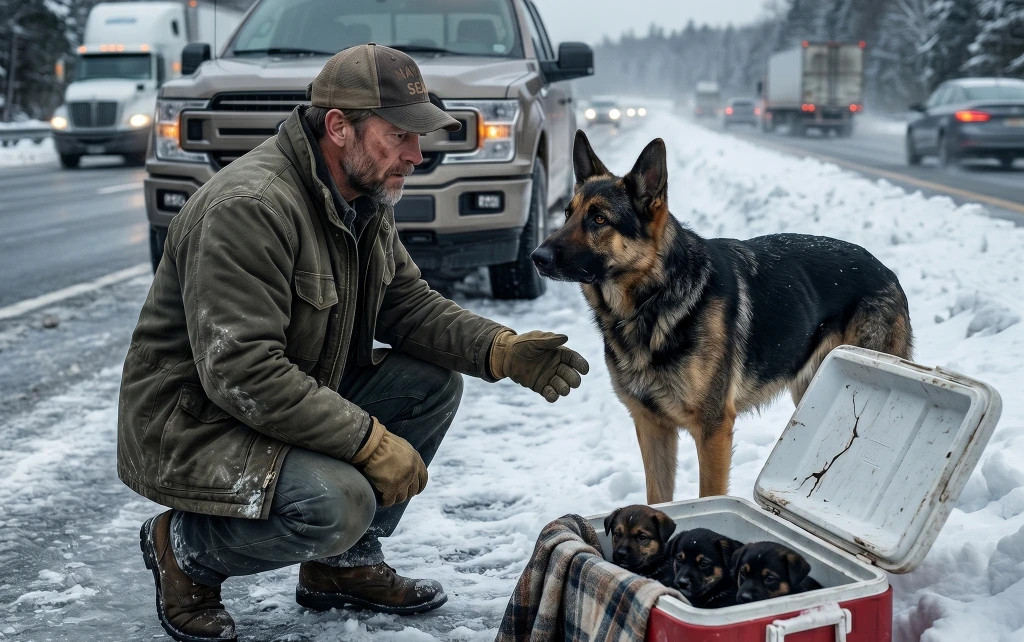
Then she turned toward a cracked plastic cooler lying against the snowbank.
Traffic had already slowed for construction outside Ashford, Maine. A flagger in a fluorescent jacket shouted at Nolan to keep moving, but Nolan put on his hazards and pulled as far onto the shoulder as the plowed snow allowed.
The shepherd returned to the cooler and sat beside it. Her front legs trembled beneath her, and one paw folded slightly inward as though putting weight on it hurt. She did not bark or bare her teeth. She simply looked back at Nolan.
He knew that look.
For nearly twenty years, Nolan had served in places where people learned to ask for help without using words. He had seen it in frightened interpreters, wounded teammates, and parents who understood before anyone else that there would not be enough room in the evacuation vehicle.
Seven months into retirement, he had hoped never to recognize it again.
A pickup rolled past, its driver gesturing angrily. Nolan ignored him, pulled on his gloves, and climbed out.
The cold cut through his canvas jacket. Wind from the passing traffic lifted grains of road salt around his boots, and the shepherd tracked every step he took. Nolan approached sideways, keeping his hands low.
“Easy,” he said. “I’m looking. That’s all.”
The dog remained still until he crouched beside the cooler. The lid had split down the middle, and a frayed length of clothesline lay beneath one corner. When Nolan lifted the broken plastic, he found three puppies packed together beneath a damp kitchen towel.
For one terrible second, none of them moved.
Then the smallest gave a thin, scraping cry.
Nolan stripped off his jacket and wrapped it around the litter. The puppies were perhaps five weeks old, though starvation made them look younger. Their ears were still soft, their bellies hollow, and the fur around their paws had frozen into dark points.
The shepherd leaned forward and touched her nose to each one.
“All right,” Nolan murmured. “They’re here.”
The construction flagger had come closer, his irritation replaced by concern. He used his radio to stop the nearest lane while Nolan lifted the cooler.
“There’s a vet in Ashford,” the man said. “Green building across from the feed store. Ten minutes if the road’s clear.”
“Call ahead.”
The flagger nodded and reached for his phone.
Nolan carried the cooler to the truck. The shepherd followed, limping badly now that she no longer had to pretend she was strong. When Nolan opened the rear door, she tried to jump and nearly collapsed against the running board.
He caught her beneath the chest.
She stiffened at his touch but did not fight. Up close, he could feel every rib beneath her coat. A raw groove circled her neck where something narrow had rubbed away the fur.
Nolan lifted her into the back seat and placed the cooler beside her. She immediately curved herself around the puppies, using her body to hold his jacket in place.
The heater blew at full power as Nolan drove. He kept one hand near the vents, checking the air, while the shepherd watched him in the mirror.
His pulse had not settled.
He told himself it was the road, the sudden stop, the puppies’ shallow breathing. He did not admit that the first cry from inside the cooler had carried him somewhere else for half a second—to dust, shouting, and a radio call that had ended before anyone could answer.
The shepherd rose unsteadily and placed one paw against the back of his seat.
Nolan glanced at her.
“I’m driving,” he said.
Her paw remained there until his shoulders lowered.
Ashford Veterinary Center was a low brick building with a hand-painted sign and two empty parking spaces marked for emergencies. A veterinary technician met Nolan at the door with blankets and a rolling cart.
The shepherd refused to leave the puppies. When the technician reached for the cooler, the dog stepped between them, ears forward.
“She comes too,” Nolan said.
The technician looked at the dog’s neck and nodded. “All right. Keep your hand near her shoulder.”
Inside, Dr. Caroline Park moved quickly without creating panic. She was in her early fifties, with gray beginning at her temples and the calm voice of someone accustomed to frightened animals and frightened people.
“Severe cold stress,” she said after examining the first puppy. “Dehydration. Probably no food since yesterday, maybe longer.”
“Will they make it?”
“I don’t know yet.”
Nolan preferred the answer to false reassurance.
Dr. Park’s staff warmed the puppies gradually, starting fluids beneath the skin and rubbing their paws with towels fresh from a dryer. The shepherd stood near the treatment table, following every hand. She allowed Dr. Park to examine her only after Nolan placed his palm against her shoulder.
“She’s been nursing,” the veterinarian said. “Not enough nutrition, but she kept them alive. Another night out there and we’d be having a different conversation.”
The dog’s injured paw was not broken. The neck wound was older than the morning’s abandonment, though the clothesline fibers caught in her coat were recent.
Nolan looked through the treatment-room window at the cracked cooler.
“Someone tied her.”
“Looks that way.”
Dr. Park glanced at him. “Did you see anyone nearby?”
“Only traffic.”
“We’ll document everything.”
Nolan gave his name and paid the emergency deposit. When the receptionist asked for his local address, he had to pull the rental agreement from his email. He had not yet spent a night at the cabin on Black Spruce Road.
Ashford was supposed to be a place where no one knew him. He had chosen it after looking at a map and finding a town far enough from his former base, his former marriage, and every grocery store where someone might ask what he planned to do next.
His plan had been simple. Unpack. Repair the cabin’s porch. Learn to sleep without a television running.
Instead, he sat on the floor of an exam room while three half-frozen puppies lay beneath a warming unit and a German shepherd rested her head on his boot.
A metal tray fell in the next room.
The crash was ordinary. Nolan’s body did not know that.
He was standing before he understood he had moved, one hand raised and his breath trapped high in his chest. The walls seemed to narrow around him.
The shepherd rose and pressed her shoulder against his leg.
Nolan looked down. Her amber eyes held his without fear.
“I’m all right,” he said.
The words came out rough.
She leaned harder until he sat again.
Dr. Park returned carrying a handheld scanner. She passed it slowly over the dog’s shoulders, and the machine gave a sharp electronic chirp.
“There you are,” she said.
The chip was registered locally. The dog’s name was Sadie, and the listed owner was Marian Bell, seventy-four, of Old Mill Road.
Dr. Park called the number on file. It had been disconnected. She tried a second number from an old vaccination record, listened for several rings, and left a message.
Then she frowned at the computer.
“What?”
Dr. Park turned the monitor slightly away, not hiding it from Nolan so much as protecting someone else’s information.
“Mrs. Bell called three clinics this week. She was looking for this dog and a litter of puppies. She also filed a missing-animal report with the county shelter.”
“So she didn’t leave them.”
“It doesn’t sound like it.”
The shepherd lifted her head at the sound of footsteps in the hallway. Her ears came forward, and the exhaustion vanished from her posture.
A woman appeared in the doorway wearing an olive winter coat over a blue cardigan. She was small, silver-haired, and breathing as though she had crossed the parking lot at a run. One bare hand gripped the doorframe.
The shepherd rose so quickly that the IV stand beside the warming unit rattled.
“Sadie,” the woman whispered.
The dog crossed the room.
Nolan saw one more detail before Marian Bell dropped to her knees: she looked over her shoulder, checking the empty hallway.
“Please,” she said as Sadie pushed into her hands. “Whatever you do, don’t call my son.”
Nolan waited.
Marian buried her face against the dog’s neck. “He told me they were dead,” she whispered. “And if Evan learns they’re alive, he’ll come for them…”
To read the rest of the story – CLICK the NEXT button 👇👇👇