


Ms. Marian Cole pulled the piano bench away from the grand and turned it toward the class. “Since you’ve spent the last three weeks staring at those keys, Emma, you may as well show us what you know.”
Twenty-four fourth graders looked toward the back row. Emma Carter felt every face arrive at once—curious, relieved, amused. Until that moment, she had done an almost perfect job of disappearing.
She kept both hands under her desk. “I’d rather not.”
Ms. Cole’s smile did not change, but something in her eyes hardened. “That wasn’t an invitation.”
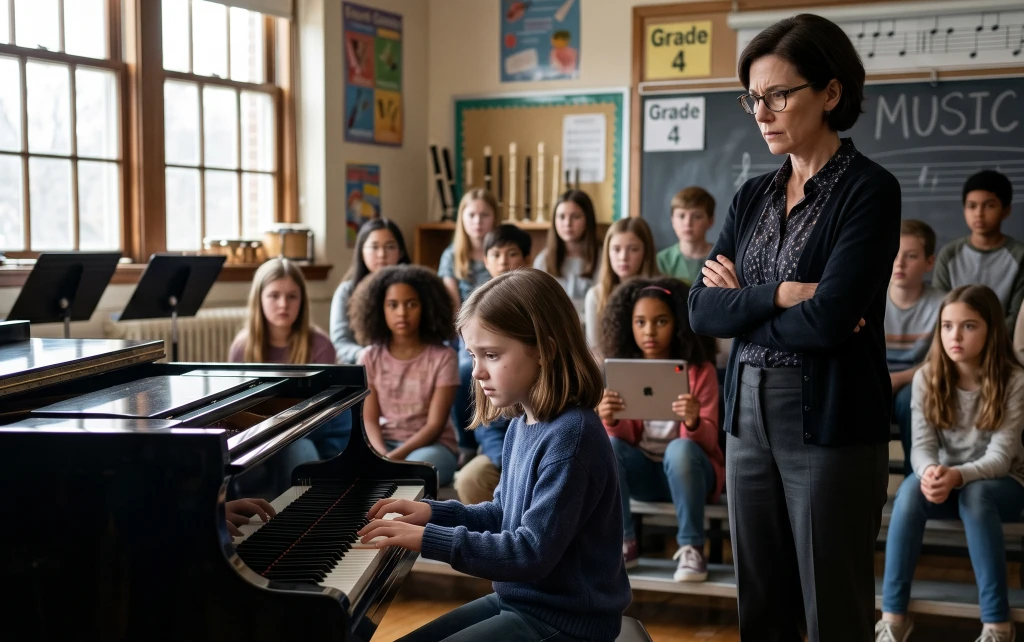
The music room at Brookside Elementary was usually the one place Emma could breathe. It smelled faintly of dry-erase marker, valve oil, and the lemon polish the custodian used on the piano. Guitars hung along one wall, drums were stacked beneath the windows, and the black grand piano occupied the center of the room with the authority of something everyone else had agreed not to touch without permission.
Emma had noticed it on her first day in Ashford, Ohio. She had noticed the faint scratch near the fallboard, the soft wear on the middle pedal, and the way one ivory-colored key sat a fraction lower than the others. She had also noticed Ms. Cole watching her notice.
That first morning, Emma had arrived in a navy sweatshirt with a repaired cuff and sneakers her father had sealed near the toes with clear glue. Her backpack was clean but old, with a pale square where a patch had once been. She had taken the only open seat, placed her pencil exactly parallel to the desk edge, and answered attendance in a voice so quiet Ms. Cole had asked her to repeat herself.
The other students already knew the rules of the room. Owen Brooks played violin and was praised for arriving early. Claire Donnelly had private piano lessons twice a week and sat with the straight-backed certainty of someone accustomed to adults saying she was gifted. Marcus Reed loved percussion but rushed every rhythm when he got nervous, which meant Ms. Cole often stopped him with a sigh before he reached the end.
Emma learned quickly that Ms. Cole liked preparation, polish, and children whose parents used words such as *conservatory* and *enrichment*. She did not raise her voice often. She did not have to. A lifted eyebrow could make a student start over; a long pause could make a child apologize without knowing exactly what for.
The spring showcase was six weeks away, and Ms. Cole had spent most of March reminding the class that soloists represented the entire school.
“Interest is common,” she liked to say. “Discipline is rare.”
Each time she said it, her eyes moved toward Owen, Claire, or one of the students she already expected to choose.
Emma never volunteered. She sang softly during warmups, clapped the assigned rhythms, and kept her gaze on her music folder whenever someone played badly enough to draw Ms. Cole’s displeasure. Still, she could not stop looking at the piano.
It was not because she wanted attention. Attention had become dangerous after her mother died. Adults lowered their voices around her. Children asked questions and then looked embarrassed when she answered. Neighbors offered casseroles, teachers sent home worksheets with extra time, and everyone seemed to expect grief to make noise.
Emma’s grief did the opposite. It made her careful.
Eighteen months earlier, she and her father had lived in a small house outside Dayton with a maple tree in the front yard and an upright piano in the living room. Her mother, Rachel, taught lessons there in the afternoons. At night, after the last student left, she sat beside Emma on the bench and guided her hands through scales, inventions, and pieces whose names Emma could not pronounce when she first learned them.
“Don’t hit the note,” Rachel would say. “Let your hand arrive there.”
She made music sound less like a subject than a place they could enter together. A phrase could be rain moving across a window. A chord could be a door opening. Silence was not the absence of music; it was where the next note gathered itself.
Then Rachel got sick. Ben Carter missed work to drive her to appointments, and bills accumulated in careful white stacks on the kitchen counter. By the time Emma was eight, the house was gone, the maple tree belonged to strangers, and the upright piano had been rolled down the front steps by two men who kept apologizing as if that made the sound of its wheels easier to hear.
After that, Emma and her father moved twice. The apartment in Ashford was the smallest place yet: one bedroom for Emma, a pullout couch for Ben, and a kitchen table that wobbled unless a folded envelope was tucked beneath one leg. Ben worked maintenance at a distribution center on the edge of town. His shift often stretched past dinner, but every morning he packed Emma’s lunch and left a note inside the brown paper bag.
On the second night in the apartment, he had taped a hand-drawn keyboard across the kitchen table.
He measured every key with a ruler. The black keys were shaded in pencil; the white ones were outlined in blue ink because that was the pen he had. It was not beautiful, and it made no sound, but Emma practiced on it after homework. Her fingers traveled through scales, arpeggios, and pieces her mother had taught her while the refrigerator hummed nearby.
She had not touched a real piano in fourteen months.
At Brookside, she intended to keep it that way. The first time her fingers hovered near the grand after class, she pulled them back before making contact. The second time, she pressed one middle C so softly the note seemed to belong more to the room than to her.
She had thought she was alone, but Ms. Cole had been seated behind a stack of concert forms. The teacher said nothing then. In the next class, however, she began asking questions that sounded casual and were not.
“Have you ever taken lessons, Emma?”
Emma kept her eyes on the worksheet. “A little.”
“How little?”
“I don’t anymore.”
Ms. Cole waited, perhaps expecting more. Emma gave her nothing.
That silence irritated the teacher more than an answer would have. Ms. Cole had spent twenty-two years deciding which students possessed promise, which needed encouragement, and which were wasting everyone’s time. Emma’s worn sleeves, lowered eyes, and refusal to perform did not fit the kind of talent Ms. Cole recognized. Yet the girl followed every piece played in class with small movements of her fingers beneath the desk.
On Tuesday, Ms. Cole watched Emma silently correct Claire’s missed accidental by pressing the right note against her own knee. On Thursday, Emma leaned forward during Owen’s violin solo exactly one measure before the harmony changed. By the following Tuesday, Ms. Cole had decided the behavior was either affectation or disrespect.
So she moved the bench.
Now Emma sat at the back of the room while the class waited for her to fail in public. Claire looked toward the piano, then back at Emma. She did not smile, exactly, but her expression carried the guarded interest of someone whose territory had been crossed.
Owen glanced down at his music stand. Marcus watched Ms. Cole with his jaw set; he knew what it felt like to be turned into a lesson for everyone else.
Near the front, Tessa Lane’s school tablet remained propped against a stack of rhythm cards. The class had been recording a percussion exercise before Ms. Cole changed direction. A small red light still glowed at the top of the screen.
“Come on,” Ms. Cole said. “You clearly have opinions about how the piano should be played.”
“I never said that.”
“You don’t have to say much, do you?” The teacher folded her arms. “You watch. You correct people under your desk. You touch the instrument when you think no one is looking. If you know something, share it. If you don’t, this is a useful time to learn the difference between curiosity and ability.”
A few students shifted in their chairs. The words were calm, almost reasonable, which made them worse.
Emma looked at the classroom door. She could refuse again. She could accept whatever consequence followed and spend the rest of the year being known as the girl who would not play. That might hurt less than hearing a real piano answer her after so long.
Then she remembered her father bent over the kitchen table with a ruler, erasing one crooked black key and drawing it again. She remembered him saying, “It isn’t much, Em, but your hands shouldn’t have to forget.”
Her mother’s voice came next, not as a ghost or a miracle, but as memory stored in muscle.
*Let your hand arrive there.*
Emma stood. The floor felt uneven beneath her sneakers as she crossed the room, though she knew it was not. Ms. Cole stepped aside with the satisfied patience of an adult who believed the ending had already been decided.
At the piano, Emma paused. The lid was raised only to the short stick, and the polished rim reflected the fluorescent lights. She could smell wax, old wood, and the faint metallic scent of strings beneath the soundboard.
“Anything simple will do,” Ms. Cole said. “A scale, perhaps.”
Emma set her backpack beside the bench. She adjusted the seat two notches lower without testing it, slid forward until her weight rested over her feet, and found the pedals by feel. Her shoulders settled. Her wrists rose.
Ms. Cole had watched beginners sit at pianos for more than two decades. Beginners searched for middle C. Beginners held their elbows too close or stretched their fingers flat. Beginners did not measure distance with a single glance and place their hands as if the instrument had been waiting for them. For the first time that morning, Ms. Cole stopped smiling…
To read the rest of the story – CLICK the NEXT button 👇👇👇