


Atlas stopped before Mara saw the truck. One moment the Belgian Malinois was moving beside her with the steady, economical gait he had kept through airports, deserts, and too many windowless rooms. The next, he stood motionless on the narrow trail, one front paw lifted, his amber eyes fixed beyond a curtain of sword ferns.
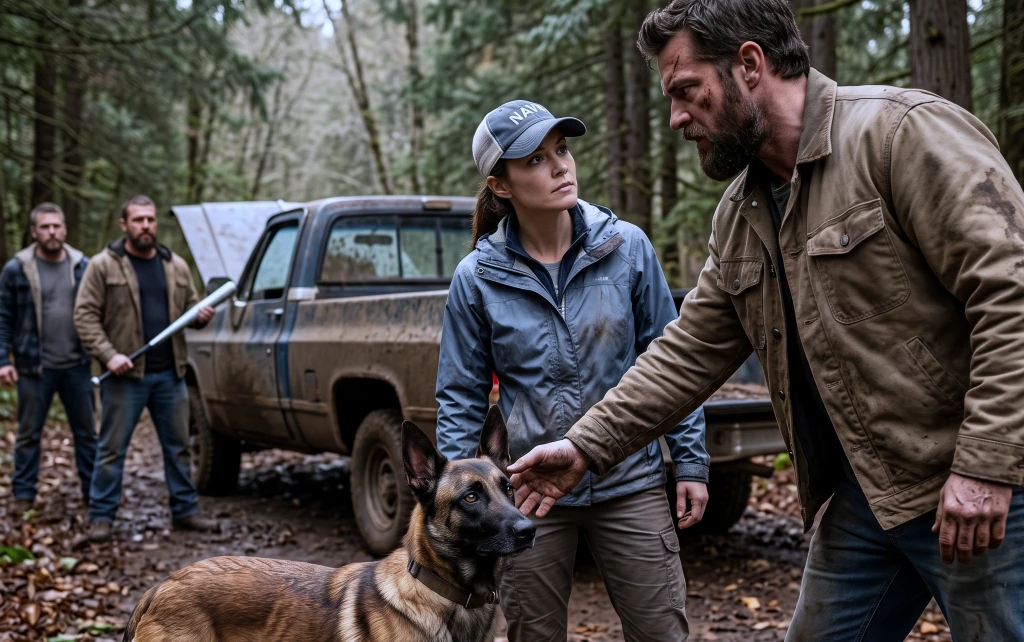
Mara Ellis followed his stare. A mud-caked pickup sat sideways across the path, its rear tires sunk into the soft shoulder. Three men waited around the open tailgate. One held an aluminum bat. Another kept touching the pocket of his canvas jacket as if checking that something was still there.
“Easy,” Mara murmured.
Atlas did not look at her, but the tip of his ear turned toward her voice. A pale seam crossed his left shoulder where surgeons had removed fragments years earlier. He was nine now, retired from military service and entitled to slow mornings, expensive joint supplements, and every patch of sunlight in Mara’s house.
She had promised him there would be no more bad doors.
The promise had begun beside a veterinary cot overseas, while Atlas lay sedated beneath a silver warming blanket. Mara had told him that if he woke up, she would find him a life with grass under his feet and no one shouting through a radio. He woke, then returned to limited duty because neither of them knew how to stop when they were needed. When his retirement finally came, Mara signed the adoption papers before sunrise and drove him home herself.
Quiet had not arrived simply because the orders ended. Atlas still lifted his head when a pan struck the kitchen floor. Mara still chose restaurant seats that faced the door. Their weekly hikes were not an escape from that truth so much as practice living beside it.
The man in the middle slid off the tailgate. He was thick through the chest, with a graying beard and the restless confidence of someone accustomed to making other people back down. His two companions spread apart without being told.
“Trail’s closed,” he said.
Mara glanced behind her. The path dropped steeply for a hundred yards before bending out of sight. Turning around would have been easy if the men had stayed where they were. Instead, the thin one moved to her left, cutting off the wider shoulder, while the man with the bat stepped onto the trail behind her.
“This is public land,” Mara said. “Move the truck enough for us to pass, and we’re gone.”
The bearded man smiled. “You hear that, Cal? She’s giving instructions.”
Cal tapped the bat against his boot. The third man laughed too quickly, his eyes never leaving Atlas.
Mara lowered her hand beside the dog’s neck. She wore a faded rain shell, trail pants, and an old Navy cap with the stitching nearly washed white. Nothing about her suggested what she had once done for a living, and that was how she preferred it.
She had entered the Navy at nineteen and become a military working dog handler. Later, she and Atlas had been assigned in support of teams whose names rarely appeared in public. She had not been a movie version of a commando. She had searched buildings, read a dog’s breathing in the dark, and learned how quickly an ordinary doorway could become the last thing someone saw. The work had also required years of training in weapon retention and close-quarters survival, because a leash never protected a handler from the person at the other end of a room.
Now she rehabilitated working dogs that had forgotten how to live in quiet houses. On Saturday mornings, she and Atlas walked the wooded ridges east of Portland because the forest asked nothing of either of them.
The bearded man looked at Atlas’s scar. “That dog trained?”
“He’s retired.”
“Retired from what?”
Mara did not answer.
The thin man took another step. “A dog like that’s worth money.”
Atlas’s breathing changed. It was almost nothing—one slower draw through the nose—but Mara felt the shift through her fingertips.
“Don’t come closer,” she said.
The bearded man’s smile thinned. “Name’s Wade. Since we’re getting acquainted, you can hand over your phone and your wallet. Then maybe we talk about the dog.”
Mara looked at each of them in turn. Cal with the bat. The thin man, Neal, judging by the name Wade used when he told him to circle wider. Wade himself standing beside the truck, one hand resting near his waistband.
“I don’t want to hurt anybody,” she said.
Cal barked out a laugh. “That’s good.”
“No,” Mara said. “It’s a warning.”
For the first time, uncertainty crossed Wade’s face. It lasted less than a second, then pride closed over it.
“Take the dog,” he told Neal.
Neal reached toward Atlas’s collar.
Mara moved between them. “Last warning.”
Cal swung the bat.
She heard it cut through the air and stepped in instead of away. Her forearm caught his wrists before the swing gathered force. She drove her shoulder into his chest, turned with his momentum, and sent him hard onto the trail. The bat spun into the ferns.
Cal tried to rise. Mara planted a boot beside his shoulder and told him not to.
Neal came at her with a folding knife. His fear made him fast and careless. Mara knocked his arm aside, trapped it against the truck, and forced the knife from his hand. He struck at her with his other fist. She ducked, shoved him into the tailgate, and swept his legs from under him.
He hit the ground and stayed there, stunned and wheezing.
Atlas had not moved.
Every muscle in his body trembled with the effort of obeying. He watched Mara, not the men, waiting for the word that had governed his whole working life.
Wade stared at Cal and Neal as though they had betrayed him by falling. Then his hand disappeared beneath his jacket.
Mara saw the revolver before the barrel cleared his waistband.
“Don’t,” she said.
Wade pulled anyway.
“Atlas—arm.”
The dog crossed the distance in a blur and struck Wade high enough to turn him sideways. His jaws closed over the heavy sleeve around Wade’s forearm, pinning the gun hand against the pickup. The revolver dropped into the mud.
Wade screamed and tried to wrench free. Atlas held without shaking, exactly as he had been trained, his eyes still on Mara.
“Stop fighting him,” she said. “He’ll stop when you do.”
Wade froze. His breath came in short, frightened bursts.
Mara kicked the revolver out of reach, picked it up by the grip, and opened the cylinder. She emptied the cartridges into her pocket before setting the weapon on the truck’s roof.
“Out,” she told Atlas.
He released immediately and backed to her side. A strand of saliva hung from his jaw. Mara crouched, ran both hands over his muzzle and neck, then pressed her forehead briefly to the top of his head.
“You’re okay,” she whispered. She needed to hear it as much as he did.
Behind her, Wade cradled his arm. The sleeve was torn, but the thick jacket had taken much of the bite. Cal was sitting up slowly, one hand pressed to his ribs. Neal had a split lip and the stunned expression of a man who had just discovered that intimidation was not a plan.
Mara retrieved her satellite communicator from her pack. There was no cell signal in the hollow, but the device connected overhead. She triggered the emergency function and typed a short message with the location, the number of injured men, and the recovered firearm.
Then she opened her first-aid pouch.
Wade stared at her. “You’re helping us?”
“I’m keeping you alive until the sheriff gets here.”
“You think they’re coming for this?” His laugh sounded thin. “You don’t know what you walked into.”
Mara wrapped Cal’s wrist after he complained that he had landed on it. She checked Neal’s pupils and made him sit against a tire where she could see both hands. Wade refused treatment until Atlas looked at him; then he allowed Mara to wrap his forearm over the torn sleeve.
She used two ratchet straps from the pickup bed to secure the men’s ankles, loose enough not to cut circulation but tight enough to stop them from running. Wade watched every movement with mounting panic.
“You need to leave,” he said.
“You blocked the trail.”
“I’m serious.”
“So am I.”
Mara reached into the bed for another strap. A folded tarp lay beneath a stack of oily moving blankets. When she pulled the strap free, one corner of the tarp slid away.
Under it sat three hard-sided transit cases the color of dull green stone.
They were not toolboxes. Mara recognized the recessed latches, the tamper seals, and the stenciled inventory panel before she fully uncovered the first case. A government property plate was bolted to the side. Beneath the serial number, a red warning label identified the contents as controlled explosive material.
For a moment, the trail narrowed to that one rectangle of red.
Mara photographed the plate with her communicator and sent it through the emergency channel. “Where did you get these?”
No one answered.
She turned to Wade. The swagger had left him completely.
“Who are you meeting?”
Wade looked past her, down the trail.
At first Mara heard only wind moving through cedar branches. Then came the low, climbing sound of engines below the switchback—two vehicles, moving fast. Wade swallowed. “You wanted the sheriff,” he said. “Those aren’t the sheriff…”
To read the rest of the story – CLICK the NEXT button 👇👇👇