


The dog at the bus shelter lifted his head when Daniel Mercer said a name no one had heard him use in eleven months. “Ranger?”
Mike Alvarez glanced across the cab of his SUV, then back through the rain-smeared windshield. Traffic crawled along Second Avenue under a low November sky, brake lights bleeding red across the wet pavement. Mike was driving Daniel home from another spinal-rehabilitation appointment, the sort that measured progress in inches and sent him away with new exercises he had no intention of doing. Beneath the plexiglass shelter, a German shepherd lay folded against the metal bench, so thin and mud-darkened that he might have been a pile of discarded blankets.
Daniel gripped the door handle. His wheelchair was collapsed in the cargo area, beyond his reach, and for one furious second his body forgot what had happened to it. His shoulders pitched forward as if his legs might still answer.
“Pull over.”
“Danny, we’re in the right lane.”
“Pull over now.”
Mike heard something in his voice and stopped arguing. He cut across toward the curb, earning a horn from the sedan behind them, and braked beside the shelter. Rain hammered the roof. Daniel lowered the window, and cold water struck his face.
“Ranger!”
The shepherd’s ears moved. Not much—one small, uneven twitch—but Daniel saw it. He had watched those ears turn toward whispered commands in crowded train stations, abandoned houses, and dark stretches of riverbank where frightened families waited for news. He knew the right ear carried a narrow notch near the tip from a training accident with barbed wire. Even through the rain, even beneath mats of filthy fur, he thought he could see it.
Mike leaned toward the windshield. “It’s a stray, Danny.”
“No.” Daniel’s hand shook against the door. “Get my chair.”
Eleven months earlier, Daniel had awakened in a hospital with a fractured spine, burns along his left arm, and no feeling below his waist. He had asked one question before he asked whether he would walk again.
Where was Ranger?
The answer had arrived in the careful silence of three fellow officers and the way Deputy Chief Hayes kept looking at the floor. The old machine works in Hazelwood had burned for six hours after the gas explosion. Part of the roof had come down between Daniel and his K-9 partner. Fire crews had found no body, but they had found no survivable space either.
Daniel had spent months refusing the word dead. He called shelters from his hospital bed, searched rescue pages until the letters blurred, and made Mike drive him past the fenced ruins after every follow-up appointment. Eventually, the calls became pitying. His physical therapist stopped mentioning closure, and his sister quietly removed Ranger’s untouched bowl from the kitchen.
Daniel put it back the next morning.
Now the dog beneath the shelter raised his head another inch. One eye caught the gray light. The other was nearly hidden by wet fur and a swollen lid, but the visible eye was amber—not proof, not even close, yet familiar enough to make Daniel’s chest hurt.
Mike opened his door. “Stay put. I’ll take a look.”
“I’m coming.”
“It could be scared. It could bite.”
“He won’t bite me.”
Mike’s jaw tightened, but he went to the rear hatch and pulled out the chair. By the time he returned, Daniel had already dragged his transfer board across the seat. The movement sent a sharp bolt through his damaged back, and Mike swore under his breath while helping him settle into the chair.
“You’re going to soak through in thirty seconds.”
Daniel locked his hands around the rims. “Then move.”
The sidewalk tilted toward the street, slick with leaves and oily rain. Mike held the handles while Daniel pushed, both of them fighting the uneven concrete. The shepherd watched them come. He did not growl or flatten his ears. He simply stared at Daniel with the exhausted concentration of an animal trying to place a sound from a life it could no longer reach.
Up close, the dog looked worse. His ribs made hard ridges under his coat. The pads of his feet were split, and one rear leg lay at an awkward angle as if an old injury had healed without help. Beneath the smell of wet fur and city grime, Daniel caught another scent—faint, acrid, impossible to mistake: smoke. He stopped two feet away. “Hey, buddy.”
The dog’s nostrils widened.
Daniel lowered his voice to the tone he had once used in dark rooms and crowded alleys. “Ranger. With me.”
For seven years, those words had brought a ninety-pound shepherd to his left knee. Ranger had been the hardest dog at the regional training center, too alert for one handler, too stubborn for another. On Daniel’s first day, the young shepherd had ignored every offered treat, paced the fence twice, then sat in front of him and looked up as though the decision had already been made.
They learned each other from there. Daniel learned that Ranger hated puddles but would cross a flooded culvert on command. Ranger learned that one lift of Daniel’s eyebrow meant wait, even when every muscle in his body wanted to run. Together they found a six-year-old boy asleep beneath a fallen tree in Frick Park, tracked an armed robbery suspect through three blocks of backyards, and spent long night shifts sharing the silence inside a patrol SUV.
Ranger was listed on department forms as equipment assigned to Unit K-9-4. At home, he slept beside Daniel’s bed.
The dog at the shelter tried to move. His front paws scraped against the concrete, and his chest lifted before his hindquarters gave way. A sound came from him, low and rough, more breath than whine.
Daniel forgot the rain running into his eyes. “Easy. You don’t have to get up.”
The shepherd pulled himself forward anyway. Mike crouched beside the chair, his expression changing as the dog crossed the first few inches. “Danny…”
“I know.”
“No, look at the left ear.”
The fur shifted. There it was: a small V-shaped notch near the tip, old and clean-edged. Daniel had held gauze against that ear years ago while Ranger glared at the world for allowing a fence to win.
Still, the rational part of him resisted. There were thousands of shepherds with amber eyes. Scars repeated themselves. Grief could make a man build a bridge out of almost nothing and call it truth.
Then the dog reached the front wheel.
He pressed his nose against the rubber, inhaled once, and went still. Daniel watched recognition move through him—not like excitement, but like pain easing. The shepherd’s eyes closed. His tail, little more than a muddy rope, struck the pavement once.
Daniel bent as far as his back allowed. “It’s me.”
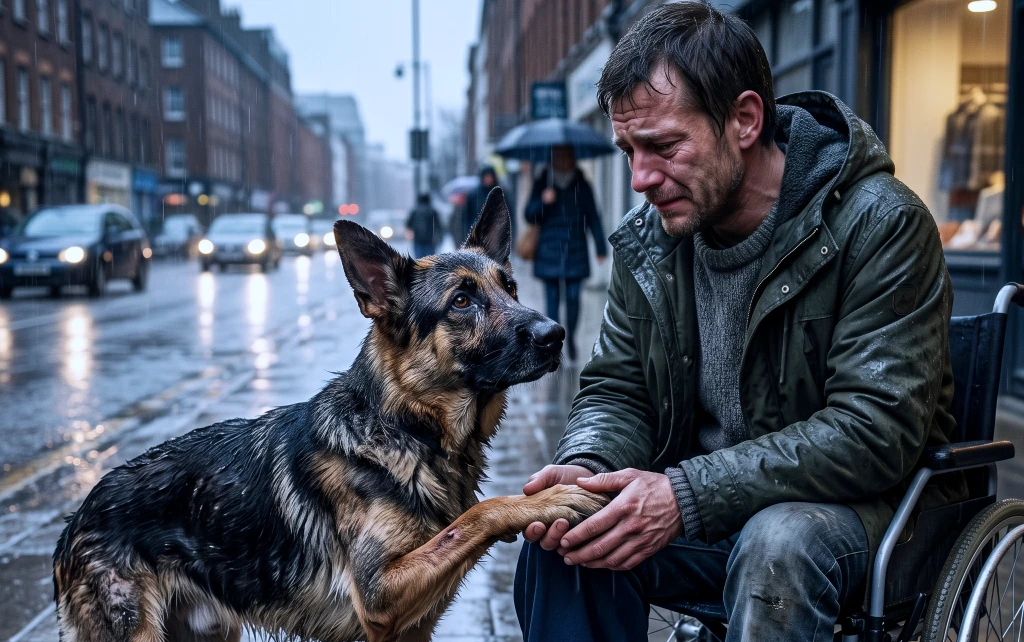
The dog opened his eyes again. Slowly, with a tremor running from shoulder to paw, he lifted his right front leg and placed it against Daniel’s knee.
Mike sat back on his heels.
Ranger had done that since training school. After difficult searches, after gunfire, after Daniel returned from a briefing angry or shaken, the dog would put one paw on his leg and wait. The unit’s handlers joked that Ranger was checking his officer for damage.
Daniel covered the paw with both hands. It was cold, scarred, and frighteningly light.
“Oh, God,” Mike whispered.
Daniel could not answer. He lowered his forehead until it touched the dog’s damp muzzle. Ranger’s breath came hot and sour against his skin. For months Daniel had dreamed of this face through smoke, always waking before he could reach it. Now the bones beneath his palms were real.
“I’m sorry,” he said. “I’m so sorry.”
The memory he had tried to bury returned without permission: an abandoned machine works beside the Monongahela, three copper thieves cutting apart old industrial lines, the chemical hiss Ranger noticed before anyone else. One man ran. Another swung a steel bar. Ranger launched, Daniel shouted, and a damaged gas line found the open flame of a torch.
The blast threw Daniel into a concrete column. When he woke beneath fallen debris, his legs were pinned and the warehouse was burning around him. Ranger had been on the other side of a curtain of flame, limping toward Daniel despite the command to get back.
Then the roof came down between them.
Daniel had heard one bark after that. Only one.
At the shelter, Ranger shifted his head and pushed weakly into Daniel’s hands. Mike reached toward the dog’s side, then stopped.
“His coat’s hiding something.”
Daniel followed his gaze. Along Ranger’s left ribs, wet fur clung to a wide patch of puckered skin. The scar ran from shoulder to flank in pale, irregular bands. Lower down, smaller marks crossed his belly and foreleg—old burns, unmistakable now that he was close enough to see them.
Daniel’s breath left him. There was no longer room for coincidence.
He slid his fingers carefully beneath the matted fur at Ranger’s neck. Something hard knocked against his knuckle. The collar was almost gone, reduced to a blackened strip fused with dirt, but a metal tag still hung from one twisted ring.
Mike used the sleeve of his jacket to wipe it clean, and the stamped letters appeared one at a time.
PITTSBURGH POLICE K-9
RANGER — 417
Daniel closed the tag inside his fist. Ranger had carried it through fire, winter, traffic, and whatever had happened in the missing months between. He had carried his name when no one else knew he was alive.
“Call the emergency clinic,” Daniel said.
Mike was already reaching for his phone.
Ranger’s paw slipped from Daniel’s knee. His body sagged against the footplate, and the shallow rise of his ribs stopped long enough for Daniel to count one second, then two.
“Ranger?” Daniel gathered him closer, feeling almost no weight at all. “Mike, tell them we’re coming. Tell them he’s crashing…”
To read the rest of the story – CLICK the NEXT button 👇👇👇