


The cardboard sign had gone soft in the snow, but the two words were still legible. FOR SALE. It hung by a piece of twine from a rusted wire crate beside a bus shelter on Cleveland’s West 25th Street. Inside, a German shepherd had folded herself around two puppies so completely that, at first, Daniel Mercer thought he was looking at one dark, trembling shape. Then one of the puppies moved. A paw no bigger than Daniel’s thumb slid through the mother’s fur and went still again.
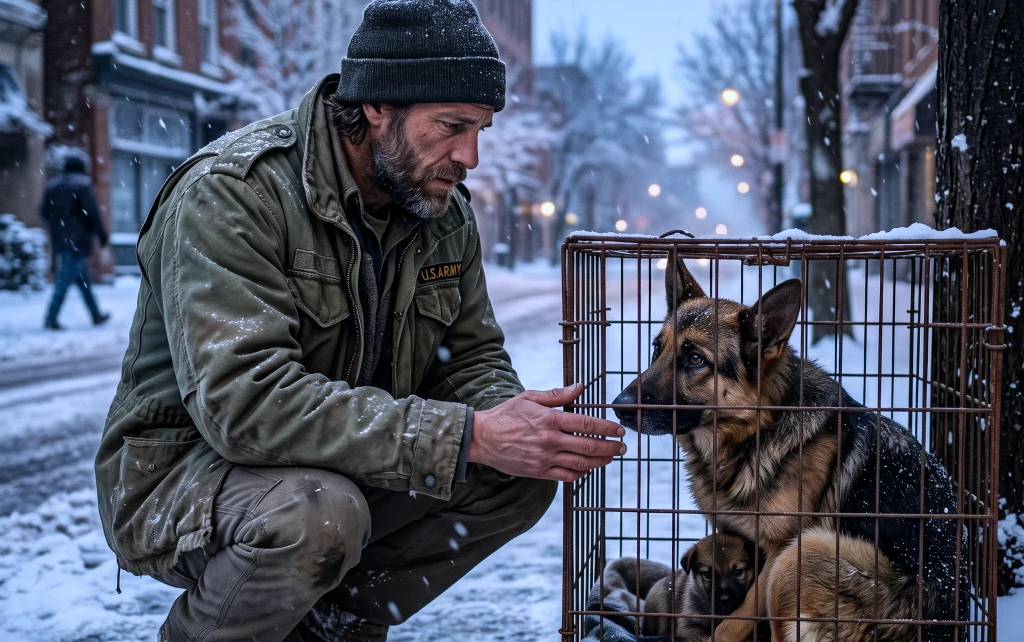
People stepped around the crate without breaking stride. A man carrying a paper cup glanced down, tightened his scarf, and kept walking. Two women in hospital scrubs hurried toward the train station, their shoes grinding salt into the sidewalk. A city bus pulled in, sighed at the curb, and left behind a cloud of diesel that briefly erased the dogs from view.
Daniel stopped.
He had left his apartment before dawn because sleep had become a room he could enter but never stay in. Three months earlier, the Army had medically retired him after seventeen years. Since then, mornings arrived with the hum of the refrigerator, the rattle of pipes, and the sharp certainty that no one needed him to be anywhere.
Walking gave the hours a shape. He could count blocks, watch intersections, feel the old injury in his left hip loosen as he moved. It was not a mission, but it kept him from sitting in the dark with the framed photograph he had turned facedown on his dresser.
Now snow gathered on the shoulders of his faded field jacket while he stared at the crate.
The shepherd lifted her head. Her ears came forward, then flattened. She did not growl. She simply tightened her body around the puppies and watched him with the exhausted focus of an animal that had no strength left to waste.
Daniel crouched several feet away. “Easy,” he said. His voice came out rough from disuse, so he tried again. “I’m not coming any closer.”
The dog’s breath fogged the narrow space between the bars. Ice clung to the tips of her whiskers. A nylon collar had cut a dark groove into the fur at her throat, and one hind leg was streaked with dried blood.
He looked up and scanned the sidewalk, the bus shelter, the closed laundromat across the street. “Anybody know who left these dogs?”
No one answered. A woman in a red coat slowed long enough to say, “That’s awful,” then crossed with the light.
Daniel took out his phone and called the city’s animal-control line. The dispatcher sounded alert but overwhelmed. A lake-effect storm had caused two crashes involving livestock trailers, and every available officer was already out.
“Can you get them somewhere warm?” she asked. “Don’t force the crate open if the mother’s defensive. If you can safely transport them, the emergency clinic on Lorain is expecting weather cases.”
“I can transport them.”
“Sir, I need you to be sure.”
Daniel looked at the puppy whose paw had slipped free. Its ribs moved once, shallowly. “I’m sure.”
A bell chimed behind him. The owner of the corner coffee shop had come outside without a coat, carrying two fleece blankets. She was in her early forties, with a knit cap pulled over dark curls and the strained expression of someone who had just understood what she had been seeing through the window.
“I thought it was an empty crate,” she said. “Oh, God.”
“Do you have security cameras facing the sidewalk?” Daniel asked.
“Yes. One over the door and one on the awning.”
“Save the footage from last night. Don’t overwrite it.”
The woman nodded quickly. “I’m Claire. Claire Brooks.” She held out the blankets, then seemed to realize his hands were occupied. “What can I do?”
“Stand where she can see you. Move slowly.”
Claire knelt on the other side of the crate. Together they draped one blanket over the top and windward side, leaving the front open. The dog flinched at the movement, but Daniel kept talking in the same low tone until her ears eased forward again.
Up on the third floor of the brick apartment building, Ruth Bennett stood at her kitchen window with both hands around a mug of tea. She had noticed the crate before sunrise and had spent the last hour telling herself that someone must be coming back for it. At seventy-two, she had become skilled at finding reasonable explanations for things she was afraid to know.
Then the tall man in the army jacket stopped, and the lie she had been telling herself became impossible to maintain.
Ruth recognized the way he held still. Her husband, Thomas, had stood like that after Vietnam—quiet not because he was calm, but because every part of him was listening for danger no one else could hear. She watched Daniel remove one glove and rest his bare hand against the snow a few inches from the crate.
The shepherd stared at his fingers. For several seconds, nothing happened. Then she stretched her neck and touched her nose to his knuckles through the bars.
Daniel closed his eyes.
The contact lasted less than a second, but it reached a place in him that conversation had not. The dog had no reason to trust him. Whatever had happened before the bus shelter had taught her the opposite. Still, with her body shaking and her puppies under her chest, she had spent the last of her courage on that small decision.
“All right,” he whispered. “I won’t waste it.”
The crate had been secured with two plastic ties and a bent padlock that was not actually fastened. Daniel borrowed a pair of cutters from Claire’s shop, clipped the ties, and opened the rear hatch of his old blue Ford Escape. He placed folded blankets across the cargo area, then lifted the crate with Claire supporting the far end.
It was heavier than it looked. The shepherd shifted, trying to keep the puppies beneath her, and a thin whine escaped her before she could stop it.
“I know,” Daniel said. “We’re moving. That’s all.”
The emergency clinic was less than three miles away, but a collision had closed Lorain Avenue. Traffic barely moved, and the clinic called to warn him that their exam rooms were full. A technician stayed on the phone while Daniel drove, asking about the dogs’ breathing and gum color.
“Get them indoors,” she finally said. “Warm them gradually. No heating pad directly against them, and don’t give the mother a large meal all at once. We can see you at eight when the day staff comes in. Bring them sooner if any of them stops responding.”
Daniel’s apartment was closer than the clinic. It occupied the ground floor of an old duplex in Clark-Fulton, a place with narrow rooms, uneven floors, and a furnace that complained whenever the temperature dropped below twenty. He carried the crate inside and set it near a radiator, far enough away that the heat would not overwhelm them.
For the next hour, he worked with the careful economy that had once made other soldiers trust him in bad situations. He warmed towels in the dryer. He filled a bowl with water and set it within reach. He found a can of chicken in the back of a cupboard, rinsed off the seasoning, and offered the shepherd a few pieces at a time.
She waited until he backed away before eating. Even then, she swallowed one piece and nudged the next toward the puppies.
“They’re not ready for that,” Daniel told her. “You have to keep some.”
Her eyes stayed on him while she ate the rest.
The larger puppy began to stir first, crawling over his sibling with a determination that seemed impossible in such a small body. The second puppy remained tucked against the mother’s belly, breathing fast but regularly. Daniel sat on the floor with his back against the wall and watched all three of them as daylight slowly found the windows.
The apartment did not look different. The same unopened mail sat on the counter. The same mug had been in the sink for two days. Yet the silence had changed. It now held the soft scrape of claws against fleece and the faint, wet sounds of puppies nursing.
A knock came shortly after seven.
Daniel froze before he could stop himself. The shepherd raised her head, and the larger puppy burrowed under her front leg. No one came to his door without calling first, mostly because no one came at all.
He checked the peephole. The older woman from the third-floor window stood in the hall holding a covered pot and a grocery bag.
“I saw you bring them in,” Ruth said when he opened the door. “I hope that doesn’t sound like I spend my life spying on the street.”
Daniel looked at the pot. “Depends what’s in there.”
“Chicken and rice soup.” Her mouth tilted. “So I prefer the word observing.”
He stepped aside.
Ruth entered slowly, taking in the bare walls, the folded cot in the second room, and the single photograph turned facedown on the dresser. She did not comment on any of it. When she saw the dogs, her face softened so quickly that Daniel had to look away.
“Oh, sweetheart,” she murmured.
The shepherd watched her approach but did not bare her teeth. Ruth placed the grocery bag on the floor several feet away. Inside were puppy formula, two stainless-steel bowls, and a package of soft towels.
“My husband and I had a golden retriever,” she explained. “I kept some things after she died, though I couldn’t have told you why. The formula is new. I called the pharmacy and made them read the date to me twice.”
Daniel lifted the lid from the pot. Steam rose into the cold kitchen. “You didn’t have to do this.”
“No,” Ruth said. “That is usually when doing something matters most.”
She sat in the worn chair while he ate. The soup was simple—chicken, carrots, celery, rice—but the first spoonful made him realize how long it had been since someone had cooked with him in mind. Ruth pretended not to notice when he finished the bowl too quickly.
The larger puppy crawled out from the blanket and bumped into her shoe. Ruth bent with a quiet laugh and let him sniff her fingertips.
“That one thinks he’s in charge,” she said.
“He weighs maybe three pounds.”
“Authority has never depended on size.”
The smaller puppy gave a thin squeak. Daniel immediately set down his spoon and crossed the room. He lifted the edge of the blanket, checked the puppy’s breathing, and rested two fingers against its chest until the tiny heartbeat steadied beneath them.
When he looked up, Ruth was watching him with an expression he could not name.
“You’ve done this before,” she said.
“Not this.”
“But something close.”
Daniel adjusted the blanket. “Close isn’t the same.”
Ruth did not push. She rose, rinsed his bowl, and wrote her phone number on the back of an envelope by the sink. Before leaving, she paused beside the shepherd.
“You chose well,” she told the dog, glancing toward Daniel. “He looks difficult, but I think he can be trained.”
For the first time in months, a laugh surprised its way out of him.
At eight, Daniel loaded the crate back into the Escape. Ruth came downstairs to help, and Claire met them at the curb with a flash drive containing the overnight security footage. She also handed Daniel a paper cup of coffee.
“Black,” she said. “You looked like a black-coffee person.”
“I look that predictable?”
“You look like cream would offend you.”
The veterinary clinic occupied a narrow storefront between a bakery and a tax office. Inside, the air smelled of disinfectant and wet fur. Dr. Maya Chen, a compact woman with silver-framed glasses and a calm, direct manner, brought them into an exam room before Daniel finished the intake form.
She examined the puppies first. They were about five weeks old, underweight and chilled, but both had strong heartbeats. The smaller one would need supplemental feeding. The mother was dehydrated, badly nourished, and covered in old abrasions beneath her coat. Her body told a history her eyes did not need to explain.
“She’s had several litters,” Dr. Chen said quietly. “Too many, too close together. See the hair loss here and the thickened skin around her neck? She was tethered for long periods.”
Daniel kept one hand on the dog’s shoulder. “Will she recover?”
“With time, food, and follow-up care, I think so.” Dr. Chen ran a scanner slowly over the shepherd’s back. “Let’s see whether anyone bothered to register her.”
The scanner chirped near the left shoulder.
The dog flinched. Daniel leaned close enough for her to smell him. “You’re all right.”
Dr. Chen copied the number into the national registry and waited. Her expression changed as the record loaded. She checked the digits, scanned the dog again, and then turned the monitor slightly away as if that might alter what it said.
“What?” Daniel asked. The veterinarian looked from the screen to the shepherd, who had lowered her head onto Daniel’s wrist. “Her name is Sadie,” Dr. Chen said. “She was registered to a commercial breeder outside Lorain.” Daniel waited. Dr. Chen drew a slow breath. “According to this record, Sadie has been dead for eighteen months…”
To read the rest of the story – CLICK the NEXT button 👇👇👇