


At 11:47 on Christmas Eve, the southeast camera sent Mara Ellison a picture of five men standing outside her fence. They were not lost. Lost people clustered together, argued over maps, and looked for a road. These men had spread themselves along the timber in quiet intervals, leaving one man behind to watch the trail while another pressed a gloved hand against the new steel gate. Two carried rifles low against their bodies. A third held a compact pack shaped for tools rather than food.
Mara set down her coffee and enlarged the image. Snow moved sideways through the camera’s infrared glow, whitening their shoulders and erasing the tracks behind them. One man crouched beside a fence post, studying the cable that fed her motion sensor. When he found the camera, he looked straight into it and smiled.
The cedar star in Mara’s window caught the reflection from the monitor. Ruth Calder had carved it for her two months earlier and left it beside a covered dish on the porch, along with a note that read, You’ll need both when winter turns mean. The star looked delicate in the glass. The men beyond it did not.
Mara opened the live feed and listened. The microphone carried wind, the rub of branches, and a low burst of laughter.
“New owner spent money,” one of them said.
“New owner scares easy,” another answered.
Mara’s face did not change. She had spent most of her adult life learning that fear became useful only after it was measured. She counted bodies, marked weapons, and studied the way they handed responsibility from one man to another without speaking. The habits were old enough to feel less like memory than posture.
On paper, Mara was thirty-six, honorably discharged, and living alone on four hundred acres above Ridgeway, Montana. Before that, she had been an Army captain attached to a special operations reconnaissance unit, where her team had called her Echo Three. She had spent years observing people who believed darkness made them invisible.
Seven winters earlier, bad intelligence had sent her team into the wrong valley. Sergeant Jonah Reed, her observer and closest friend, had died before the extraction aircraft reached them. The official review used phrases such as operational uncertainty and incomplete reporting. Mara remembered the snow in Jonah’s eyelashes and the way he had tried to apologize for leaving her there.
Afterward, the Army offered her a staff assignment, then an instructor’s post. Everyone spoke carefully, as though the right job title might make the past feel orderly. Mara left instead. She bought Sable Ridge because the nearest neighbor was three miles away and the access road appeared on county maps as a broken gray line.
She had not come to the mountain to prove she could survive alone. She had come because solitude did not make promises it could not keep.
The man at the post stood and tugged twice on the wire. Another stepped close to the gate and shone a covered flashlight along the hinges. They were not trying to enter yet. They were learning what entering would require.
Mara called the county dispatch line and gave her address, the number of men, and the direction from which they had approached. The dispatcher asked her to repeat the road name, then warned that the closest unit was handling a rollover south of town.
“Are they threatening you?” the woman asked.
“They’re armed and testing my gate.”
“But they haven’t crossed it?”
“Not yet.”
The word sat between them. The dispatcher promised to log the call and send someone when a unit cleared. Mara thanked her, ended the conversation, and saved the footage in three places.
Outside, the man who had smiled at the camera tied a strip of orange survey ribbon to the fence. Then the five of them withdrew into the trees with the same unhurried confidence they had brought with them.
No deputy came that night.
By dawn, the storm had softened. Mara drove down the mountain with printed stills in a manila envelope and a thermos she never opened. Ridgeway’s storefronts were trimmed in white lights, and families crossed Main Street carrying foil-covered pans toward the church hall. The county sheriff’s office sat two blocks away in a low brick building that smelled of burnt coffee and wet wool.
Deputy Evan Price was working the front desk. He looked young enough that the skin beneath his eyes had not yet learned the permanent fatigue worn by older officers. He listened while Mara described the men, then glanced through the photographs too quickly.
“Could be hunters,” he said. “Weather came in hard last night. People get turned around up there.”
“They moved in a security pattern.”
Evan looked at the nearest image again. “That’s hard to establish from a still photo.”
“I have video.”
“Did they damage anything?”
“They tested the gate, inspected the sensor line, and marked the fence.”
He leaned back, trying for patience and landing closer to dismissal. Mara had heard that tone from men who mistook a quiet woman for an uncertain one.
“Ms. Ellison, a lot of that country borders public timber,” Evan said. “Folks have crossed those ridges for generations.”
“My deed is newer than their habits. It is not less valid.”
A gray-haired sergeant had stopped in the hallway behind Evan. His nameplate read WHITAKER. He did not interrupt, but his gaze moved from Mara’s notes to the time stamps on the photographs, then to the ruler she had placed beside a boot print for scale.
Evan slid a form across the counter. “I’ll take the report. With the roads the way they are, response up there could be slow. Don’t confront anybody.”
“I came here so I wouldn’t have to.”
That landed harder than she intended. Evan’s mouth tightened, and Sergeant Whitaker looked away first.
Mara left the report, kept her copies, and walked back into the cold. Anger would have been easier than disappointment. Anger burned clean. Disappointment had weight.
She found Ruth Calder at the Ridgeway Diner, sitting in the last booth with black coffee and a slice of pie she had not touched. Ruth was sixty-eight, broad-shouldered, and direct in the way of someone who had spent thirty years delivering rural mail through weather that made excuses irrelevant. She knew every ranch truck in the county and most of the lies attached to them.
Mara sat across from her and placed one photograph on the table.
Ruth’s expression changed before she touched it. “How many?”
“Five last night.”
“Then they were measuring you.”
“You know them?”
“Not their names. Their work.” Ruth turned the picture toward the window. “They call themselves guides when it suits them. They take elk out of season, cats when they can find them, anything somebody will pay to hang on a wall. They use private ground because owners are easier to frighten than federal wardens.”
Mara watched the older woman’s thumb press against the edge of the photograph. “Who runs it?”
“Grant Vale. Highline Outfitters. He donates to the winter coat drive and buys tables at every sheriff’s fundraiser. He lets other men carry the guns.”
“Why hasn’t anyone built a case?”
Ruth gave a quiet, humorless laugh. “People try. Then a fuel line gets cut. A dog disappears. A barn catches fire with no one around to see how. After a while, folks decide an elk carcass is not worth losing their home over.”
The waitress came by with a coffeepot. Ruth waited until she moved away, then lowered her voice.
“You didn’t buy an ordinary piece of ground, Mara. Sable Ridge sits over the winter migration route. If Vale loses that corridor, he loses the easiest road into three drainages.”
Mara looked through the diner window toward the dark shoulder of the mountain. She had chosen the property because it offered distance, water, and only one maintained road. She had not asked who else depended on its silence.
Ruth studied her. “Tell me something honestly. Are you trying to keep men off your land, or are you looking for a war that feels simpler than the last one?”
Mara’s first answer rose too quickly, which was how she knew it was not the truth. She wrapped both hands around the untouched coffee the waitress had poured.
“I want them to leave,” she said.
“That wasn’t my question.”
“No.” Mara met her eyes. “It wasn’t.”
The drive home took nearly an hour. Fresh snow filled the ruts as fast as her tires made them, and the mountain disappeared in sections behind veils of white. She saw the shape at her gate from fifty yards away.
A mule deer doe hung from the crossbar by its hind legs. The animal had been cleaned elsewhere and brought there only to be seen. Orange survey ribbon had been knotted around one leg, the same bright strip the men had tied to her fence the night before.
Mara stopped the truck but did not get out immediately. Her hands rested at ten and two on the steering wheel. The doe turned slightly in the wind, one foreleg brushing the metal with a soft, repeating tap.
Not a hunt. Not waste. A sentence written in flesh.
She photographed the scene, called the state wildlife tip line, and cut the animal down. The work took time because she refused to let disgust make her careless. She covered the carcass with a tarp in the truck bed for the warden, removed the orange ribbon, and checked the gate for damage.
The sensor cable had been disconnected and reattached so neatly that most people would never have noticed.
Mara noticed.
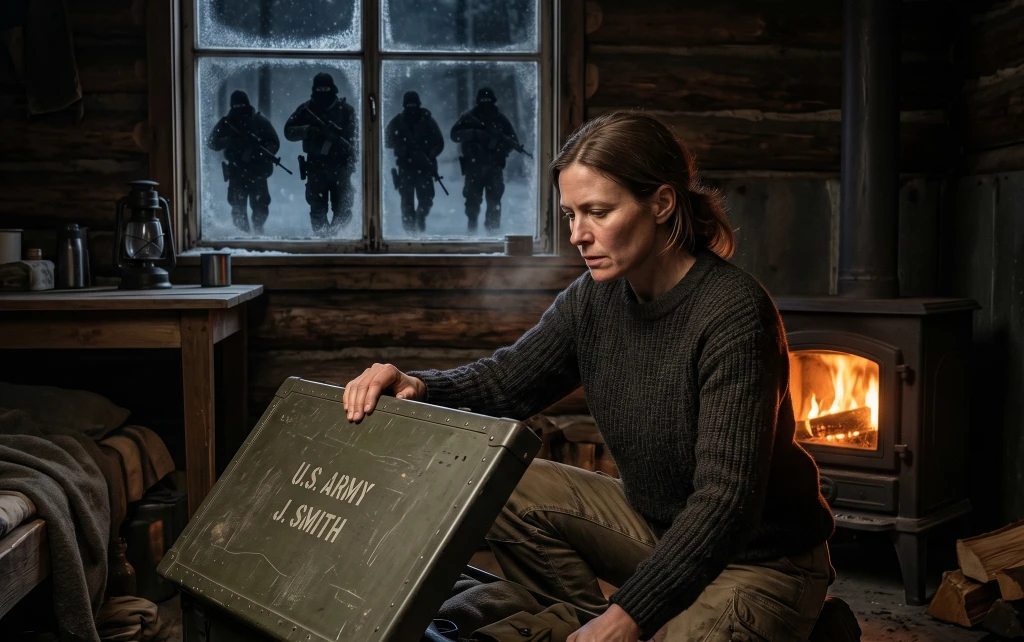
Inside the cabin, she locked the door and stood beside the woodstove until feeling returned to her fingers. The cedar star trembled faintly in the window whenever the wind struck the glass. She looked at it, then at the steel footlocker beneath the workbench.
She had not opened the locker since moving to Sable Ridge. The rifle inside was legal, maintained, and stored with the care of something she hoped never to need. Beside it lay Jonah Reed’s small field compass, returned to her with his effects because his mother had said Mara would understand what it meant.
Mara set the compass on the table. The needle swung once and settled north.
Her phone vibrated.
East boundary.
Before she could open the feed, a second alert appeared from the north trail. Then a third from the western draw.
Twelve figures moved across three camera screens, already inside the posted line. They advanced toward the cabin in separate groups, their lights covered, their rifles ready. One man stopped beneath the camera and lifted his weapon toward the house. The porch light exploded before Mara heard the shot…
To read the rest of the story – CLICK the NEXT button 👇👇👇