


The gray bundle in the road moved just as Mara Bennett’s headlights found it. She slammed on the brakes. Her SUV shuddered across the ice and stopped less than six feet from a tiny animal curled in the center of the lane. The bouquet of sunflowers on the passenger seat struck the dashboard, scattering yellow petals across the floor. The clock read 4:14 p.m.
Three years earlier, at that exact minute and almost that exact spot, black ice had carried Mara’s SUV into a spruce tree. Her seven-year-old son, Noah, had been sitting on the passenger side. He died in a hospital before midnight while Mara held a hand so small that her fingers could close around it.
She had returned to Mile 114 every April 7 since then.
Until that afternoon, the ritual had never changed. Mara drove west from Kalispell with fresh sunflowers, stopped beside the white roadside cross she had fastened to the tree, and stood in the cold for exactly twenty minutes. Then she returned to the quiet house where Noah’s winter coat still hung in the closet and his bedroom door remained closed.
But now something was breathing in the road.
Mara switched on her hazard lights and stared through the windshield. Snow swept sideways across U.S. 2, erasing the mountains and most of the guardrail. The animal lifted its head, revealing a blunt muzzle and eyes that were barely open.
A wolf pup.
It couldn’t have been more than a few weeks old.
“No,” Mara whispered.
The pup tried to crawl. Its front paws moved, but its hindquarters dragged uselessly over the ice. A gust rolled it onto its side.
Mara grabbed her coat, emergency beacon, and the heavy leather gloves she had carried everywhere since the crash. She stepped into a wind that nearly took the door out of her hand.
The roadside cross stood twenty yards ahead, blurred by snow. One sunflower from the old plastic wreath still clung to it, faded almost white after a year of sun and weather. Beneath it, the shoulder dropped toward Black Pine Creek and a concrete drainage culvert swollen with spring runoff.
Mara crouched several feet from the pup. Its coat was wet to the skin, and ice had formed around its whiskers. It made no sound when she approached.
She knew enough not to touch it yet.
A wolf pup this young could not have traveled alone. Its mother had to be nearby, and a healthy female defending a litter would not hesitate because Mara happened to be grieving.
She scanned the shoulder.
At first she saw only drifting snow. Then a darker shape appeared beneath the guardrail, where the ditch widened near the trees. One pointed ear rose and disappeared.
Mara’s breathing stopped.
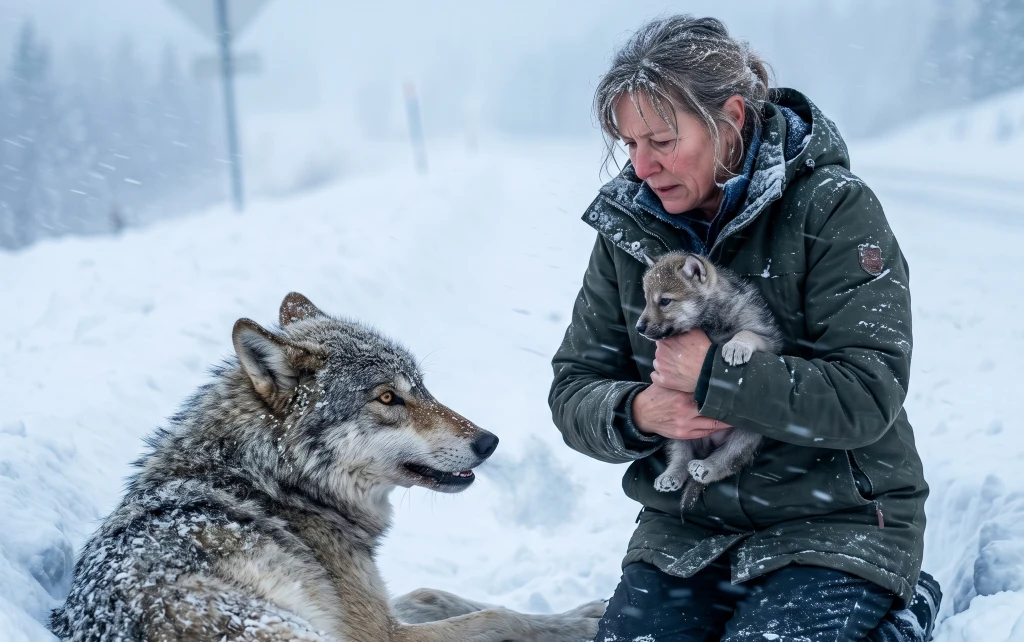
The adult wolf lay on her side against the frozen embankment. Her coat was silver-gray, dark along the spine, and matted with snow. One rear leg rested at an unnatural angle, although Mara could not tell whether it was broken or simply trapped beneath her. The wolf’s ribs moved in shallow, uneven pulls.
Farther down the ditch, close to the pavement, lay another motionless shape.
A large male.
Tire marks crossed the slush before vanishing under fresh snow. The male had likely been struck while crossing the highway. Whether the female had been clipped by the same vehicle or injured scrambling down the embankment, Mara could not tell.
Near the culvert, the bank had partially collapsed. Mud, broken branches, and chunks of frozen earth filled what might once have been a den. A trail through the snow suggested the female had dragged herself from that wreckage toward the road.
She had brought at least one pup with her.
Mara took out the emergency beacon and sent an SOS with her location. A reply came several minutes later through the satellite network: county responders had multiple crashes on the pass. A wildlife officer had been notified, but the estimated arrival time was more than an hour.
The message ended with a warning not to approach the adult animal.
Mara looked at the pup in the lane. Its breathing had become so faint that she had to watch the fur beneath its neck to see it.
An hour was not help. Not in that wind.
She moved back to the SUV and opened the rear hatch. After Noah’s crash, she had begun carrying enough emergency equipment for a small expedition: reflective cones, traction boards, a folding shovel, wool blankets, a plastic pet crate, water, flares, a first-aid kit, and silver thermal wraps.
Her former husband, Lucas, had once asked whether she truly believed disaster followed her personally.
Mara had not answered. Some beliefs sounded irrational only until you had watched a child die.
She placed the reflective cones behind the SUV, then set the plastic crate on the ground with a wool blanket inside it. When she approached the pup again, she kept her movements slow and her body turned slightly sideways.
The adult female raised her head.
A low growl vibrated through the ditch. It was not loud, but it stopped Mara where she stood.
“I know,” she said, though the wind tore the words away. “I’m not taking him from you.”
The wolf’s amber eyes remained fixed on her. Fear lived there, along with exhaustion and the last hard edge of an animal prepared to spend whatever remained of her strength.
Mara waited.
The female tried to rise. Her forelegs pushed against the snow, but her body lifted only a few inches before collapsing. The growl ended in a rough breath.
Mara looked toward the male in the ditch and understood enough of what had happened. The family’s shelter had failed. The male had reached the road first and died there. The female had followed, injured and carrying a pup away from the flooded bank.
Whether she had moved toward the highway because it was open ground or because headlights meant something to her, Mara could not know.
She only knew the pup had ended up directly in Mara’s path.
Three years earlier, people had stopped for her. A truck driver had climbed into the wreckage before the ambulance arrived. A nurse on her way home had knelt in broken glass and kept Noah’s airway open. Strangers had done everything they could, and still he had died.
For years, Mara had treated that ending as proof that trying had been meaningless.
Now the pup’s body trembled once and went still.
She crossed the last few feet.
The mother snarled, but her head dropped back into the snow. Mara slid both gloved hands beneath the pup, supporting its chest and hindquarters, and lifted it against her coat.
It weighed almost nothing.
She carried it to the crate, wrapped it loosely in the wool blanket, and placed a thermal cover around the outside so the material would not touch its skin directly. Then she positioned the crate on the back seat near a heating vent.
The adult was the harder problem.
Mara unfolded a heavy cargo tarp and spread it beside the wolf. She did not attempt to lift her. A frightened, injured predator could recover enough strength for one bite, and one bite would be enough.
She approached from behind the wolf’s shoulders, speaking in the same low tone she had once used when Noah woke from nightmares.
“I’m going to move you. I’m sorry, but I have to.”
The wolf watched her without blinking.
Mara slid the folded edge of the tarp beneath the animal’s back, then used the shovel to work the material under her body without bringing her hands near the jaws. The wolf groaned once. Mara stopped until the breathing settled, then continued.
It took nearly ten minutes to get the female onto the tarp.
By then Mara’s gloves were wet, her knees had gone numb, and sweat ran between her shoulder blades despite the cold. She wrapped the tarp around the wolf like a sling and began pulling her toward the SUV.
The distance could not have been more than thirty feet.
It felt endless.
The tarp caught on ice and exposed roots. Twice Mara slipped and struck the ground hard enough to jar her teeth. Each time the wolf attempted to push with her forelegs, as though some remaining instinct understood the direction of movement.
“Come on,” Mara gasped. “Just a little farther.”
She was not sure whether she was speaking to the wolf, to herself, or to the memory of a hospital room where she had begged Noah to keep breathing.
At the bumper, Mara lowered the rear seats and used a traction board as a ramp. She pulled the tarp upward while the wolf weakly scraped at the board. Inch by inch, the animal slid into the cargo area.
When the wolf was finally inside, Mara secured a mesh barrier between the cargo space and the front seats. She left the tarp beneath her, covered part of her body with a dry blanket, and adjusted the heat so warm air would reach the rear without blowing directly on the animals.
The pup in the crate had begun to move again.
The mother lifted her head at the sound. She turned toward the crate and pressed her nose against its plastic door. Her eyes closed briefly, but this time she did not collapse.
Mara gripped the open hatch and bowed her head.
The roadside cross stood beyond the SUV. The sunflowers she had brought for Noah remained scattered across the passenger floor, their stems broken and petals crushed beneath the dashboard.
For the first time in three years, she had reached Mile 114 and forgotten to cry.
She reached for the hatch.
A sound rose beneath the storm. Mara froze. It came again—not from the crate, not from the adult wolf, but from somewhere under the snowbank beside the collapsed culvert. A thin, broken whimper. There was another pup out there…
To read the rest of the story – CLICK the NEXT button 👇👇👇