


By 4:18 on Thanksgiving afternoon, I had learned how many times an automatic door could open for everyone except the person you were waiting for. I stood inside the arrivals level at O’Hare, near Door 2D, with one hand looped through the handle of my suitcase and the other wrapped around my phone. Each time the doors parted, November air rushed in around another reunion: a little girl leaping into her father’s arms, two college boys wrestling each other’s backpacks, a woman my age being wrapped in a red scarf by someone who had remembered she was always cold.
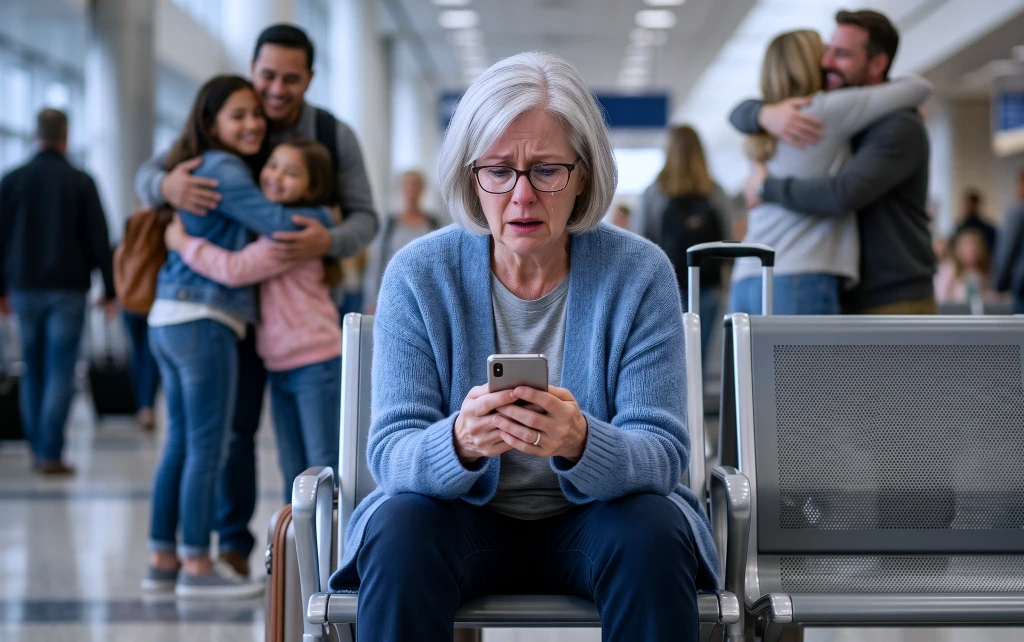
My flight had landed fifty-seven minutes earlier. My son, Daniel, had texted that morning: I’ll be right outside 2D. Don’t move. Chicago traffic is a beast.
So I had not moved.
I had collected my suitcase, found the correct terminal, and waited beneath a sign bright enough to make the silver in my hair look white. The apple-cranberry pie I had carried from Albany rested in a padded tote at my feet. I had baked it before sunrise in the blue stoneware dish Daniel used to call the Thanksgiving dish when he was a boy.
At 4:19, my phone vibrated.
For one foolish second, relief loosened my chest. Then I saw that it was not a call or a text. It was a social-media notification telling me Brooke Avery had added new photos.
I almost ignored it. Brooke posted constantly—school concerts, new throw pillows, the first iced coffee of spring. But the thumbnail showed Daniel in the charcoal sweater I had mailed him for his birthday, one arm around Brooke and the other around their son, Noah.
I opened it.
There they were at the long dining table in their Naperville house: Daniel, Brooke, thirteen-year-old Noah, nine-year-old Lucy, Brooke’s parents, her brother and his wife. The turkey had already been carved. Wineglasses caught the light from the chandelier, and a bakery tart sat where my pie should have been.
Brooke’s caption read: Grateful for a full table and the people who make this house home.
The picture had been posted eleven minutes earlier.
I enlarged it, though there was nothing I had missed. Every chair was occupied. Every face was turned toward the camera. Daniel was smiling with the careful ease he used for family photographs, as though smiling were one more household task he knew how to finish.
My first thought was not that they had lied. My first thought was that there must be another explanation.
Perhaps the photograph was from the day before. Perhaps Brooke had scheduled the post. Perhaps they had eaten early because her parents needed to leave, and Daniel was already on the expressway, furious with traffic and trying to reach me. Love is very resourceful when it is trying to protect itself. It can build a bridge out of almost nothing.
I called Daniel. The line rang until his voicemail answered.
“Hi, sweetheart,” I said, and heard how carefully I was keeping my voice level. “I’m at Door 2D, just where you said. I saw Brooke’s picture, so I assume plans changed. Call me when you can.”
I ended the message before I said anything that sounded like need.
Three days earlier, Daniel’s name had appeared on my phone while I was sorting library donations in the church basement. He rarely called in the middle of a weekday. Most of our conversations arrived as texts—Happy birthday, Mom! or Can you send me that account number?—small messages that required almost nothing from either of us.
“Tell me you haven’t made Thanksgiving plans,” he said when I answered.
His voice was warm, almost boyish. For a moment I could hear the ten-year-old who once climbed into my bed during thunderstorms and insisted that my heartbeat was louder than the rain.
“I was going to have dinner with the Kelleys from my book group,” I said. “Nothing elaborate.”
“Cancel. Come here.”
I laughed because I thought he was teasing. “To Illinois? This week?”
“Why not? The kids keep asking when they’re going to see you. Lucy wants you to teach her that card game. Noah says he’s finally tall enough to beat you at chess.” He paused, then softened his voice. “It’s been too long, Mom. The day won’t feel right without you.”
There are sentences that find the exact weak place in a person. That one found mine.
Since my husband, Ray, died seven years earlier, I had become useful in many ways. I remembered birthdays. I mailed checks before anyone asked twice. I covered the summer-camp balance when Daniel’s remodeling business had a slow season and paid Grace’s nursing-school deposit when her financial aid was delayed. People thanked me. People depended on me.
Being wanted was different.
I told the Kelleys I had family plans and bought the last reasonable ticket from Albany to Chicago. The fare was higher than I expected, but I used money from an envelope marked Christmas. I paid extra for an aisle seat because my left hip stiffened on long flights, then felt guilty about the expense until I reminded myself that comfort was not a moral failure.
The next morning, I drove into town for gifts. I found a graphic novel Noah had mentioned, a set of watercolor pencils for Lucy, and the lemon hand cream Brooke liked. At the back of the department store, I tried on a soft blue cardigan and bought it before I could talk myself out of it.
I packed two days early. I turned down the thermostat, gave my spare key to my neighbor, and wrote the flight details on a card in case my phone died. Daniel asked me to forward the confirmation, and I did. Brooke replied with three red hearts and the words, We can’t wait.
Now I stood beneath the arrivals sign in that new cardigan, looking at a photograph of the Thanksgiving that apparently could not begin without me.
An airport volunteer in a purple vest approached. She had cropped gray hair and a name tag that said MARLENE.
“Are you meeting someone, ma’am?”
“Yes,” I said too quickly. “My son is caught in traffic.”
“Do you need help calling him?”
“No, thank you. He’ll be here.”
She gave me the gentle, noncommittal smile of a person trained not to challenge another person’s hope. “There are benches around the corner if you’d like to sit.”
I thanked her and remained standing.
At 4:36, I called Brooke. At 4:42, I texted Daniel the door number again. At 4:51, I moved to a bench because my hip had begun to throb, not because I had stopped believing him.
The pie tote sat upright between my shoes. I imagined the filling shifting each time someone bumped the bench. It seemed important that it arrive intact, though I was no longer sure where it was supposed to arrive.
Across from me, a man in a tan coat greeted his mother with both hands on her face. A young couple argued cheerfully over which grandmother would hold the baby first. Two baggage handlers pushed a row of empty wheelchairs past us, their metal footrests clicking together.
My phone remained silent.
At 5:03, I opened Brooke’s photograph again. This time I noticed the clock on the wall behind Daniel. It showed 3:47. The image had not been taken yesterday or scheduled in advance. They had been eating while my plane descended over Chicago.
Something inside me became very still.
I called a taxi from the airport kiosk. The dispatcher asked where I wanted to go, and I realized I had no answer. My return flight was scheduled for Sunday. I knew no one else in Illinois. Daniel’s address was forty miles away, and the thought of arriving at his front door with my suitcase and my pie felt less like going to family than presenting evidence.
“Somewhere nearby with a room and a restaurant,” I said.
The driver was a woman named Rosa who wore silver hoops and kept the heat high. She did not ask why an older woman was leaving an airport alone on Thanksgiving. She only loaded my suitcase, placed the pie carefully on the back seat, and told me there was a small motor inn in Rosemont with a family restaurant next door.
“Nothing fancy,” she said as we joined the traffic. “But the soup is homemade, and the desk clerk won’t pretend not to see you.”
“That sounds perfect.”
Outside the car window, airplanes rose into a sky the color of unpolished steel. Office buildings passed in mirrored blocks, each one briefly reflecting the red taillights ahead of us. I held my phone face down on my lap.
It buzzed as we turned into the parking lot of the Prairie Inn.
Daniel: Mom, I’m so sorry. Dinner got away from us. Brooke thought you were landing tomorrow. Can you take a cab to the house? We need to go over some bank paperwork in the morning, so please don’t head home.
I read the message twice. He had my itinerary. He had asked me to send it. More than that, he had said he would be waiting at Door 2D.
Rosa carried my pie into the motel lobby while I checked in. The room cost more than it should have, but it was clean, warm, and mine for the night. I left my suitcase beside the bed and walked across the parking lot to Lena’s Family Restaurant, where paper leaves had been taped to the windows and a hand-lettered sign promised TURKEY DINNER UNTIL 8.
A waitress with tired eyes and a silver braid led me to a booth. “Just one?” she asked.
The question did not wound me the way I expected.
“Yes,” I said. “Just one.”
I ordered tea and pumpkin pie because I could not yet bear to open the tote at my feet. Around me, a few stranded travelers watched football without sound. A nurse in blue scrubs ate mashed potatoes at the counter. Two men in reflective airport jackets split a slice of pecan pie and argued about the Bears.
The waitress set down my tea and touched the pot before pouring. “Fresh,” she said. “I made them throw out the old batch.”
“Thank you.”
My phone vibrated again. This time Daniel had left a voicemail.
I let it sit until the pie arrived, warm at the center, with whipped cream beginning to slide down one side. Then I pressed play and raised the phone to my ear.
“Mom, call me as soon as you get this. I know today got messed up, and Brooke feels terrible. But the loan officer can only meet tomorrow morning. The business line expires if we don’t get your signature, and I already told him you’d be here. Please don’t make a decision while you’re upset. We can fix Thanksgiving later.”
His message ended with the hollow click of a call disconnected too soon.
I looked at the pie, at the steam rising from my tea, at the blue dish still hidden in the padded bag beneath the table. The invitation had finally translated itself into plain language. They had remembered exactly what I could do for them. They had forgotten only me…
To read the rest of the story – CLICK the NEXT button 👇👇👇