


The animal lifted its head once, its dark muzzle barely clearing the black water, and Evan Mercer hit the brakes before he had time to think. His tractor-trailer shuddered onto the snowy shoulder of a two-lane highway in northern Wisconsin. Air hissed from the brakes as the forty-ton rig settled beside a river that looked solid from a distance. Up close, the spring ice was gray, honeycombed, and already breaking apart along the banks.
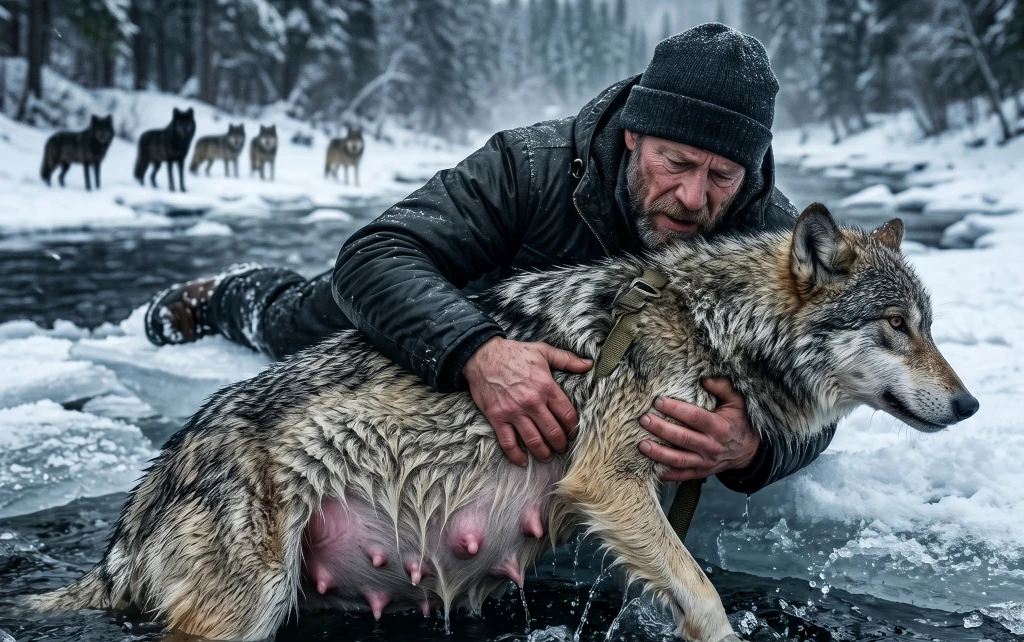
Something was trapped near the middle.
Evan climbed down from the cab, leaving the engine running and the hazard lights flashing. The cold cut through his work shirt as he pushed past the guardrail, boots sinking into wet snow.
“Hey!” he shouted. “Hold on!”
The animal clawed at the edge of the ice. Its front paws slid backward, leaving dark streaks across the white surface before it dropped into the water again.
Evan’s phone showed no signal.
He looked back at the truck. A crayon drawing was taped above the dashboard, just visible through the windshield: a red tractor-trailer, a crooked yellow sun, and a little girl standing beside a man whose arms reached nearly to the ground.
COME HOME SAFE, DAD, six-year-old Maggie had written across the top.
He had promised her he would.
He had also spent most of his life learning what happened when no one came.
Evan ran to the trailer’s side compartment and pulled out two recovery straps, a wool cargo blanket, and a pair of work gloves. He clipped the straps together, secured one end to the heavy steel frame beneath the trailer, then tested the connection with both hands.
The trapped animal gave a broken, exhausted cry.
“I’m coming,” he said, though he doubted it could hear him over the river.
He had been saying some version of those words since he was eight years old.
Back then, he had lived at Lakeview Children’s Home outside Cleveland, in a brick building close enough to the Ohio Turnpike that the children could hear trucks at night. Most of them learned to sleep through the low thunder of diesel engines. Evan listened for it.
He owned a plastic tractor-trailer with three missing wheels and a cracked blue cab. He dragged it along windowsills, cafeteria tables, and the wooden bench beneath the maple trees behind the gym. When the other boys played basketball, Evan stood at the chain-link fence and watched the real rigs move beyond it.
Coach Ray Sullivan was the first adult who noticed.
Ray taught physical education, repaired broken doors, drove the home’s old passenger van, and seemed to appear whenever a child was about to make a bad decision. He had broad shoulders, stiff knees, and faded tattoos on both forearms. Before an injury ended his driving career, he had hauled freight across forty-eight states.
“You know staring at them won’t teach you how to drive one,” Ray told Evan one afternoon.
Evan kept his eyes on a silver cab pulling two trailers east. “I know.”
“You planning to stand there forever anyway?”
“Probably.”
Ray laughed. A week later, on Evan’s birthday, he gave him a detailed model of a blue Kenworth tractor. It was secondhand and missing one mirror, but Evan held the box as though someone had handed him the keys to a real truck.
Ray began telling him about mountain grades, black ice, blown tires, truck-stop coffee, and sunrises over empty highways. He never made the work sound easy. That was part of what Evan loved.
When Evan turned fifteen, Ray took him to an abandoned section of county fairgrounds on Sunday mornings. With permission from the property owner, he taught the boy to drive an aging Ford pickup that smelled like motor oil and damp upholstery.
“Don’t fight the wheel,” Ray would say. “A vehicle tells you what it’s doing if you pay attention.”
Evan paid attention to everything.
He learned to feel the clutch engage through the sole of his shoe. He learned to reverse using mirrors instead of twisting around in panic. He learned that confidence was not the same as speed and that a good driver made decisions before trouble reached him.
After aging out of Lakeview, Evan enlisted in the Army. He spent several years driving heavy vehicles, saved nearly every dollar he could, and completed a commercial driver’s license program when he came home.
Then one company after another turned him away.
“You’ve got military time,” a terminal manager told him, scanning his application. “But you don’t have commercial miles.”
“How am I supposed to get commercial miles if nobody hires me?”
The manager pushed the application back across the desk. “Start with local deliveries. Furniture. Bottled water. Something smaller.”
Evan left the building carrying the same answer he had heard six times that month: experience required.
He drove a cab at night and searched for trucking jobs during the day. Most afternoons, he stopped at a used bookstore with a coffee counter near Cleveland’s public square. The shop carried newspapers from several counties, and Evan bought anything with a classified section.
One rainy afternoon, the young woman behind the counter watched him unfold three different employment papers beside an untouched cup of coffee.
“Do you actually read all of those?” she asked.
Evan glanced up. She had brown hair pinned loosely at the back of her neck and a pencil tucked behind one ear.
“I read the same six jobs printed in different places.”
“That sounds discouraging.”
“It’s starting to feel personal.”
Instead of offering a bright phrase and turning away, she rested her elbows on the counter. “What kind of job are you looking for?”
He told her.
He did not know why he kept talking. Maybe it was because she listened without checking the clock or trying to improve his story. By the time he finished, he had admitted that he grew up in a group home, that Ray was the closest thing he had to a father, and that every door seemed to require a key no one had ever given him.
The woman’s name was Hannah Brooks.
“You don’t sound unqualified,” she said. “You sound new.”
“Companies don’t see much difference.”
“They will. One of them will, anyway.”
“You seem pretty sure.”
“I’m not.” She smiled. “But you’re sure enough for both of us about the driving. I can cover the rest for a while.”
He returned the next day, though there were no new classifieds.
Their conversations moved from the coffee counter to walks along the lake, then to inexpensive dinners and evenings in Hannah’s parents’ kitchen. Her father, Tom, worked maintenance for the city school district. Her mother, Linda, managed the front desk at a dental office. They had no interest in Evan’s income, education, or lack of family connections.
They watched how he treated their daughter.
That was enough.
A year after Evan and Hannah married, a regional freight company finally gave him a chance. The offer came the same week Hannah showed him two pink lines on a pregnancy test.
Evan read the letter twice, then set it on the kitchen table.
“I can turn it down,” he said.
Hannah stared at him. “Why would you do that?”
“I’ll be gone four or five nights at a time. Maybe more. You’ll need help.”
“I have my parents.”
“You’ll need me.”
“I do need you.” She reached across the table and covered his hand. “I need you to be the man I married, not somebody who spends the next twenty years wondering what would’ve happened if he’d said yes.”
He accepted the job.
For a few months, life seemed almost embarrassingly generous. Evan came home from his first runs smelling of diesel and road dust. Hannah would meet him at the apartment door, press both hands to his face, and tell him the baby had kicked the moment his truck entered the parking lot.
They chose the name Margaret, after Hannah’s grandmother. Maggie for everyday life.
At thirty-five weeks, Hannah’s blood pressure climbed high enough that her doctor admitted her to the hospital for monitoring. She told Evan not to worry. He arranged several weeks off and spent the evening setting up a bassinet beside their bed.
At 2:17 the following morning, his phone rang.
“Evan,” Hannah whispered. “You need to come.”
He drove through empty Cleveland streets with both hands locked around the wheel. By the time he reached the maternity floor, nurses had already taken Hannah into surgery.
No one would let him follow.
He waited beneath fluorescent lights until the windows at the end of the hallway began to brighten. A physician finally appeared carrying a tiny bundled baby.
Maggie was premature but breathing.
Hannah had suffered a sudden complication the surgical team could not stop.
Evan remembered the doctor’s lips moving. He remembered someone placing his daughter in his arms. He remembered looking down at a face no larger than his palm and understanding that the happiest and worst moments of his life had arrived together.
Afterward, he went home and closed the curtains.
He stopped answering calls. He did not return to the hospital the next morning or the morning after that. Grief reduced the world to the scent of Hannah’s shampoo in the bathroom and the dent her body had left in the mattress.
On the third day, Tom Brooks let himself into the apartment.
He found Evan sitting on the bedroom floor, still wearing the shirt he had worn to the hospital. Tom opened the curtains and sat beside him without speaking for a long time.
Then he said, “Maggie is waiting for her father.”
Evan stared at the wall.
“I can’t do it.”
“You don’t have to know how yet.”
“She needs Hannah.”
“We all do.”
Tom’s voice broke, but he kept going.
“That little girl has already lost her mother. Don’t make grief take her father too.”
The words struck the oldest fear Evan carried. He saw Lakeview’s long hallways, the labeled cubbies, and the line of children watching families arrive for someone else.
He went to the hospital that afternoon.
For six years, Tom and Linda helped raise Maggie while Evan kept driving. He took shorter routes when he could, called every night, and carried his daughter’s drawings across half the country. He told himself each mile paid for her future, though he knew money could not return the mornings, school programs, and loose teeth he missed.
The Wisconsin run was supposed to be his last long assignment for a while. His dispatcher had promised a substantial bonus and three weeks off afterward.
Maggie had accepted the news with the solemn patience of a child who had learned not to ask for too much.
“You’ll be home for my spring concert?”
“I’ll be in the front row.”
“Not on your phone?”
“Not even in my pocket.”
She had made him shake on it.
Now, standing beside the frozen river more than six hundred miles from home, Evan tightened the recovery strap around his waist. He pulled on the gloves, tucked the cargo blanket beneath one arm, and started down the bank.
The river widened beyond the trees. Rotten ice stretched toward the far shore, broken only by the jagged hole where the animal struggled.
Evan stepped onto the edge and immediately heard water move beneath the surface.
He dropped to his stomach. The blanket helped spread his weight, though every yard brought a new web of cracks. He pushed the folded fabric forward, slid onto it, then repeated the motion.
The animal stopped clawing for a moment.
Its head turned toward him.
Evan froze.
This was not a stray shepherd or an oversized farm dog. Its ears were too small, its muzzle too broad, and its wet coat carried the heavy gray of the northern woods.
A wolf.
He looked toward the far bank. Shapes stood between the pines. At first, he counted three. Then another moved behind them, followed by two more. The pack watched without advancing, their bodies nearly invisible against the shadows.
Evan’s breath clouded above the ice. Every reasonable thought told him to retreat, reach higher ground, and find help.
The wolf slipped lower into the water.
Its movements had weakened. Only its eyes remained fixed on him.
“All right,” Evan whispered. “I see you.”
He crawled forward.
The pack did not move. The trapped wolf made no attempt to bare its teeth. It simply held on while Evan inched closer, dragging the strap behind him.
Ten feet separated them. Then eight.
The wolf twisted in the water, trying once more to lift its chest onto the ice. For the first time, Evan saw the curve beneath its soaked fur.
Her belly was swollen and heavy.
She was carrying pups.
Evan reached out one gloved hand. A black seam shot across the ice beneath his elbow. The next sound was not a crack. It was the whole sheet giving way…
To read the rest of the story – CLICK the NEXT button 👇👇👇