


The cashier looked past Marcus Bell as if he were part of the furniture. He had been standing at the register for nearly half a minute, rain darkening the shoulders of his thrift-store jacket. A young couple stepped in behind him, and the cashier’s face changed at once.
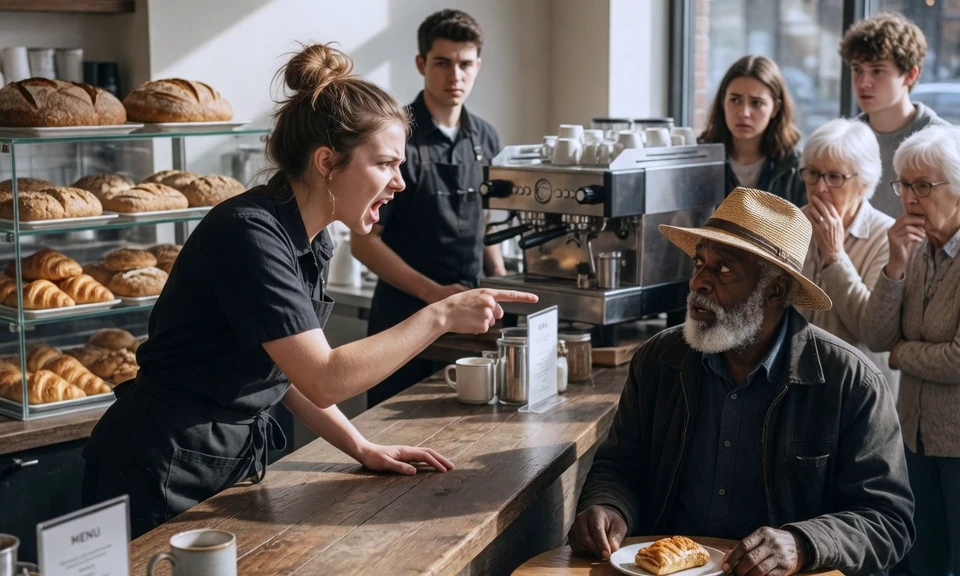
“Hey, welcome in,” she said brightly. “You two want the usual?”
She took their order around Marcus. The second barista laughed at something on her phone while he waited, one hand resting beside the pastry case. Six customers watched the exchange. A few looked uncomfortable, but no one said a word.
When the couple moved away, Marcus cleared his throat. “Could I get a cortado and a slice of the orange-cardamom bread?”
The cashier finally met his eyes. Her gaze moved over his faded ball cap, the frayed cuff of his jacket, and the scuffed work boots he had bought the night before.
“A cortado is pretty small,” she said. “You know that, right?”
“I do.”
“It’s also six dollars.”
Marcus kept his voice even. “That’s fine.”
The other barista leaned over. “Kelsey, just give him drip. He’s going to complain when the cup isn’t full.”
“I asked for a cortado,” Marcus said.
Kelsey gave a thin smile, the kind that asked him to understand he was already creating a problem. She rang it up without asking his name. When he handed her a ten, she pinched the bill between two fingers, held it toward the light, then dropped his change on the counter.
One quarter rolled beneath the pastry case.
Marcus bent to retrieve it. Behind him, somebody sighed.
He carried his drink to a table along the back wall. Printed beneath the paper sleeve were the five words he had written twenty-two years earlier:
PULL UP A CHAIR.
The cortado was barely warm. The bread, however, stopped him. Orange zest, toasted walnuts, a trace of cardamom—balanced, restrained, better than anything the corporate test kitchen had sent him that year. He took a second bite and made a mental note to find out who had developed it.
Then he heard Kelsey laugh.
“You watch,” she said to the other barista. “He’ll nurse that one drink until lunch.”
“Darren said we’re supposed to protect the room,” the other woman replied. “Once people think this is somewhere to hang out all day, the whole vibe goes.”
Kelsey lowered her voice, but not enough. “You make it a little uncomfortable at the beginning. Slow service, no extras, no invitation to stay. Most of them figure it out.”
The barista glanced toward Marcus. “He’s not exactly the crowd we’re trying to attract.”
Marcus stopped with the bread halfway to his mouth.
He had been dismissed in expensive restaurants, followed through department stores, and once asked to use a delivery entrance at a hotel where he was scheduled to receive an award. The insult itself was familiar. What held him still was the language: protect the room, slow service, make it uncomfortable.
This was not two careless employees having a bad morning. It sounded practiced.
It sounded like a system.
Twenty-two years earlier, Marcus had welded his first coffee cart in his mother’s garage in Wilkinsburg, just east of Pittsburgh. He was thirty, recently laid off from a machine shop, and stubborn enough to spend his last twelve hundred dollars on a used espresso machine that leaked from three different places.
His mother, Lorraine, had loaned him the rest from money she had saved for a new furnace. She did it without hesitation, though she made him write the amount on an index card and tape it above the workbench.
“Dreams still owe people money,” she told him. “Don’t get poetic with my furnace.”
Lorraine also gave him the reason for the company he eventually built. When Marcus was a boy, she sometimes took him downtown after church for pie and coffee. At one café, the hostess always placed them beside the swinging kitchen door, even when window tables sat empty. His mother never complained. She simply folded her gloves in her lap and thanked the waitress each time the door struck the back of her chair.
Marcus remembered that chair long after he forgot the flavor of the pie.
When he opened his first permanent shop, he printed PULL UP A CHAIR on every cup. It was not a slogan created by an agency. It was a promise to his mother that no one in a Foundry Coffee House would be made to feel like the room had been designed for someone else.
The cart became one store, then four. By Marcus’s fifty-second birthday, Foundry had thirty-eight locations across Pennsylvania, Ohio, and West Virginia. The company roasted its own beans, paid above the local minimum wage, and sold seasonal drinks that people drove across county lines to try.
From the twelfth floor of Foundry’s downtown office, the business looked healthy. Sales were up. Two new stores had opened without delays. The board wanted to discuss expansion into Maryland.
Marcus had not worked behind a Foundry counter in almost four years.
That distance had seemed responsible until his chief operating officer, Evelyn Shaw, laid a folder on his desk one Monday morning. Inside were twenty-seven customer complaints from the original Penn Avenue store—the flagship built with his mother’s furnace money and every hour he could borrow from sleep.
A retired teacher wrote that a cashier had served three people who arrived after her. A construction worker said an employee asked whether he was waiting for a food-delivery pickup, though he had already placed an order. A mother described leaving with her two children after a barista rolled her eyes and asked whether they “really needed” to sit inside.
Different dates. Different customers. The same words appeared again and again: ignored, watched, embarrassed, unwelcome.
Marcus opened the company dashboard. The flagship’s revenue remained strong, but its customer-trust score ranked thirty-eighth out of thirty-eight.
He called the store manager, Darren Pike.
“People complain when a busy shop can’t give them special treatment,” Darren said. His tone was respectful without sounding concerned. “We’re in a high-traffic neighborhood. Some customers come in expecting us to function like a public waiting room.”
“Twenty-seven people described being treated differently.”
“Perception is hard to manage.”
“So is a store,” Marcus said. “That’s why I hired a manager.”
Darren paused, then assured him the team had been retrained. The answer arrived too quickly and too smoothly. Marcus thanked him, ended the call, and spent that evening parked across from the flagship with the lights off.
At 8:40 p.m., a man in paint-splattered pants entered. Neither barista acknowledged him until he spoke. Seven minutes later, two women in expensive running clothes came through the door and received smiles, samples, and a recommendation for the seasonal menu before they reached the register.
Marcus watched the difference repeat itself twice more.
Back at home, he opened the employee schedule. Kelsey Ward and Brooke Nolan held nearly every lunch and afternoon shift, the hours with the best traffic and highest tips. One name appeared only before sunrise or near closing: Nina Morales, four years with the company, never scheduled during a peak period.
The next morning, Marcus went in as a customer wearing the old jacket and ball cap. Now he sat beneath his own promise while Kelsey and Brooke discussed how to drive people like him from the room.
He finished neither the cortado nor the bread. Before leaving, he took a photograph of the cup and another of the two women behind the counter. Kelsey saw the phone rise and stared at him until he lowered it.
Outside, the rain had thinned to mist. Marcus stood beneath the awning and called Evelyn.
“Clear next week,” he said.
“You have the lender meeting Tuesday.”
“Move it.”
There was a pause. Evelyn had worked with him long enough to hear what he was not saying.
“How bad?”
“I was ignored, made to prove I could afford a six-dollar drink, and warned that it might be too sophisticated for me. Then I listened to two employees explain how they make certain customers leave without ever asking them to.”
“We can pull the cameras. HR can interview the staff this afternoon.”
“That might remove two people,” Marcus said. “It won’t tell me who taught them the language.”
“What are you planning?”
“An internal service audit. I need a temporary employee profile approved by legal, a transfer story no one at the flagship can verify, and access limited to you, counsel, and HR.”
Evelyn exhaled. “Name?”
Marcus looked through the glass at the counter where his mother’s promise had become decoration.
“Martin Cole,” he said. “Put him on Nina Morales’s opening shift.”
That night, he read Foundry’s forty-six-page employee handbook from beginning to end. The customer-care policy was careful and detailed. The complaint process was not. Workers were told to report problems to their store manager or regional director, with no anonymous channel and no independent review.
Every safeguard depended on the person receiving the complaint being honest.
Marcus printed Nina’s schedule and laid it beside the customer reports. For sixteen straight weeks, she had opened the store at 5:00 a.m. or closed after 10:00 p.m. She had not worked a single lunch rush, weekend afternoon, or promotional event. Someone had kept her useful and invisible at the same time.
At 4:47 the following morning, Marcus approached the employee entrance in a gray polo and used the temporary badge Evelyn had arranged. The public side of the flagship had polished brass, warm lighting, and flower boxes replaced every season. The alley door had peeling paint, a broken security light, and a strip of duct tape covering a crack near the handle.
Inside, the break room smelled of sanitizer and burned coffee. Shift notices overlapped on a corkboard. A microwave leaned crookedly on a metal shelf, and beside it sat a ceramic tip jar painted with yellow sunflowers.
A white label had been taped across the front.
ALL CASH TIPS GO THROUGH KELSEY. DO NOT ADD OR REMOVE MONEY WITHOUT APPROVAL.
Marcus lifted the jar. On the bottom, beneath a thin glaze, someone had painted a small line in blue script:
For all of us — N.M.
The employee door opened behind him. A woman wearing a flour-dusted apron stopped when she saw the jar in his hands. Her eyes went first to the label, then to the hallway leading toward the manager’s office. “Put that back,” she whispered. “Kelsey can’t know you touched it…”
To read the rest of the story – CLICK the NEXT button 👇👇👇