


The little girl was kneeling on Nathan Cole’s wife’s grave when he found her. She had two pale braids, one mitten, and a red plastic shovel better suited to a sandbox than a cemetery in January. With careful, determined strokes, she scraped snow from the fresh mound beneath Claire’s temporary marker. A framed photograph leaned against a stand of frozen lilies, the glass already fogged at the corners.
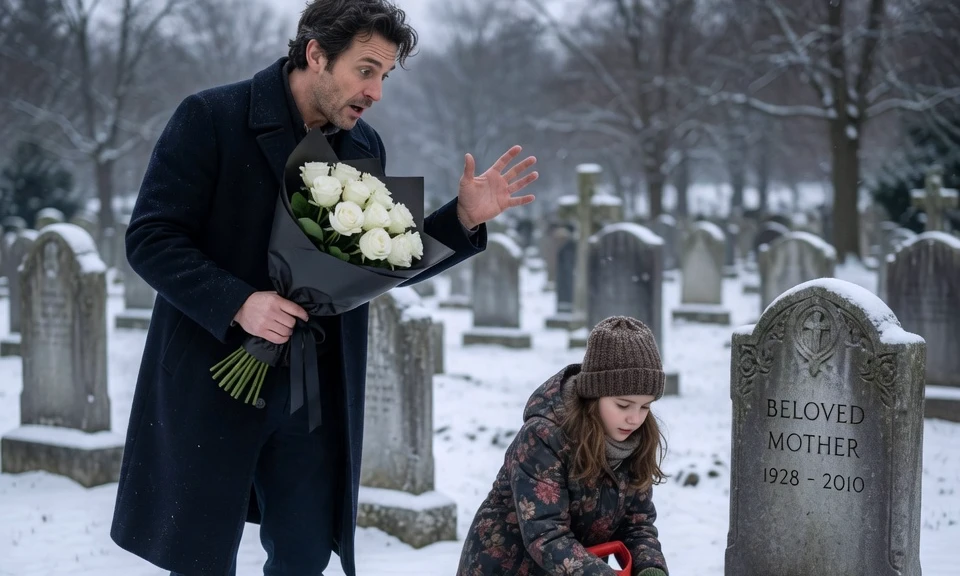
Nathan stopped several yards away, still holding the two dozen white roses he had bought at the airport. He had imagined this moment through three canceled flights and two sleepless nights. He had imagined falling to his knees, saying Claire’s name, perhaps finally understanding how a woman could be alive on Tuesday and buried by Thursday.
He had not imagined a child tending her grave.
The girl looked over her shoulder. “You can come closer. I’m almost done.”
Nathan’s shoes sank into the snow as he approached. “What are you doing?”
“Getting it off her.” She pushed another small pile aside. “My dad says dead people can’t feel cold, but he says lots of things that aren’t true.”
Her matter-of-fact voice made something tighten behind Nathan’s ribs. Up close, he could see that her uncovered hand was red from the cold.
“Did you know Claire?” he asked.
The shovel stopped.
The girl studied him with clear gray eyes. “Are you Nathan?”
He nearly dropped the flowers. “How do you know my name?”
“She showed me your picture.” The girl stood and brushed snow from her knees. “Claire was going to be my mom.”
Four days earlier, Nathan had been trapped in a hotel outside Kalispell, Montana, watching a wall of white erase the parking lot.
He owned Cole Architectural Millworks, a Minneapolis company that supplied custom flooring, paneling, and timber to hotels and high-end builders across the Midwest. The business had grown from six employees in a rented warehouse to three plants and more money than Nathan had ever expected to make. That week’s trip was supposed to protect all of it from an expensive mistake.
A Montana supplier had offered him a steep discount on a massive shipment of Douglas fir after a previous load arrived warped and improperly graded. Nathan did not trust photographs or promises this time. He wanted to see the lumber stamps himself, sign the contract, and be home with Claire by Friday night.
Instead, the plane landed hard in crosswinds, the mountain highway closed, and the storm settled over the region as if it had no intention of leaving.
By the fourth day, Nathan had called every charter company, freight operator, and private driver within a hundred miles. No one would take him the seventy miles to the yard. Snowplows had been pulled from the worst stretches. Even the county had stopped pretending the roads were passable.
“I’ll pay for a snowcat,” Nathan told a dispatcher that morning. He stood at the hotel window in yesterday’s shirt, watching drifts climb the parked cars. “A tracked vehicle. Anything that moves.”
The woman on the other end sounded exhausted. “Sir, it isn’t the vehicle. It’s visibility. People are getting lost ten feet from their own porches.”
“I only need an hour at the site.”
“You won’t get there, and if someone tries, they may not get back.”
Nathan closed his eyes. He was accustomed to solving problems by working harder, calling higher up, or paying what something cost. Weather did not care who he knew or how many zeros were in his bank account.
He called Claire again.
Her phone rang until voicemail picked up. He did not leave another message; he had already left three. Claire was an interior designer, and when she became absorbed in a project, the rest of the world could disappear around her. She once missed a dinner reservation because she spent six hours comparing stone samples under different lights. Nathan had been angry until he saw the apology she had sketched on the back of a tile catalog: a tiny drawing of him at an empty restaurant table, being served bread by a guilty-looking raccoon.
He still kept it in his desk.
That morning, though, her silence bothered him. The storm system had reached Minnesota overnight. It was weaker there, but the roads were slick, and Claire had been driving to a renovation site near Stillwater.
He sent one more text.
Please tell me you stayed home.
No answer came.
At 5:17 p.m., his father-in-law called.
Nathan smiled automatically when he saw Frank Bennett’s name. Frank rarely called unless Claire had handed him the phone. In four years of marriage, Nathan had never managed to become more than the ambitious man who kept Frank’s daughter too busy and lived in a house Frank considered unnecessarily large.
“Hey, Frank. Is Claire with you?”
There was a pause long enough for Nathan to hear a television murmuring in the background.
“Claire’s gone,” Frank said.
Nathan gripped the edge of the desk. “Gone where?”
“Her SUV went through the ice this morning. Down by the St. Croix.” Frank’s voice had no shape to it, no rise or fall. “The current pulled it under the shelf. They found the vehicle. They couldn’t get her out.”
For several seconds, Nathan heard only the heater clicking beneath the window.
“No,” he said. It was the first word his mind could reach. “No, you have the wrong car.”
“They matched the plate.”
“Did they see her?”
“The sheriff’s people were there.”
“That’s not what I asked. Did anyone see Claire?”
Frank exhaled sharply. “They know she was driving. Her purse was inside.”
Nathan sat down because his knees had begun to shake. On the desk lay a room-service receipt, his laptop, and the yellow legal pad on which he had written figures for a contract that no longer belonged to the same world.
“When?” he managed.
“This morning.”
“Why are you calling me now?”
“Anne couldn’t do it. I couldn’t either.” Frank’s voice cracked for the first time, then hardened around the crack. “We’re having the service Thursday. Family only. The cemetery has an opening.”
“Thursday is two days away.”
“We can’t drag this out.”
“I’m in Montana. The airport’s closed.” Nathan stood again, already reaching for his coat though there was nowhere to go. “Move it to Saturday. Sunday. I don’t care when. I’m her husband.”
“You should’ve been here.”
The words landed with almost no volume.
Nathan stared at the snow pressing against the glass. “What did you say?”
“She needed you here, not chasing another deal across the country.”
“I left for four days.”
“And she died on one of them.”
Frank ended the call.
Nathan called Anne next. She answered with a sound he did not recognize at first, a low, repetitive moan drawn from somewhere beneath language. He said Claire’s name, and Anne began crying so hard she could not breathe. That was when disbelief gave way—not to grief yet, but to nausea, dizziness, and the terrifying sense that the room had tilted while everything in it remained still.
He spent the next six hours trying to buy his way home.
He called commercial airlines, charter services, helicopter operators, and a medical transport pilot who listened patiently before saying no. Nathan offered amounts that embarrassed him later. Every answer was the same. The runway was closed. The ceiling was too low. The winds were unsafe. Nothing was leaving.
Near midnight, he told Anne he could not make the service. Her sobbing had stopped. In its place was a flat politeness that felt worse.
“We understand,” she said.
He wanted her to accuse him. He wanted someone to scream because screaming would have made sense. Instead, she thanked him for calling and hung up.
Nathan lay fully dressed on the hotel bed with the lights off. He thought of the fertility appointment he and Claire had scheduled for February after years of saying they would get around to it. He thought of the mug she always left on the bathroom counter, the one with a chipped blue rim. He thought of how she pressed cold feet against his calves in bed and claimed marriage entitled her to shared body heat.
At one in the morning, grief finally found him.
By sunrise, his throat was raw. He sent his operations director to inspect the lumber whenever the roads reopened, packed his suitcase, and moved to the airport terminal. He slept in a chair beneath a departures board while flights shifted from DELAYED to CANCELED and back again. He stopped answering business calls unless someone might know how to get him home.
The memorial took place without him.
On Friday afternoon, the airport reopened for limited departures. Nathan reached Minneapolis after midnight, drove to an empty house, and stood in the kitchen without taking off his coat. Claire’s keys were not in the bowl by the door. Her half-finished cup of tea sat in the sink, a faint brown line dried around the porcelain.
He did not touch it.
Saturday morning, he bought every white rose the florist had and drove straight to the cemetery in St. Paul. The storm had passed. Sunlight flashed across the snow so brightly it hurt his eyes, and the sky above the bare trees looked clean and merciless.
That was where he found the little girl with the red shovel.
“Claire was going to be your mom?” Nathan repeated.
The girl nodded. “She talked to my dad about it. He said I could go live with her because he has to work all the time.”
Nathan crouched so they were at eye level. Claire had never mentioned fostering a child, much less adopting one. They had talked about children until the subject became too tender to touch casually. She would not have made a promise like that without telling him.
“What’s your name?”
“Sophie.”
“How old are you, Sophie?”
“Six and three quarters.” She glanced at the roses in his hand. “Those were her favorite.”
“I know.”
“She told me you always bought the wrong color first and then went back for white ones.”
Despite himself, Nathan almost laughed. The first flowers he had ever brought Claire were red roses. She had kissed him and then admitted, weeks later, that red roses made her think of hotel lobbies. Every anniversary after that, he bought white.
This child had known his wife. Not in passing. Claire had talked to her about him.
Nathan set the flowers beside the framed photograph. “Were you at the service?”
Sophie’s expression changed. She looked toward the cemetery road, where no cars moved, then lowered her voice as if the dead might overhear.
“My dad brought me because I cried when he said she was gone. I wanted to say goodbye.”
Nathan waited.
“The funeral lady left the door open before everybody came in,” Sophie continued. “I went up close. There was a pretty blanket and one of Claire’s scarves folded inside.”
She pushed the red shovel into the snow and looked directly at him. “But Claire wasn’t in there,” she said. “They buried an empty box…”
To read the rest of the story – CLICK the NEXT button 👇👇👇