


The dog hit the kennel door hard enough to shake dust from the vent above it. Daniel Mercer stopped in the middle of the corridor. His white cane went still against the tile. Around him, more than a dozen dogs barked through feeding time, but the sound behind the steel door at the far end was different—lower, ragged, followed by the scrape of claws that had worn the concrete raw.
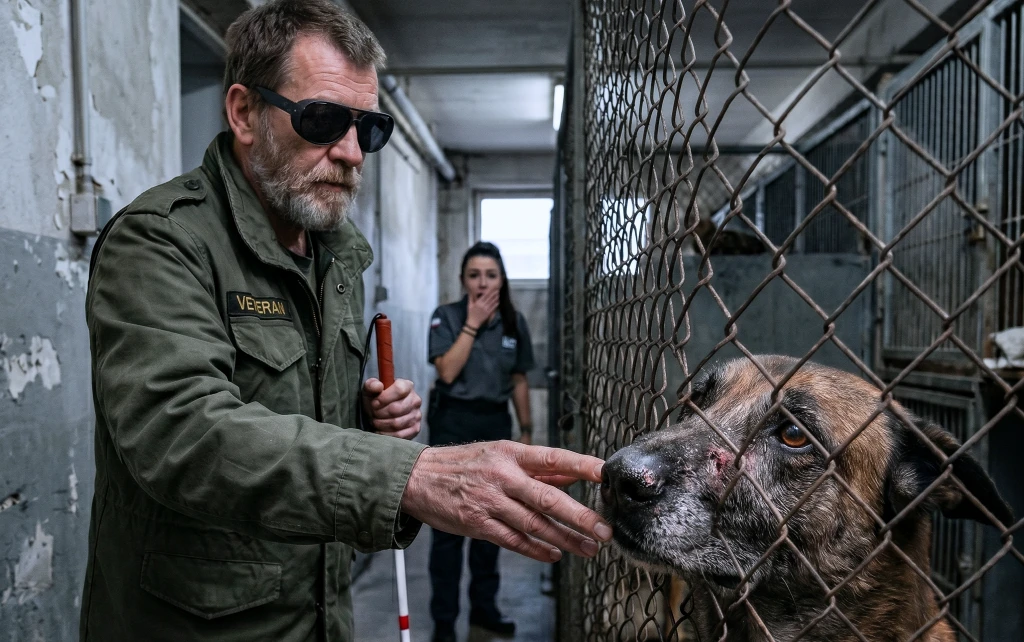
“Keep moving,” Laura Bennett said beside him. Her hand hovered near his elbow without touching. She had already learned that Daniel preferred a warning to being steered. “That wing isn’t part of today’s matching visit.”
Daniel had spent three years learning what people meant when they said something was not part of the visit. It usually meant dangerous, embarrassing, or too broken to place in front of a client.
Rain tapped the high windows of Pine Hollow Veterans Canine Center, an old retreat campus tucked into the Laurel Highlands east of Pittsburgh. Outside, wet pine and cold soil carried through every crack in the building. Inside, the air smelled of disinfectant, stainless steel bowls, damp fur, and the nervous heat of animals waiting for someone to decide what would happen to them.
Daniel tightened his grip on the cane. He had survived the blast that took his sight, six surgeries, and a year of people praising him for learning to pour coffee without spilling it. Walking through Pine Hollow’s front doors had still required three canceled appointments and a forty-minute ride in which he nearly asked the driver to turn around twice.
He had come for a guide dog. The reasonable kind.
Laura had described two Labradors before they left the lobby: Molly, steady around traffic and children, and Jasper, a big yellow dog who could ignore a dropped cheeseburger. There was also a shepherd mix named June who had a talent for finding empty chairs and elevator buttons. Every dog had been raised for assistance work, evaluated for public access, and matched by pace, temperament, and home life.
They were exactly what Daniel had asked for on paper.
“I should warn you,” Laura said as the angry barking rolled down the corridor again. “The secure wing houses retired working dogs. Most are here temporarily. A few can’t be safely adopted.”
“Military?”
“Some. Police, corrections, private security. Pine Hollow takes cases other programs won’t.”
The dog struck the door a second time. Daniel felt the vibration through the soles of his shoes.
“What’s his name?”
Laura waited just long enough to answer the question she wished he had not asked. “Rook.”
The name settled in Daniel’s mind like a piece placed on a board. “What happened to him?”
“We can talk about that after you meet the dogs you came to see.”
“That bad?”
“Daniel.” Her voice stayed kind, but the warmth had narrowed into professional caution. “Rook is not a candidate. He’s a seven-year-old Belgian Malinois with a serious aggression record and severe confinement reactivity. No one goes into his run without a full safety team.”
They started forward again. Daniel counted doors by sound as his cane found the baseboards: hollow office door, open alcove, metal threshold, another hall. He had once built maps from satellite images and radio reports. Now he built them from echoes, air currents, and the slight change in Laura’s footsteps when she entered a narrower space.
Near an open supply room, two men stopped talking too late.
“He bent the feeder bracket again,” one said. Carabiners clicked against a belt. “Calder keeps calling him a decorated dog. A decorated dog can still put somebody in the ER.”
“The board meets Friday,” the other replied. “With the insurance review, I don’t know how much longer—”
Laura shut the supply-room door with a firm push. “Could you save that conversation for somewhere clients can’t hear it?”
The men muttered apologies. Daniel turned his face toward them.
“What happens Friday?”
“No one has made a decision,” Laura said.
“That wasn’t my question.”
The nearer man exhaled through his nose. He sounded older, heavy in the chest. “Mike Harlan, senior trainer. The board is reviewing whether we can keep housing Rook in a secure setting. The center’s director has delayed that review twice.”
“And if you can’t keep him?”
“No decision,” Laura repeated.
Daniel knew enough military language to hear the missing word.
He rested both hands on the top of his cane. The olive fleece under his rain jacket had been issued on his second deployment, though nothing about it looked military now. One cuff had been resewn by his sister with gray thread. The fabric smelled of his apartment detergent and the peppermint gum he kept in the pocket. It was simply the one piece of old gear he still wore when he needed to remember that his body had once known what to do.
“Tell me about his handler,” he said. Mike’s carabiners went quiet.
“Staff Sergeant Owen Price,” the trainer said. “Rook worked explosive detection and patrol. Price was killed during a route search overseas. Rook survived the blast, but he came home with a concussion, shrapnel wounds, and a different nervous system. He completed medical rehab. Behavior rehab never held.”
“What does ‘never held’ mean?”
“He’d make progress with one person, then something would set him back. A door slamming. A restraint pole. A man reaching over his shoulders. He started guarding thresholds and striking the kennel front. Six months ago he caught a technician’s sleeve and broke her wrist when she fell. Since then, protected contact only.”
The dog barked again, but the sound ended halfway through. A long inhalation followed, loud enough for Daniel to hear from several yards away. Rook was scenting the corridor.
Laura touched Daniel’s sleeve. “We should go.”
He did not move. The dog inhaled again, then paced close to the gate. Daniel heard each nail set down separately. The animal was no longer throwing his weight against steel.
“What is he doing?” Daniel asked.
Mike answered slowly. “Standing at the front of the run.”
“Ears?”
“Forward. Tail level.”
“Teeth?”
“No.”
The next sound was so small that Laura seemed to stop breathing beside him. It was not a bark or a growl. It was a thin, uneven whine, quickly swallowed as though the dog regretted letting it out.
Mike whispered something under his breath.
Daniel turned toward the secure door. “Take me closer.”
“No,” Laura said at once.
“Behind the barrier.”
“No. His calm can flip without warning.”
“Then let it flip with two fences between us.”
Mike did not answer immediately. Daniel could hear the trainer shifting his weight, studying a dog Daniel could not see. At last, keys moved on the man’s belt.
“We go to the yellow line,” Mike said. “No farther. You don’t put fingers through the mesh. You don’t kneel. If I tell you to back up, you back up.”
Laura made a frustrated sound. “Mike, the intake team hasn’t even evaluated Daniel with a candidate.”
“I’m not matching them,” Mike said. “I’m observing the dog.”
Daniel followed the wall into the secure wing. The temperature dropped several degrees, and the barking from the main kennel faded behind a heavy fire door. Rook’s breathing took its place—fast, deep, close.
His cane found a raised strip in the floor.
“Yellow line,” Mike said. “Gate is six feet in front of you. Secondary mesh between.”
Daniel folded the cane and held it along his leg. He did not reach forward. He had learned in hospitals that frightened beings noticed every unnecessary movement.
“Rook,” he said.
The dog’s nails clicked once in answer. Daniel’s old command voice had mostly deserted him after the blast. At home, he spoke softly so the neighbors would not hear him collide with furniture. Here it returned without effort—not loud, not hard, simply certain.
“Easy.”
Rook drew in another breath. His nose pressed against wire with a faint metallic rattle.
Laura stood somewhere behind Daniel’s left shoulder. “He’s looking directly at you.”
“Let him.”
“He doesn’t like eye contact.”
Daniel almost smiled. “Then we finally found something I’m good at.”
No one laughed, but the pressure in the corridor changed. Rook’s breathing slowed by a fraction. Daniel lifted the back of his hand, stopping well short of the first barrier, and let the dog decide whether the gesture meant anything.
The Malinois sniffed from the other side. He moved once from Daniel’s hand to his chest, then back to the hand. The quiet whine came again, deeper this time.
Daniel felt it under his ribs.
“I know,” he said. “I know what it is to wake up ready for a fight that ended without you.”
Laura’s voice softened. “Daniel, he doesn’t understand the words.”
“Maybe not.” He kept his hand still. “But neither did I, for a while.”
Rook lowered himself. Daniel heard elbows touch concrete, then a long breath pushed through the mesh.
Mike took one cautious step closer. “He’s lying down at your feet.”
“For how long has he done that with a stranger?”
“He hasn’t.”
The answer did not feel triumphant. It felt like hearing someone on the other side of a locked door answer a knock.
Daniel moved one foot beyond the raised strip.
Laura caught his sleeve. “That’s the line.”
“He’s not asking me to leave.”
“He’s a dog, Daniel. You can’t turn one reaction into a promise.”
“No. But you turned his worst reaction into a sentence.”
Rook rose at the change in their voices. A low vibration gathered in his chest, aimed past Daniel toward Laura’s hand on his arm.
“Let go of me,” Daniel said. Laura did, and the growl stopped.
Mike swore quietly. “He’s resource guarding you already. That is not a good sign.”
“Or he thinks I’m the only person in the hall who isn’t about to force him backward.”
“Both can be true.”
Daniel knew that. He also knew what it was to have every protective instinct treated as proof that you could no longer be trusted. People had spoken around him in rehab as if blindness had removed judgment along with sight. He had answered by refusing help until refusal became another kind of cell.
He unfolded his cane and extended it sideways until the tip touched the outer mesh. Rook did not lunge. The dog sniffed the rubber tip, then followed its slow movement as Daniel traced the barrier toward the latch.
Mike’s boots moved fast. “Daniel, stop.”
His fingers found cold steel through the gap between fence panels. “Which gate is this?”
“The access gate, and you are not opening it.”
“Does it lead into his run?”
“It leads into the safety vestibule. The inner door is still locked.”
Daniel lifted the latch before anyone could pull his hand away. Laura said his name sharply. Mike reached him as the outer gate swung inward, but Daniel had already stepped into the narrow vestibule and closed it behind himself.
Rook sprang to his feet on the other side of the inner gate.
“Now you’ve made your point,” Mike said. “Step back out.”
Daniel set his folded cane on the floor. “Open the inner door.”
“Absolutely not.”
“Then tell me why he’s crying.”
The Malinois pressed his muzzle to the seam. A tremor ran through the metal.
Mike’s voice dropped. “Because he is overloaded. That doesn’t make him safe.”
“I didn’t say safe.” Daniel faced the dog. “I said open it.”
Laura came close to the outer gate. “You came here because you need a dog who can keep you alive in traffic. Rook has never done guide work. He may never tolerate a grocery store, a bus, or a stranger brushing past him. This is not the partner you asked us for.”
“No,” Daniel said. “He’s the one nobody asked.”
For several seconds, only the ventilation fan moved air through the corridor. Then metal clicked near Daniel’s shoulder. Mike had taken hold of the inner release.
“One inch,” the trainer said. “I crack the gate. If he loads forward, I shut it. You do not move.”
Laura protested, but Mike was already counting under his breath. The lock withdrew. The bottom edge of the gate scraped over concrete. Rook’s nails dug in as the opening widened. Then the dog launched himself straight at Daniel…
To read the rest of the story – CLICK the NEXT button 👇👇👇