


The lion touched Ben Mercer’s hospital bracelet before he touched anything else. His muzzle hovered over the white plastic band showing beneath Ben’s jacket cuff, nostrils widening as he sorted through the smells inside the stalled safari bus—hot vinyl, spilled soda, sunscreen, gasoline, and the sharp human scent of thirty-nine people trying not to panic.
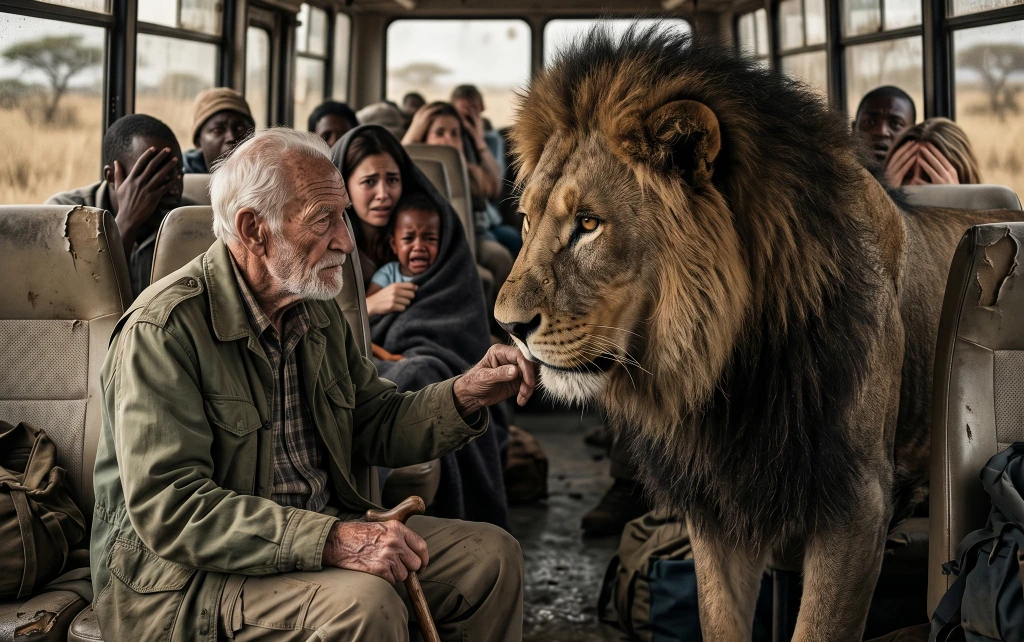
A woman across the aisle pressed both hands over her mouth. Near the rear emergency hatch, a little girl had buried her face against her father’s chest. The young tour guide stood at the front with a dead radio in one hand and the useless door switch under the other.
“Sir,” he whispered. “Please don’t move.”
Ben had no intention of moving.
The lion’s mane brushed his knuckles. Up close, Ben could see gray around the animal’s muzzle and a clouded patch in one amber eye. The lion’s left foreleg carried less weight than the right, and every few seconds the paw trembled against the rubber floor.
Ben knew that tremor.
He had once held the same leg in both hands when it had been no thicker than a broom handle.
Eleven minutes earlier, the bus had been noisy enough to make memory seem impossible.
A family from Phoenix had argued cheerfully about which side offered the best view. Two teenagers filmed everything through the glass. A man wearing a golf visor narrated the tour into his phone as though he had personally discovered every giraffe, antelope, and ostrich roaming the property.
Ben sat alone in the second row, one hand resting on his cane. Despite the Arizona heat, he wore a faded field jacket with cracked leather at the cuffs. Inside its left pocket was an old photograph. Inside the right was an appointment envelope from Santa Catalina Regional Cancer Center.
He had folded the envelope twice so the date would not show.
June 27. Surgical Oncology. 8:30 a.m.
It was almost ten.
The appointment had been his daughter’s idea, although the doctors had used other words: necessary, urgent, potentially curative. Ben had heard the cost estimates more clearly than the medical ones. He had spent three weeks imagining Rachel refinancing her house, picking up extra shifts, and pretending she wasn’t exhausted.
That morning, instead of driving to the hospital, he had turned south.
Saguaro Ridge Wildlife Park had changed since his last visit. The hand-painted wooden sign was gone, replaced by a steel arch and electronic ticket lanes. The old gravel parking lot had become a paved plaza with a gift shop, a café, and a banner offering private predator tours for corporate groups.
Ben had nearly left.
Then he saw the name Cyrus on the senior-animal board near the entrance.
He bought a ticket and boarded the next bus.
Owen Keller, the guide, could not have been more than twenty-four. He wore a khaki polo darkened with sweat between the shoulder blades and delivered each animal fact with the careful brightness of someone being evaluated.
“As we turn toward Predator Mesa,” Owen announced, “keep your eyes on the shaded ridge to the right. Our oldest male lion, Cyrus, usually rests near the upper rocks this time of day. He’s seventeen and has lived at Saguaro Ridge since he was a juvenile.”
Ben’s fingers tightened around his cane.
Cyrus had not been a juvenile when he arrived. He had been a half-starved cub with a damaged leg, a fever, and enough anger left to bite through a leather work glove.
Ben looked through the tinted window. Artificial rock ledges rose above yellow grass and mesquite. Beyond the public habitat stood a row of service pens separated by steel fencing and a narrow road.
At first, he saw nothing.
Then a tawny shape moved behind one of the holding gates.
The lion stepped into view with a slow hitch in his left shoulder. Even at a distance, Ben recognized the uneven rhythm of his walk: pause, plant, follow through. It was the gait Ben had watched develop across the floor of a converted tack room fifteen summers before.
His breath stopped halfway into his lungs.
The bus engine shuddered.
Owen glanced toward the dashboard. “That’s new.”
A few passengers laughed. The engine coughed again, harder this time, and the bus rolled to a halt beside the medical service road. The air-conditioning fan wound down until the only sound was the ticking of hot metal.
Owen tried the ignition twice. “All right, folks. We’re going to enjoy a very authentic desert pause while I call maintenance.”
He raised the radio.
“Base, this is tour four near Predator Mesa. We’ve lost power.”
Static answered.
Owen turned the volume knob and tried again. A clipped voice surfaced, then vanished beneath interference. His smile remained, but something behind it had begun to strain.
Ben looked toward the service pens. One gate stood open six inches.
Cyrus was no longer behind it.
A hard electrical pop came from above the windshield. The front door indicator flashed red, and the folding panels released with a mechanical sigh.
Heat rushed into the bus.
Owen hit the switch. The door shuddered but did not close.
“Everybody remain seated.”
The golf-visor man laughed uneasily. “You might want to sound more convincing.”
Something moved through the glare beyond the doorway.
The first visible part of Cyrus was his scarred paw. It settled on the lower step, followed by his broad head and darkened mane. He paused there, breathing heavily, with dust clinging to the whiskers along one side of his mouth.
The golf-visor man stopped laughing.
A woman screamed from the fourth row. Someone dropped a metal water bottle, and its clatter sent Cyrus’s ears backward. People surged away from the aisle, pushing children under arms and climbing over seat backs.
“Stop moving!” Owen shouted. “Please, everybody—just freeze.”
His radio crackled once and went silent.
Cyrus climbed inside.
He did not charge. He entered with the cautious, irritated gait of an animal moving through pain. His flank brushed the front seats, and the bus leaned slightly under his weight.
Ben watched the damaged leg.
There was no doubt.
The cub he had carried out of a condemned roadside menagerie had grown into an old lion. The mane had darkened. The face had widened. Time had altered nearly everything except the small delay before the left paw touched the ground.
Cyrus lifted his head and studied the bus.
Fear changed the air. Ben had smelled it in barns, examination rooms, trailers, and roadside ditches. It came off people warm and sour, and predators noticed it long before humans believed they were showing it.
The little girl near the rear began to cry.
Cyrus turned toward the sound.
“Sweetheart, look at me,” her father whispered. “Don’t make a sound.”
Ben loosened his grip on the cane. Its rubber tip had begun to squeak against the floor beneath his trembling hand.
The lion looked at him.
For a few seconds, neither moved.
Then Cyrus came down the aisle.
Owen raised one hand as though he could stop four hundred pounds of muscle with his palm. “Sir, keep your eyes down. Don’t reach for him.”
Ben knew the advice was sound. He also knew Cyrus was not walking like an animal preparing to attack. The lion’s mouth was open because of the heat, not aggression. His tail moved low. His attention kept returning to Ben’s jacket.
That jacket had hung beside the tack-room door through the summer Cyrus learned to eat from a steel bowl. Ben had worn it during midnight feedings when desert temperatures dropped and the cub woke crying from pain.
It should not have mattered after fifteen years.
Ben lowered his gaze anyway.
Cyrus stopped beside him. The lion’s breath warmed the back of Ben’s hand, and the loose hospital bracelet clicked softly against his watch.
Behind Ben, a woman began whispering a prayer.
Cyrus sniffed the bracelet, then the cracked leather cuff. His ears turned forward.
Ben felt the change before he trusted it. The lion’s breathing slowed. The muscles across his shoulders loosened a fraction.
A sound came back to Ben from a summer he had spent trying to convince a wounded cub that food was not a trap: one low whistle, two short notes, then another low note.
His wife Evelyn had invented it because Cyrus responded badly to voices when the pain medication wore off. She would stand outside the tack room with a bottle tucked under her arm and whistle before opening the door.
Ben wet his lips.
The first note barely sounded. His mouth had gone dry, and his lungs no longer gave him air as generously as they once had. He tried again.
Low. Short-short. Low.
Cyrus froze.
The lion looked directly into Ben’s face.
Owen made a small sound near the windshield, but Ben could not tell whether it was fear or disbelief.
Cyrus leaned forward. His mane pressed against Ben’s chest, carrying the smells of dust, old grass, and something medicinal. Then, with painful care, the lion lowered his head across the empty seat beside Ben and let the weight of his cheek settle against Ben’s thigh.
No one on the bus moved.
Ben’s hand hovered above the mane. He remembered tiny milk-wet whiskers, a splinted leg, and Evelyn sitting cross-legged on the tack-room floor while a cub chewed the lace from her boot.
“Hello, Cy,” he said.
The lion’s eyes half-closed.
Ben laid his palm against the mane.
Outside, tires tore across gravel. A white response truck stopped sideways near the bus, followed by a utility cart carrying two animal-care officers. One held a tranquilizer rifle angled toward the ground.
A woman in green veterinary scrubs stepped out before the vehicles fully settled. She was in her forties, with dark hair pulled into a knot and a stethoscope hanging crookedly around her neck.
“Keep the aisle clear,” she called. “Nobody tries to exit until I tell you.”
Owen pressed himself against the dashboard. “Dr. Vega, he’s on a passenger.”
“I can see that.”
One of the officers raised the rifle.
Ben’s fingers closed in the lion’s mane. “Not yet.”
The officer looked toward the veterinarian.
Dr. Marisol Vega studied Ben, then Cyrus. Her eyes stopped on the lion’s posture and the relaxed angle of his ears.
“Do you know this animal?” she asked.
Ben continued the four-note whistle beneath his breath. “I used to.”
“Can you keep doing whatever you’re doing?”
“For a little while.”
Dr. Vega moved toward the first step, slow enough that even the passengers could understand her caution. Behind her stood a lean man in a white button-down shirt and sunglasses, his hands planted on his hips.
“Marisol,” he said, “we need the animal down immediately.”
“We need the people out first, Neil.”
“This is a public-safety event.”
“It becomes worse if you rush him.”
Cyrus shifted his head. Ben moved his hand along the mane, feeling for the old thickened skin near the shoulder. His fingers found the familiar ridge above the damaged leg.
Then they found something that did not belong.
The fur beneath the mane had clumped around a wet patch. Ben separated it carefully and felt raw skin in a band across the lion’s neck. A short length of black nylon fiber had dried into the edge of the wound.
His stomach tightened.
This was not an injury from brush, rock, or fencing. Ben had seen the same crosshatched abrasion on frightened animals left too long in transport restraints.
Dr. Vega saw his expression. “What did you find?”
Ben lifted his hand. A narrow strand of black webbing lay across his thumb beside a smear of fresh blood. He looked past the veterinarian to the man in the white shirt. – “Why was Cyrus wearing a restraint collar long enough to cut through his skin?”…
To read the rest of the story – CLICK the NEXT button 👇👇👇