


The old man stepped off the curb just as Rachel Dawson’s passenger-side wiper tore loose. For one blind second, the blade dragged sideways across the windshield and left a white smear of rain. Rachel hit the brakes. Her Honda shuddered, a paper cup rolled under the passenger seat, and six-year-old June stirred beneath the thrift-store quilt in the back.
The man stopped in the beam of her headlights. He was soaked through, one hand wrapped around a bent black cane and the other lifted as if he could apologize for nearly being struck. Behind him, the street had become a shallow river, water rushing along the curb beneath the dark storefronts of downtown Riverton.
Rachel’s first instinct was to lock the doors. It was nearly midnight, her daughter was asleep behind her, and every sensible rule she had ever learned said to keep moving. Then the man took one careful step toward the sidewalk and his knee buckled.
She lowered the window three inches. Rain sprayed across her cheek. “Sir, are you hurt?”
He turned toward her voice. He looked close to eighty, with silver hair flattened to his forehead and a wool sport coat hanging heavily from his shoulders. “Only embarrassed,” he said. “My phone died, and I seem to have argued with the wrong street.”
“Where are you trying to go?”
“Hawthorne Ridge. Linden Drive.”
Rachel knew the neighborhood. The stone houses there sat behind old trees and gates that opened without anyone touching them. It was less than three miles away, but in this weather, with his limp, it might as well have been another county.
She looked at June. Her daughter had fallen asleep at Mrs. Alvarez’s apartment while Rachel closed the Carver Street Grill, and Rachel had carried her down three flights of stairs without waking her. One small red rain boot had slipped halfway off. Rachel reached back, tugged the quilt higher, then unlocked the passenger door.
“Get in before the car floods,” she said. “I’ll drive you.”
The man hesitated. He glanced toward the back seat, understood exactly what she was risking, and gave her a slow nod. “My name is Arthur Grant. You may take a picture of my license if it would make you feel safer.”
It did. Rachel photographed it, texted the image and the address to Mrs. Alvarez, then helped him lower himself into the seat. Water darkened the cracked upholstery beneath him. He tried to apologize for that too.
“The seat has survived juice boxes, melted crayons, and one very determined chocolate milk,” Rachel said as she pulled back into the road. “Rain isn’t going to finish it.”
Arthur smiled, but his hands kept trembling. Rachel turned the heater as high as it would go. It produced a tired breath of warm air and a clicking noise that suggested it resented the effort.
For the first few blocks, Arthur gave directions in short phrases. He had attended a memorial program at the old Carnegie library, he explained, and dismissed the driver his son had arranged because he wanted to walk part of the route he used to take with his wife. The rain arrived early. Then his phone died, and the familiar streets stopped looking familiar.
“My son will have several things to say about my judgment,” he added.
“He can get in line behind me.” Rachel kept her eyes on the shining road. “Walking alone in a storm after dark is a terrible plan.”
Arthur’s laugh came out rough but genuine. “You don’t soften the message much.”
“I work at a diner. Soft messages get lost under the coffee orders.”
In the back, June made a sleepy sound and turned toward the window. Arthur looked over his shoulder. His expression changed, not dramatically, but enough for Rachel to notice.
“My wife used to tuck our boy in exactly like that,” he said. “One foot always escaping.”
Rachel waited, but he did not continue. She knew the shape of that silence. Her own mother had been gone four years, and there were still moments when memory arrived so suddenly that speaking felt like trying to swallow a stone.
The house on Linden Drive was large without being showy, old red brick with white columns and a porch light burning above the door. The front walk sloped upward. Arthur reached for the handle, but Rachel was already out of the car.
Rain soaked the shoulders of her uniform as she came around to him. She took his elbow, guided his cane over the lip of the curb, and stayed close while he climbed the steps. At the door, he fumbled twice with the keypad before getting it right.
A lamp came on in the foyer. Family photographs covered the wall beyond it, and an umbrella stand held more walking sticks than umbrellas. Arthur turned back to her.
“You haven’t asked what I do,” he said. “Or who lives here. Or why the house is this size.”
Rachel pushed wet hair from her face. “I asked where you lived. That was the useful question.”
For a moment, he simply looked at her. Then he reached into his pocket, and Rachel took a step back.
“No,” she said. “I’m not taking money.”
“I was reaching for my handkerchief.” He drew out a folded square of linen and smiled. “But I understand.”
Rachel laughed despite herself. She waited until the dead bolt turned, then hurried back to the car. By the time she reached her apartment, carried June upstairs, changed them both into dry clothes, and set three alarms on her phone, it was after two.
At 6:40 a.m., she woke to June standing beside the bed with one sock on and a solemn announcement that the phone had been making noises for a long time.
Rachel moved through the next hour in fragments: cereal in a travel cup, missing library book, wet hair twisted into a clip, daycare traffic backed up around a stalled school bus. She kissed June at the classroom door and drove to the diner with both hands tight on the wheel.
She was seventeen minutes late.
Doug Ferris was waiting beside the register. Since taking over the morning shift six months earlier, he had developed a habit of correcting employees where customers could hear him. He said public accountability built standards. Rachel thought it mostly built an audience.
“Nice of you to come in,” he said.
She tied her apron while walking. “I’m sorry. I had a situation last night, and daycare traffic—”
“There’s always a situation.”
“That isn’t true.” Rachel stopped. She had covered doubles, worked holidays, and once finished a shift with a fever because nobody else would come in. “I’ve been late twice in four years. The other time you changed the schedule after I left.”
Doug’s face tightened. The cooks went quiet behind the pass-through window. A few regulars looked down at their plates.
“You also left early in March.”
“My daughter had an asthma attack. Denise covered the last twenty minutes.”
“And now you’re arguing.” He leaned closer, lowering his voice just enough to make the gesture feel private while keeping every word audible. “I need people I can count on, Rachel. Hand me the apron.”
She stared at him. “Are you firing me?”
“I’m ending a pattern before it becomes a bigger one.”
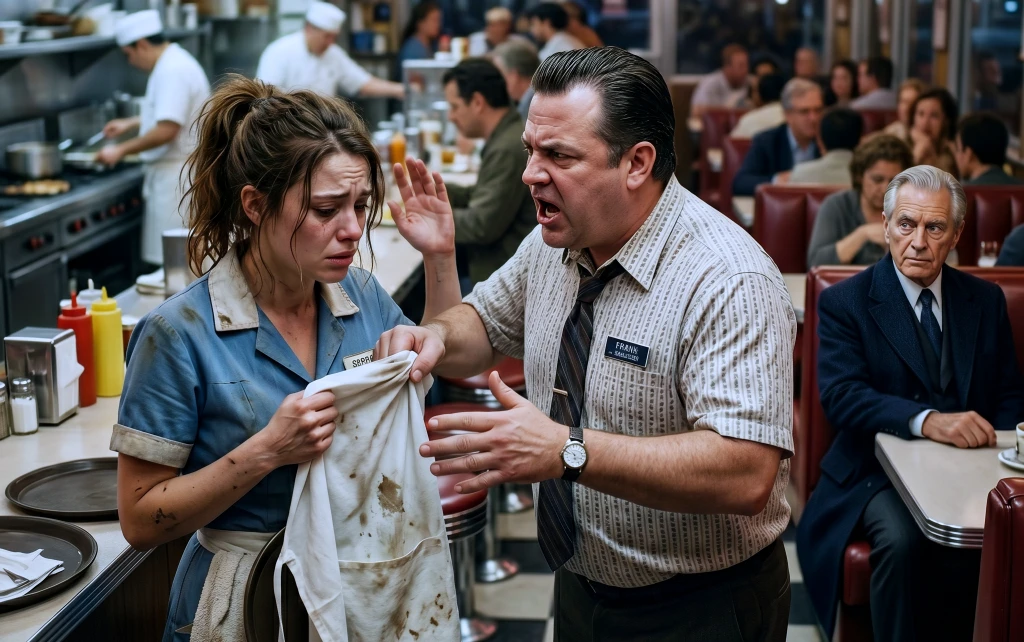
There was no pattern. They both knew it. Doug had been cutting the older servers’ hours and giving weekend shifts to his cousin, and Rachel had made the mistake of asking why pooled tips no longer matched the receipts. Her lateness had simply given him a cleaner sentence to use.
“Please,” she said, hating the word as soon as it left her. “Rent is due next week. Give me the lunch shift. Write me up. Anything.”
Doug held out his hand. “The apron.”
Rachel untied it. The strings caught in her damp hair, and for a second she had to fight with the knot while the whole diner watched. She folded the apron once, set it on the counter, and walked out before her face gave him anything else.
She did not see Arthur Grant in the rear booth.
He had arrived ten minutes earlier with a driver and a dry coat, carrying an envelope he had no intention of forcing her to accept. From behind his coffee cup, he watched Doug turn away as if four years of work could be cleared with a swipe of a dish towel.
Outside, Rachel sat in her car until her breathing steadied. Then she opened the banking app on her phone and looked at the number she had already memorized: six hundred and twelve dollars. Rent was nine hundred. The electric bill was late, June needed new sneakers, and the Honda’s check-engine light had been glowing for three weeks.
She drove home, opened her laptop, and applied for six jobs before noon. When June returned from school, Rachel said the diner had changed her schedule. It was not a good lie, but June was more interested in showing her a paper crown made from yellow construction paper.
At four, someone knocked.
Rachel expected Mrs. Alvarez or the landlord. Instead, a tall man in a charcoal raincoat stood in the hallway. He was in his late thirties, clean-shaven, with Arthur’s gray-blue eyes and none of his ease.
“Rachel Dawson?”
“Yes.” She kept one hand on the door.
“I’m Evan Grant. Arthur is my father.”
Her grip loosened. “Is he all right?”
“He is. Cold, embarrassed, and under strict instructions not to take solitary walks in thunderstorms.” Evan glanced toward June, who was coloring at the kitchen table, then back at Rachel. “I came to thank you.”
“You didn’t need to.”
“I did.” He paused. “And I need to tell you something before you decide whether to close the door on me.”
Rachel waited. “My father was sitting in the back booth when your manager fired you,” Evan said. “He heard every word…”
To read the rest of the story – CLICK the NEXT button 👇👇👇