


The euthanasia form was already on Dr. Ethan Cole’s desk when the blind giraffe calf stopped trying to stand. At 6:40 on a cold October morning, Maya Torres found her stretched on the rubber floor of the quarantine barn, her long legs folded at angles that made her look even more fragile. The calf’s name was Juniper, though everyone had shortened it to June. She was twelve days old, stood nearly six feet tall when she could be persuaded upright, and weighed less than she should have at birth.
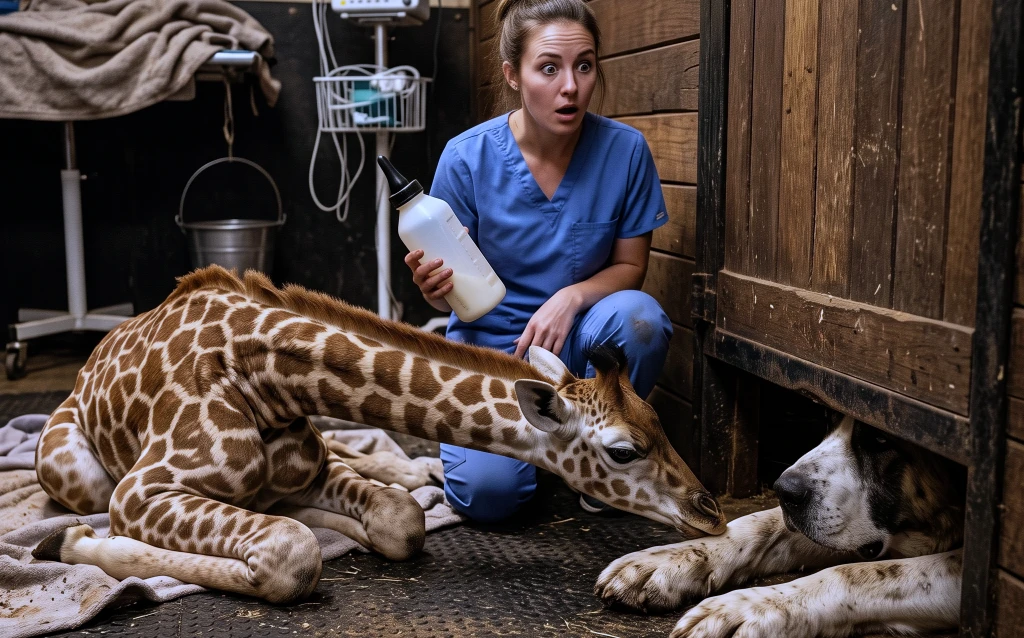
She had refused five feedings in a row.
Maya knelt near June’s shoulder without touching her. A blind giraffe could startle violently when contact came without warning, and even an exhausted calf could injure herself—or the person trying to help her.
“June,” Maya said softly. “It’s me.”
One ear moved toward her voice. The other remained flat against the calf’s head.
That small response was the only reason Maya did not call Ethan immediately and tell him it was over.
She tapped twice against the floor, the signal the staff used before entering June’s space, then placed one hand against the calf’s neck. June’s skin was cold beneath its faint spotted coat. Her breathing came in shallow pulls, and the bottle prepared for the morning feeding stood untouched in a warming bucket near the gate.
The bottle held a formula designed for giraffe calves and fitted with an oversized nipple. During June’s first few days at the High Plains Wildlife Recovery Center, two people had been needed to feed her—one to hold the bottle near the height of a mother giraffe’s udder and another to steady the frightened calf. Now it took three people to accomplish less.
June would smell the formula. Her nostrils would widen. Sometimes her tongue would touch the nipple.
Then she would turn away.
Ethan arrived before seven. His gray hair was still wet from the shower, and his jacket hung open over his scrubs. He had practiced wildlife medicine for twenty-three years, long enough to distrust both miracles and despair. Most crises changed when examined closely. A hopeless case became manageable. A hopeful one revealed damage no treatment could reverse.
June had done neither.
Her bloodwork showed worsening dehydration, dangerously low glucose and early strain on her kidneys. They could keep fluid moving through her body for a little longer, but an IV line could not replace the calories she refused to take.
Ethan listened to her heart, checked the catheter in her leg and studied her gums.
“How long since she tried to rise?” he asked.
“Three hours.”
“Even when you moved the bottle?”
Maya shook her head. “She tracked my voice. That’s all.”
From the observation aisle, Claire Bennett watched through the mesh. Claire ran the center’s operations, which meant she was responsible for permits, insurance, payroll, public donations and every decision that became someone else’s emergency. She cared about the animals deeply enough to know that caring was not always the same as continuing.
“Ethan,” she said, “we need to talk before the board call.”
He knew what was waiting on his desk.
June had come to them eight days earlier after county officials closed a deteriorating roadside safari park outside Midland. Inspectors had found underfed animals, broken fencing and medical records that had not been updated in years. June was five days old. Both eyes were swollen shut from an infection that had gone untreated since birth.
Her mother, a nineteen-year-old giraffe named Della, had been lying beside an empty water trough.
The recovery center’s team stabilized them during transport, but Della died before dawn from complications of infection and prolonged neglect. June survived the first night, then the second. Ethan and an ophthalmologist saved both eyes as organs, but not her sight. Scarring covered the corneas completely.
Blindness alone did not make her life unlivable. Ethan had seen animals compensate for losses that would have overwhelmed most people. They learned patterns, smells, textures and reliable sounds.
But June had lost her mother, her vision and every familiar scent within the same week. Since Della’s death, she had become less responsive each day.
By midmorning, the senior staff gathered in the cramped conference room beside the clinic. A photograph of June’s first standing attempt remained pinned to a corkboard behind Ethan’s chair. In it, Maya supported the calf under the chest while June leaned toward the smell of warm milk.
The animal in that photograph seemed much farther away than eight days.
Claire placed the medical summary on the table. “I’m not asking for a decision this minute. But we need a line. We can’t keep moving it because none of us wants to be the person who stops.”
“She still responds to sound,” Maya said.
“She moves an ear.”
“That matters.”
“I know it matters.” Claire’s voice remained gentle. “But does it matter enough?”
No one answered.
Ethan looked down at the unsigned form. It did not use the word failure. Forms never did. It described suffering, prognosis and humane intervention in precise language designed to keep emotion from influencing a necessary decision.
He had signed similar forms before. He remembered every one.
“What time is the board call?” he asked.
“Four.”
“Give me until noon tomorrow.”
Claire studied him. “For what?”
“I don’t know yet.”
“That’s not a plan.”
“No. It’s one night.”
Maya looked from Ethan to Claire. “If her glucose drops again, we don’t wait.”
Ethan nodded. “If her pain increases, if she can’t regulate her breathing or if the kidney values cross the line, we stop. I’m not asking anyone to prolong suffering.”
Claire closed the folder but left it in front of him. “Noon tomorrow.”
The meeting ended without relief. Maya returned to the quarantine barn. Claire went to call the board. Ethan stayed at the table, staring at the photograph behind his chair.
At 11:15, his phone vibrated.
The missed call had come from Dana Ruiz, director of the Randall County Animal Shelter. Ethan almost ignored it. He occasionally performed surgeries for the shelter, but anything short of an emergency could wait.
Then he saw the message.
I know you’re overloaded, but I need your opinion on a dog. Eleven-year-old Central Asian shepherd. Owner died. Healthy enough to recover, but he’s shutting down. Hasn’t stood for anyone since yesterday.
Ethan read it twice.
He called Dana.
“What do you mean, shutting down?”
“He eats only if I sit inside the kennel. He doesn’t react to other dogs, toys or walks. He spends all day facing the service entrance.”
“Pain?”
“Arthritis, but it’s controlled. Bloodwork is decent. He had heat exhaustion when he came in, and his paws were torn up, but those are healing.”
“What happened to the owner?”
There was a pause.
“Stroke in the south pasture. The ranch hand found them the next morning. The dog had stayed beside him through the night.”
Ethan looked through the conference-room window toward the quarantine barn. The long metal roof shone white beneath the Texas sky.
“What’s the dog’s name?”
“Atlas.”
Two hours later, Ethan drove north through fields flattened by dry wind. He told himself he was going because a shelter had requested a veterinary consult. He told himself it had nothing to do with June.
He did not believe either explanation.
The shelter’s quiet ward stood behind the main kennel building, separated from the sharp chorus of barking by two concrete walls. Dana met him at the door with her hair tied beneath a faded baseball cap.
“You look worse than I do,” she said.
“I have a giraffe calf who won’t eat.”
“I have a two-hundred-pound dog who thinks every person walking past might be dead.”
“Then we’re both having a good week.”
Dana gave him a tired smile and led him to the last kennel.
Atlas lay on a raised bed with his back against the wall. He was enormous, even curled tightly. His coat had once been white but was stained rust-colored along the legs from the ranch soil. A pale gray patch covered one ear, and an old scar crossed the bridge of his nose.
He opened his eyes when Ethan approached.
He did not lift his head.
Central Asian shepherds were bred to make decisions without constant human direction. Ranchers valued them because they could patrol alone, assess danger and place themselves between livestock and predators. They were not usually eager to please strangers.
Atlas did not look suspicious of Ethan. He looked past him.
Dana unlocked the gate and entered first.
“Hey, old man.”
One of Atlas’s ears moved. His gaze remained fixed on the service door at the opposite end of the ward.
Dana sat on the floor and held out a piece of cooked chicken. After several seconds, Atlas raised his head and took it carefully. He chewed once, swallowed and lowered his chin again.
“His owner was Sam Hayes,” Dana said. “Sheep and goats, about thirty miles east of here. His daughter signed the intake papers because she lives in a second-floor apartment in Austin. She wanted to take him, but Atlas has never lived indoors, and he nearly went through a window the first night.”
“What did the ranch do with the flock?”
“Sold most of it. A neighbor took the rest.”
Ethan stepped into the kennel after Dana. Atlas followed him with his eyes but made no other movement.
“Sam’s clothes?”
“The daughter took them. There’s a blanket from the truck in his bed.”
Ethan crouched several feet away. “Atlas.”
The dog’s eyes shifted toward his face.
Ethan waited. He had learned that silence sometimes revealed more than calling, touching or coaxing. Atlas smelled the air, examined him briefly and returned his attention to the service entrance.
Waiting for a man who would not walk through it.
Ethan thought of June turning her face from the bottle. He thought of her ear moving toward Maya’s voice while the rest of her body stayed flat against the floor.
The comparison was imperfect. One animal was a guardian dog shaped by years of work beside a human being. The other was a newborn prey animal whose world had vanished before she had learned its boundaries.
Still, both had stopped responding to the things meant to keep them alive.
“I brought something,” Ethan said.
Dana watched as he opened his medical bag. Inside was a sealed plastic pouch containing a small square of cotton cloth. Maya had rubbed it against one of the padded rails in June’s stall, where the calf had rested her neck.
“You brought giraffe smell into my dog ward?”
“Not into the ward. Not yet.”
“That distinction disappeared when you opened the bag.”
Ethan held the cloth loosely at his side. He did not push it toward Atlas. The dog’s nostrils moved almost immediately.
For the first time, Atlas turned his head away from the service entrance.
He inhaled again.
His expression did not transform. There was no sudden brightness, no dramatic recognition. His body simply became attentive. The muscles along his shoulders tightened beneath the heavy coat, and his nose lifted several inches from the bed.
Ethan placed the cloth on the floor between them.
Atlas stared at it.
Then the old dog rose.
The movement was slow. His back legs shook, and he paused halfway up as though surprised by the effort. But he stood, crossed the kennel and lowered his broad white head over the piece of cloth.
He smelled it for nearly a minute. When Ethan reached for the pouch, Atlas placed one paw over the cloth. Dana stopped breathing. Atlas lifted his head and looked directly at Ethan. Then he walked past him to the kennel gate and waited…
To read the rest of the story – CLICK the NEXT button 👇👇👇