


The first SUV stopped so close to Ruth Callahan’s porch that its tires crushed the border of white stones she had arranged around the marigolds. A second one settled behind it, followed by a gray sedan with Tennessee plates. Three doors opened almost at once.
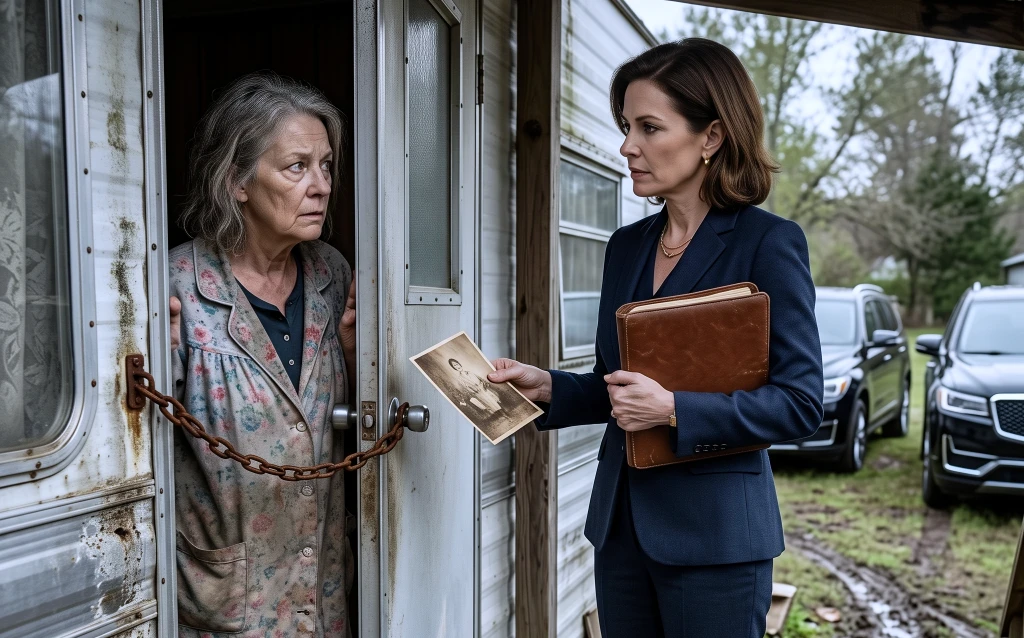
Ruth watched through a slit in the blinds, one hand still wrapped around the dish towel she had been using to catch rainwater beneath the kitchen window. People who came to her single-wide in polished shoes usually wanted a signature, money, or both. The finance company had already called twice that month about the roof loan. The county had sent notices about the abandoned trailer next door. She could not think of any good reason for three vehicles.
Her phone buzzed on the counter. It was her neighbor, June.
You okay over there?
Ruth typed back, Don’t know yet, then slid the chain across the door before opening it four inches.
The woman on the porch looked to be in her forties, with a navy suit, sensible heels, and a leather folder held against her chest. A silver-haired man stood a step behind her. The third visitor, a younger woman, waited beside the sedan with a document box.
“Mrs. Callahan?” the woman asked. “Ruth Ann Callahan?”
“That depends on who’s asking.”
“My name is Leah Park. I’m an attorney with the estate of Jonah Vance.” She offered a business card through the gap, but Ruth did not take it. “Were you once Ruth McKenna, owner of the Lantern Diner in Bellwether, Tennessee?”
The name struck harder than it should have. McKenna belonged to a different kitchen, a different marriage, and a version of Ruth who still believed there were some losses a person could outwork.
“I haven’t used that name in thirty years.”
Leah nodded as if that answer completed something. “Then we found the right woman.”
The silver-haired man lowered his gaze to the porch boards before speaking. “Mrs. Callahan, do you remember the ice storm in January of 1991? A teenage boy came into your diner carrying a guitar case repaired with gray tape.”
Ruth’s fingers tightened on the door.
There were things age blurred kindly: phone numbers, faces from church, the reason she had walked into a room. That boy had never blurred. He had remained eighteen in her memory, all elbows and watchful eyes, holding a broken guitar case as if it were the only proof he had ever belonged to anyone.
“What about him?”
Leah glanced toward the rain beginning to stipple the porch. “May we come inside? What we need to show you shouldn’t be discussed through a chained door.”
Ruth almost said no. Then the younger woman opened the document box and lifted out a flat archival case—the sort museums used for things that could not be replaced. Ruth unhooked the chain.
Her kitchen had room for four chairs if everyone turned sideways. Leah sat across from Ruth while the silver-haired man introduced himself as Martin Bell, a forensic investigator retained by the estate. The younger woman, Celia Grant, represented a Nashville trust company. Their titles made Ruth feel as though she had wandered into the wrong meeting.
Leah placed a photograph on the table.
A man stood alone beneath a stage light, his head bent over an acoustic guitar. He was older than the boy Ruth remembered, with silver at his temples and a face made lean by years on the road. Thousands of blurred lights filled the dark beyond him.
Ruth did not recognize the expensive guitar or the black shirt or the confidence in his stance. She recognized the way he held his shoulders, slightly forward, as if part of him still expected to be asked to leave.
“That’s him,” she said. “That’s the boy from the diner.”
Leah’s expression softened. “His legal name was James Hale. He performed as Jonah Vance.”
Ruth looked again. The stage name meant little to her, but the face in the photograph did. “He became a musician?”
Martin and Celia exchanged a look.
“He became one of the most successful songwriters of the last thirty years,” Leah said. “You’ve almost certainly heard his music.”
Ruth gave a small, embarrassed shrug. After her second husband died, she had stopped replacing things unless they were necessary. The television had gone first. The radio in her truck only picked up two stations, one gospel and one farm report.
Leah took out her phone. “There’s one song in particular.”
The opening guitar figure was quiet enough to sound private. Then came a piano, followed by a voice weathered at the edges. Ruth had heard that voice in grocery stores, at a memorial service, once through the wall of a motel room when she was driving home from her sister’s funeral. She had never known who sang it.
The chorus began.
When there’s nowhere left to send your love,
Give it to the living…
Ruth reached for the phone and stopped just before touching it.
“Turn that off.”
Leah paused the song.
For several seconds, the only sound in the kitchen was water tapping into the metal bowl beneath the window.
“He wrote that down,” Ruth said. “At the counter. On one of my napkins.”
No one asked what she meant. Their silence told her they already knew.
The memory opened from the middle, bright and complete.
The Lantern Diner had been nearly empty that night in 1991. Sleet struck the front windows, and the neon coffee cup above the entrance blinked on and off because Ruth had not yet found the money to repair the transformer. She was stacking stools at 10:40 when the door dragged open against the wind.
The boy stepped inside but did not come farther than the rubber mat. His denim jacket was dark with melted ice. A flannel shirt showed through a split seam at one elbow, and his sneakers made small wet marks on the tile. The guitar case in his hand had been wrapped so many times with duct tape that almost none of the original black covering remained.
“We’re closed,” Ruth said, then wished she had not sounded so tired.
“I’m not asking you to open.” His voice was careful. “I saw the help-wanted card in the window. I can wash dishes or take out trash. Just for something to eat.”
The card had been there since Thanksgiving, though Ruth could not afford another employee. She looked at his hands. They were red from the cold and trembling hard enough to rattle the brass latches on the guitar case.
“How old are you?”
“Eighteen.”
“You got identification?”
He shook his head.
“A name?”
A pause. “Jamie.”
It might have been true. Ruth understood even then that it was all he planned to give her.
She should have pointed him toward the overnight shelter in the next county, though the roads were already closing and the shelter had twelve beds for three towns. Instead, she heard herself say, “Sit in that booth before you fall over.”
She cooked eggs, hash browns, and the last two strips of bacon from the breakfast tray. He ate too quickly at first, then slowed when he noticed her watching. When she put a wedge of chocolate pie beside his plate, he stared at it as though there might be a condition hidden beneath the whipped cream.
“I can work,” he said.
“You can eat.”
“I don’t take charity.”
“Then wash the skillet afterward, and we’ll both feel respectable.”
That almost made him smile.
The county dispatcher came over the radio at eleven to announce that the highway east of town had been shut down. Ruth looked toward the windows, where the sleet had become thick, slanting snow.
“You have somewhere to sleep?”
Jamie focused on the pie. “I’ll figure it out.”
There had been a time when Ruth believed that phrase. Her son, Sam, used to say it whenever he was scared and did not want her to know.
I’ll figure it out, Mom.
The last time he said it, he was nineteen and trying to convince her that the rattle beneath his old Pontiac could wait until payday.
Three weeks later, a drunk driver crossed the center line on Highway 18.
Ruth picked up Jamie’s empty plate. “There’s a storeroom behind the kitchen. It has a cot, if you don’t mind sleeping next to canned peaches and paper towels.”
His face changed so quickly that she had to look away. Suspicion came first, then hope, then a stubborn effort to hide both.
“What do you want for it?”
“Tonight? Nothing.” She pointed the plate toward the sink. “Tomorrow, you can earn breakfast.”
He stayed through the storm. Then he stayed through the week after it, because the snow melted but whatever waited for him beyond Bellwether did not become safer.
Jamie never had to be told twice. He scrubbed the griddle, repaired a loose cabinet hinge, and took apart the leaking faucet with a borrowed wrench. During the day he disappeared to the public library. At night, after Ruth turned the sign to CLOSED, he sat in the last booth and played so softly that the notes seemed to rise from the building itself.
Ruth had not understood how silent the diner had become until music returned to it.
Back in her trailer, Leah slid a cream-colored sheet from the folder. It was a copy of a songwriter split agreement dated May 3, 1994. The paper carried Jonah Vance’s signature, the signature of a publisher, and one line typed beneath them.
Ruth Ann McKenna — twenty-five percent, lyrics.
Ruth pushed the page away. “No. I didn’t write a song.”
“He said you did,” Leah replied. “His publisher argued with him for weeks. Mr. Vance would not release the record until your share was protected.”
“I talked to a frightened kid in an empty diner. That’s all.”
Celia opened a second folder. “Since you could not be located, your share was placed in a restricted account. It includes mechanical royalties, performance income, licensing fees, and the investment earnings directed by Mr. Vance’s publishing trust.”
Ruth looked from one stranger to another. “How much?”
Leah did not answer immediately. Instead, she set a sealed envelope beside the old agreement. The handwriting on the front was firm and slanted, nothing like the cramped scrawl Ruth remembered—except for the capital R, which leaned too far to the right.
For Ruth, if they ever find her.
“He died seven months ago,” Leah said. “And this letter was the first instruction in his will…”
To read the rest of the story – CLICK the NEXT button 👇👇👇