


“Which one of you wants to hold him?” Dr. Lena Ortiz asked.
Claire Bennett looked down at the German Shepherd puppy already tucked against her chest. Scout’s head rested in the bend of her elbow, heavier than it had any right to feel. At four months old, he should have been wrestling with shoelaces, stealing dish towels, and discovering new ways to get stuck beneath the coffee table.
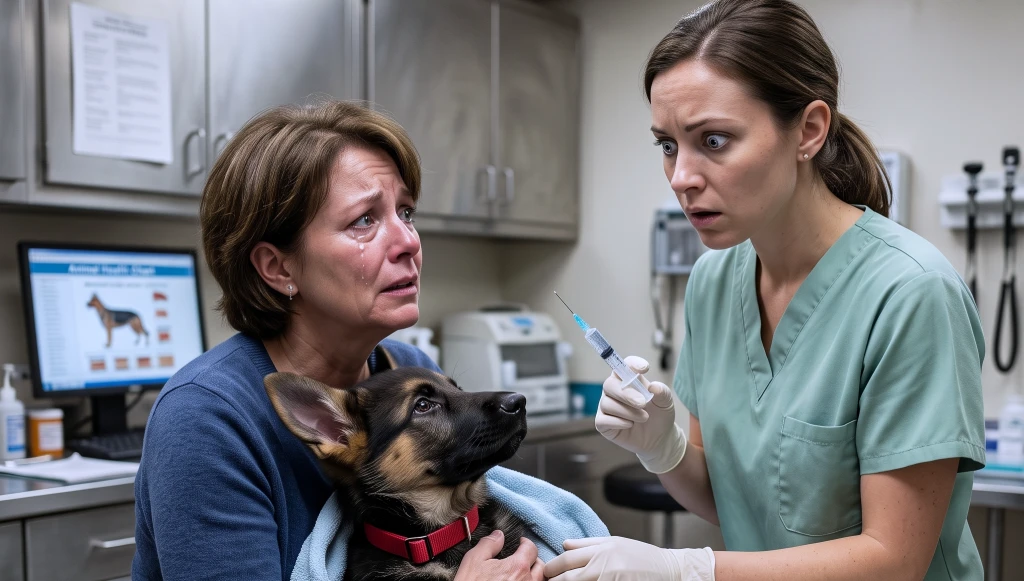
Instead, each breath seemed to require a decision.
“I’ve got him,” Claire said.
Across the examination room, Ethan stood beside the metal table with an empty red leash wrapped around his fist. The signed euthanasia form lay on the counter behind him. Claire had watched him write his name at the bottom, watched the pen hesitate before the final letter, and still had not forgiven him.
Dr. Ortiz pulled a rolling stool closer. She was in her early forties, with dark hair twisted into a loose knot and the tired, attentive face of someone nearing the end of an overnight shift.
“I’m going to explain everything once more,” she said. “You can stop me at any time. You can also change your mind at any time before I give the final medication.”
Claire pressed her mouth against Scout’s forehead. His ears, usually too large for his head, lay flat against her arm.
“Will it hurt?”
“No. I’ll give him a sedative first. He’ll become very sleepy. After that, the final injection will stop his heart. He won’t be frightened, and he won’t feel pain.”
Scout’s eyes moved toward the sound of her voice.
That was what Claire could not reconcile. His body had failed in pieces over the previous three days, but his eyes still followed them. When Ethan crossed a room, Scout watched him. When Claire whispered his name, his gaze shifted toward her as though he were trapped somewhere behind the weakness, waiting for them to find the door.
Ethan moved closer. “Can we have another minute?”
“Take as long as you need.”
Dr. Ortiz rose and stepped outside, leaving the door partly open.
The clinic was quiet at 2:17 in the morning. Somewhere beyond the room, a dog barked once and was answered by the muted roll of a cart. The ventilation system blew cold air from a ceiling vent, lifting one corner of the consent form.
Claire stared at Ethan.
“You signed it.”
He flinched as though she had struck him. “You said you couldn’t.”
“I said I couldn’t hold the pen.”
“What was I supposed to do?”
“Tell them no.”
“And then what?” His voice stayed low, but the leash tightened around his hand. “Take him home when he can’t stand? Wait until he can’t draw another breath?”
Claire looked away.
On Tuesday morning, Scout had stumbled while chasing a tennis ball across their kitchen. He had stood again immediately and shaken himself, embarrassed in the way puppies sometimes seemed embarrassed by their own feet. Claire had laughed and called him clumsy.
By that evening, his back legs were dragging.
Their regular veterinarian had found no broken bones, no fever, and no obvious injury. Bloodwork showed mild dehydration but nothing that explained the weakness. Scout was given fluids and sent home with instructions to return if he worsened.
He worsened before sunrise.
On Wednesday, he could no longer climb the two steps from the patio. By noon, his bark had faded into a dry whisper. That night, he coughed after trying to drink, and water ran from the side of his mouth.
They drove him to a second clinic thirty miles away. More bloodwork. More examinations. X-rays that revealed no obstruction and no injury. The veterinarian there had spoken carefully about an aggressive neurological disease, possibly congenital, possibly affecting the nerves that controlled Scout’s muscles.
When Scout’s breathing became shallow, they were sent to Riverbend Veterinary Emergency Center in Knoxville.
The notes transferred with him used phrases Claire had read so many times that the words no longer looked real: rapidly progressive weakness, poor prognosis, respiratory compromise.
One doctor had mentioned a specialist, advanced imaging, days or weeks of intensive care, and no guarantee that Scout would ever breathe normally again. Another had asked them to consider whether further intervention would prolong his life or only prolong his distress.
At 1:40 a.m., Scout had stopped lifting his head.
Claire had said, “I don’t want him to suffocate because we’re too scared to let him go.”
Now Ethan repeated the words back to her.
“That’s what you told me,” he said. “You made me promise.”
“I wasn’t asking you to agree so fast.”
“I didn’t agree fast.”
“You didn’t even argue.”
“Because you were already falling apart.”
“And you weren’t?”
Ethan loosened the leash from his hand. The skin across his palm was marked with red lines.
“I took him into the hall before I signed,” he said. “I asked Dr. Ortiz if there was anything they had missed. I asked her twice.”
Claire had not known that.
He sat beside her, leaving several inches between their shoulders. For the first time since they arrived, she noticed how pale he was.
“What did she say?”
“She said she’d examine him again before anything happened. She said she couldn’t promise a different answer.”
Scout’s back foot twitched against Claire’s sweater.
Both of them looked down.
“Hey, buddy.” Ethan touched one finger to the puppy’s nose. “I’m right here.”
Scout’s eyes shifted toward him.
They had met him seven weeks earlier at a rescue event outside a farm supply store. Claire had gone only to buy potting soil. Ethan had warned her before they entered that they were not bringing home a dog.
Twenty minutes later, he was sitting cross-legged on the concrete with a black-and-tan puppy chewing the lace from his left boot.
Scout had been the quietest of the litter, but not the shyest. He watched everything. Shopping carts, children, sparrows beneath the parked cars. When Claire knelt, he placed one paw on her wrist and leaned his entire warm weight against her.
“He scouts the place before he trusts it,” Ethan had said.
The name followed them home.
For the first week, Scout refused to sleep unless one paw touched Claire. She would wake to find it resting on her arm or pressed against the side of her neck. Ethan joked that the puppy was checking whether she had disappeared.
On the night before Scout became sick, he had finally climbed onto the couch without help. He celebrated by stealing Ethan’s sock and falling asleep with it in his mouth.
The sock was still beneath the coffee table.
Claire had seen it before they left for the clinic and had nearly collapsed beside it.
“I should’ve found something,” she whispered.
Ethan turned toward her. “We took him to three doctors.”
“I’m his person. I should’ve known.”
“You knew he was sick.”
“I thought he tripped because he was growing too fast. I laughed.”
“So did I.”
“I told him he was clumsy.”
“Claire.”
She closed her eyes. “He trusted us.”
Ethan placed his hand on Scout’s side, careful not to press against his ribs. “And we brought him here.”
“To die.”
“To keep him from suffering.”
The words landed between them, neither cruel nor comforting.
Dr. Ortiz tapped softly before entering. A veterinary technician followed her carrying a small tray. On it were two syringes, a folded towel, and a strip of white tape.
Claire’s arms tightened.
“Before we begin,” Dr. Ortiz said, “I want to listen to him one more time.”
She placed her stethoscope against Scout’s chest, then along his side. She listened for nearly a minute, moving the bell to several positions. Scout’s heartbeat was fast but steady enough to make the metal disk shift against his ribs.
Dr. Ortiz checked his gums and shone a narrow light into his eyes. Then she pressed the pad of one finger between the toes of his back foot.
Scout pulled the foot away.
It was barely a movement, but it was there.
Dr. Ortiz repeated the test on the other side.
Again, Scout responded.
“What does that mean?” Claire asked.
“It means he still has sensation. That doesn’t tell us why he’s weak.”
“But is that good?”
“It’s information.” Dr. Ortiz looked at Scout’s face. “His pupils are responsive. He’s mentally alert, even though he can barely move.”
“The other doctor said that could happen with a nerve disease,” Ethan said.
“It can.”
The technician fitted a small catheter into a port already taped to Scout’s front leg. Dr. Ortiz picked up the first syringe but did not attach it.
“Once I give this, he’ll become sleepy,” she said. “There’s no rush. Say whatever you need to say.”
Claire bent over Scout until her forehead touched his.
“I’m sorry,” she whispered. “I’m so sorry we couldn’t fix it.”
Scout’s breath warmed a small patch beneath her chin. For several seconds, he did not move.
Then his front leg trembled.
The paw slid upward, caught in the sleeve of Claire’s sweater, and rested across her wrist.
Claire made a broken sound that did not feel like it came from her. She curled around him, supporting his chest as he strained to lift his head.
“Easy, baby. You don’t have to.”
Scout pushed his muzzle beneath her chin.
The movement turned his head sharply to the left. His red collar, loose after three days of refusing food, slipped toward his shoulder.
Dr. Ortiz stopped with the syringe in her hand.
Her gaze fixed on the dark fur below Scout’s ear.
“Claire,” she said, “don’t move him.”
The tone of her voice changed the room.
Ethan stood. “What is it?”
Dr. Ortiz set the syringe down. She leaned close, parted the fur above the collar with two gloved fingers, and stared at something hidden against Scout’s skin.
“Get me forceps,” she told the technician. “And turn on the oxygen.”
The technician crossed the room immediately.
Claire looked from the veterinarian’s face to the small patch of exposed skin.
“What do you see?”
Dr. Ortiz reached beneath the loosened collar. “Something that should have been found days ago…”
To read the rest of the story – CLICK the NEXT button 👇👇👇