


The service gate at the Juniper Wells Fairgrounds was not designed to be opened from a wheelchair. Seventeen-year-old Eli Mercer had to hook two fingers beneath the spring latch and pull sideways while bracing his other palm against a push rim. Behind him, his mother said his name once—not loudly, but with the stripped-down terror of someone who had already watched one ordinary afternoon turn into sirens and a helicopter.
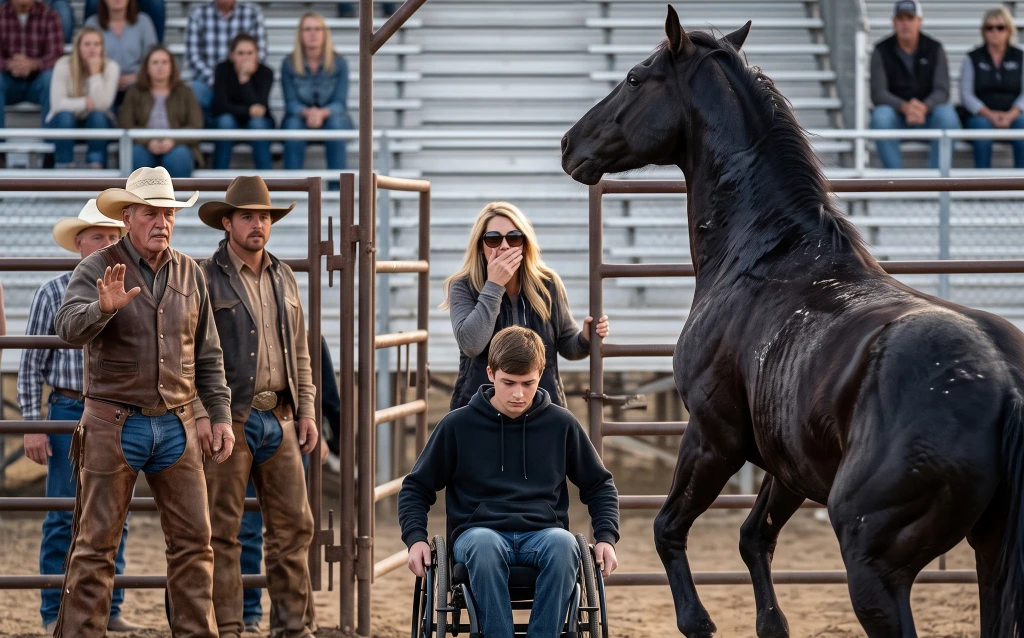
“Eli. Take your hand off that gate.”
Across the arena, the black mustang drove both hind feet into a steel panel. The impact shook the temporary fencing and sent a sharp report through the covered grandstand. A little boy near the aisle dropped his snow cone. One of the handlers swore and backed away with a torn lead rope hanging from his glove.
The horse’s intake card called him Rook. He had been gathered nine days earlier from the Blackstone Range, where there were no loudspeakers, plastic banners, or people leaning over rails to watch him fail. Since arriving at the adoption event, he had broken a gate hinge, climbed halfway over a sorting panel, and sent one experienced horseman to urgent care with a deep bite through the forearm.
Now five handlers had him boxed inside a round pen no larger than a suburban backyard. Every time one of them lifted a rope or shifted a boot, Rook spun to face the pressure, his neck rigid and his dark coat pasted with sweat. The crowd had cheered his first explosion. No one was cheering anymore.
Eli kept his fingers on the latch.
His mother moved around the chair until she stood between him and the gate. Rachel Mercer wore sunglasses, but they could not hide the fear tightening the skin around her mouth. “Back up,” she said. “Right now.”
“He’s not trying to fight them.”
“I don’t care what he’s trying to do.”
“He thinks there’s nowhere left to go.”
Rachel stared at him as if the sentence had come from someone standing behind the chair. For most of the two-hour drive from their home outside Carson City, Eli had answered her with shrugs. He had ignored the horses in the first two pens, refused lunch, and kept his hood up despite the heat. She had brought him because a physical therapist once said, carefully, that being near horses might remind him of something he still wanted. Rachel had clung to the suggestion long after Eli stopped returning the therapist’s calls.
Until that moment, the trip had looked like another mistake.
A public-address speaker crackled above the ring. “We’re going to pause the demonstration while the crew resets,” the announcer said. His voice had the false ease of a man speaking to families while deciding whether an ambulance should be moved closer. “Please remain behind the yellow rail.”
Two handlers opened a narrow lane toward the holding pens. Rook saw the opening and rushed it, but another man stepped into view with a flag. The mustang slammed on his front feet, wheeled, and struck the fence again. A bolt jumped loose and landed in the dirt.
Eli flinched—not at the sound, but at the way the horse’s body folded back on itself. He knew what it was to have every available direction closed by somebody who claimed to be helping.
Twenty-two months earlier, Eli had still been the kid adults asked to start their nervous colts. He had ridden ranch-horse classes on weekends, worked cattle for a neighbor after school, and kept a running list of colleges with equine programs taped beside his bedroom door. At fifteen, he could read the change in a horse before most people noticed the ears move.
Then a side-by-side ATV rolled into a dry wash on a trail he had driven a hundred times. The machine landed across his lower back. By sunset, his mother was standing beneath the rotor wash of a medical helicopter while a paramedic held her shoulders to keep her from running toward it.
The surgeries saved his life. Rehabilitation taught him how to transfer into a shower chair, how to dress without falling, and how to answer strangers who asked questions they would never have asked before. None of it gave him back the feeling below his waist.
For months after he came home, his saddle stayed on its rack in the garage. Rachel dusted around it until the day she found him staring at it from the doorway. The next morning, the saddle was gone. She never told him where she put it, and he never asked.
Now Rook hit the panel a third time, and something inside Eli came awake so abruptly it hurt.
He saw details the crowd missed: the horse always escaped to his right; the left eye stayed harder; the shoulders tightened before the hindquarters swung. He saw that Rook was not choosing aggression so much as selecting the last answer that had not yet been taken from him. More pressure would not make him manageable. It would make him desperate.
“Mom,” Eli said, “move.”
Rachel’s hand closed around one of the wheelchair handles. “No.”
“I’m not asking to touch him.”
“You’re not going in there at all.”
A handler at the rail glanced toward them. “Ma’am, you need to keep him back from that gate.”
“I’m trying,” Rachel said.
The words landed harder than she intended. Eli’s shoulders stiffened, and her grip loosened at once.
“I didn’t mean—”
“Yeah, you did.” He released the latch, but only so he could turn the chair. For half a second, Rachel thought he had given in. Then he drove both hands against the rims and angled around her toward the wider equipment entrance.
The loose arena footing grabbed his front casters almost immediately. Eli leaned back, lifted them over a ridge, and shoved again. The motion was ugly and effortful, nothing like the quiet control he once had in a saddle, but it carried him three feet closer.
Rachel caught up and planted herself in front of him. “Look at me.”
He stopped because there was no path around her.
Her sunglasses had slipped down her nose. Behind them, her eyes were wet and furious. “I know you’re angry. I know you hate that I brought you. You can hate me all the way home. But I will not stand here and watch another machine carry you away.”
The chair seemed to narrow around him. People nearby had begun pretending not to listen, which was worse than staring. Eli lowered his voice.
“This isn’t about proving I’m not scared.”
“Then what is it about?”
He looked past her. Rook had stopped moving, though only because the handlers had retreated to inspect the loose panel. The mustang stood in the far corner, legs spread, sides heaving. Dust clung to the wet skin beneath his eyes.
“He hasn’t had one person walk up to him without wanting something,” Eli said. “Every rope says come here. Every flag says move. Every gate says not that way. He needs somebody to stop asking.”
Rachel followed his gaze. For one dangerous second, sympathy crossed her face. Then fear closed over it again.
“You can stop asking from this side of the fence.”
“Not if all he sees is another person at the rail.”
A gray-bearded man in a sweat-darkened hat had come out from behind the holding chutes. He did not join the other handlers. He watched Rook first, then Eli, measuring both with the same unreadable expression. When the announcer asked over the speaker whether the crew was ready, the older man raised one hand and shook his head.
The pause gave Eli the opening he needed.
He spun the chair hard, caught the equipment gate before Rachel could reach him, and shoved the latch upward with the heel of his hand. The gate swung inward six inches. Rachel grabbed his shoulder, but momentum had already carried the small front wheels across the threshold.
“Eli!”
A woman screamed from the lower bleachers. The announcer’s voice snapped through the speakers. “Stop. Young man, do not enter the arena.”
The handlers turned together. One started toward him, and Rook reacted to the movement before anyone could call him off. The mustang lunged away from the man, cut across the pen, and came to a sliding stop with his chest facing Eli.
For the first time all afternoon, the horse became completely still.
Eli was twelve yards inside the fence. The gate remained open behind him, but Rachel stood in the gap, one hand pressed to her mouth. If Rook charged, there was no firm ground to push against and no time to turn. Eli knew that. The knowledge moved coldly through his chest, precise and clean.
He took his hands off the wheels.
“Everybody hold,” the gray-bearded man said. His voice carried without the microphone. “Don’t crowd either one of them.”
A handler stared at him. “Wade, that kid can’t get clear.”
“I can see that.”
Eli lowered his chin and let his gaze fall to a patch of dirt several feet in front of Rook. Direct eye contact would have been another demand. He softened his elbows, opened his hands on his thighs, and forced air slowly through his nose.
The chair sat crooked because one caster had sunk deeper than the other. Every part of him wanted to straighten it. He resisted. Even the click of a brake lever might be too much.
Rook’s nostrils worked. His ears stayed pinned, but no longer at a handler or a flag. They were aimed at the unfamiliar shape in the arena—the chrome frame, the black tires, the boy who had entered his space and then refused to advance.
A fly landed on Eli’s cheek. He let it crawl toward his jaw.
The grandstand had gone so quiet he could hear the old ventilation fans turning above the rafters. Somewhere behind the holding pens, a horse knocked a feed tub against a wall. Rook’s head jumped at the sound, but his feet remained planted.
Eli remembered an unstarted bay colt he had worked with when he was fourteen. His old coach had told him that patience was not the absence of action; it was choosing not to spend pressure before it could buy anything. At the time, Eli had nodded as though he understood. Sitting unprotected in the churned dirt, he finally did.
He let Rook keep the distance.
The mustang blew out once, sharp and suspicious. A cloud of pale dust lifted around his muzzle. The muscles along his neck quivered, then released by a fraction.
Behind Eli, Rachel whispered, “Please come back.”
He could not answer without changing the room between himself and the horse. His fingers trembled against his jeans, and he pressed them flat so Rook would not see the motion.
The gray-bearded man—Wade—stepped sideways until his body blocked the nearest handler from entering. “Give the horse a choice,” he said.
“He’s going to get that boy killed,” someone muttered.
Wade did not look away from the pen. “Maybe. But rushing in will make sure of it.”
Rook’s ears eased apart. One turned toward the handlers; the other stayed on Eli. His breathing slowed enough that the hollow above his nostril stopped fluttering.
Eli waited without lifting his head.
A full minute passed. Then another. The fear did not vanish from the horse, and Eli did not pretend his own had gone anywhere. It sat between them, honest and heavy, with no rope attached to either end.
Rook raised his head until both dark eyes settled on the wheelchair. Then he left the fence and took one careful step into the open—not toward the gate or the handlers, but straight toward Eli…
To read the rest of the story – CLICK the NEXT button 👇👇👇