


The sound came from beneath the snowbank after I had already driven past it. I hit the brakes hard enough to send two empty dog crates sliding into the back of my truck. For a few seconds there was only the tick of the engine and the dry hiss of snow crossing the road. Then it came again—a thin, torn note, too low for a bird and too weak for a bark.
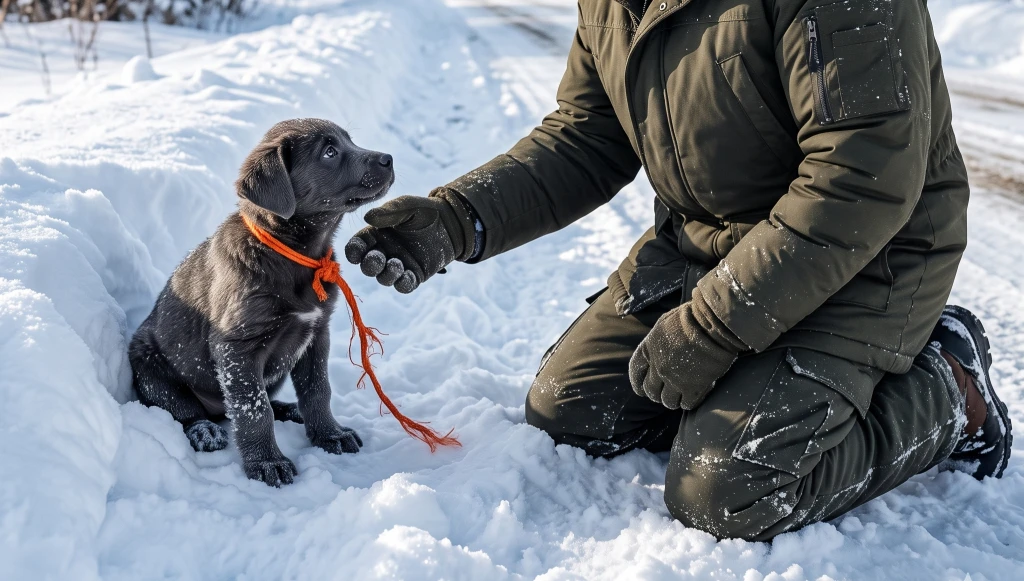
I backed onto the shoulder and climbed out. The December sun hung over the Beartooth foothills like a white coin, bright enough to make the drifts glitter and cold enough to hurt my teeth when I breathed. I had just finished a volunteer shift at the county shelter outside Red Lodge, and my gloves still smelled faintly of bleach and kibble.
At first I saw nothing. Then a patch of gray moved in the ditch.
The animal was wedged beneath a shelf of plowed snow, one foreleg bent under him and his muzzle crusted with ice. He was puppy-sized, though his paws looked too large for the rest of him. A narrow nylon collar circled his neck. Clipped to it was six inches of bright orange cord, cut cleanly at the end.
Someone had tied him to something and then left without him.
I knelt, keeping my body turned sideways so I would not crowd him. His eyes opened, pale and unfocused. He tried to lift his head and made the same damaged sound I had heard from the road.
“Easy,” I said. “You don’t have to do anything.”
I called Dr. Elena Ruiz at the emergency clinic with one hand while I cleared loose snow from his ribs with the other. She told me not to put him against direct heat, not to give him food, and to get him there as fast as I safely could. I wrapped him in the wool blanket I kept behind the seat and laid him in a crate with the door removed so I would not have to force him through it.
The blanket had belonged to my wife. Nora used to keep it in the truck because she believed Montana weather took personal offense when people felt prepared. She had been gone almost two years, but I still thought of it as hers.
The puppy did not resist when I lifted him. That frightened me more than teeth would have.
Halfway to the clinic, he began to shiver. Dr. Ruiz later told me that was a good sign. At the time it sounded like his bones were rattling apart.
They took him through the back as soon as I arrived. A technician cut away the collar because the buckle had frozen, and the orange cord landed on the stainless-steel table with a small, ugly tap. I put it in my coat pocket without knowing why.
For the next hour, I sat under a television no one had turned on and watched staff move through the swinging doors. I had spent enough Saturdays at the shelter to recognize the careful faces people wore when they did not want to make promises. When Dr. Ruiz finally came out, her dark hair was escaping its clip and there was a wet mark on the shoulder of her scrub top where the puppy had been resting.
“He’s severely hypothermic and dehydrated,” she said. “There’s frost injury on the pads and ear tips. But his heart rhythm is improving, and I’m not hearing fluid in his lungs.”
“Is he going to make it?”
“I don’t know yet.” She sat beside me instead of standing over me. “He’s young. Maybe ten weeks, give or take. Young can work for him or against him.”
They kept him overnight. I went home because the clinic had no reason to let a middle-aged cabinetmaker occupy its waiting room until morning, but I did not sleep. I washed the blood and road grit from my hands, made coffee at two, and stood in the kitchen staring at the empty space where Nora’s blanket usually hung over a chair.
At 4:17 a.m., Dr. Ruiz texted: He is warmer. He ate a few bites. Still guarded, but better.
I read the message six times.
By afternoon he could stand, though his legs trembled. The clinic had scanned him twice for a microchip and checked every local lost-animal report. No one had called about a gray puppy with an orange tether. No one came looking during the next three days either.
The shelter manager told me they could take him once he was medically stable, but they were already housing dogs in collapsible kennels in the laundry room. I had fostered eleven dogs since Nora died. Most stayed a week or two, learned that hands could bring food instead of pain, and moved on to homes with children, fenced yards, and people who wanted to be photographed beside them.
“I can keep him until you have space,” I said.
Dr. Ruiz looked at me over the puppy’s chart. “Temporary?”
“That’s generally what foster means.”
She smiled in a way that suggested she had heard me say that before.
I named him Mica because, when the light caught his coat, silver flashed beneath the charcoal guard hairs. At first the name seemed too bright for him. He spent his first week in my mudroom with a baby gate across the doorway and a crate left open under the counter. He would not step into the crate, but he slept behind it, pressed into the narrow space between plastic and wall.
He ate only after I left the room. He flinched at metal bowls, so I fed him from a heavy ceramic plate. The sound of a latch made him flatten against the floor. If I moved too quickly near his collar, he vanished behind the washing machine with a speed that did not match his weak body.
None of that seemed mysterious. Fear has ordinary habits. I had seen dogs afraid of boots, men, brooms, car doors, newspapers, hardwood floors, and once a blue laundry basket. An animal does not need to explain what happened for the body to remember it.
What was different was how closely Mica watched without asking for comfort. Most frightened puppies eventually crawled toward warmth. Mica studied it. He tracked my hands, the door, the windows, and every sound beyond the walls. When he finally approached me on the ninth night, he did not lick my fingers or roll onto his back. He pressed the bridge of his nose to my wrist, inhaled once, and stepped away.
It felt less like affection than permission.
My daughter, Sophie, came down from Billings the weekend before Christmas. She was twenty-three, worked night shifts at a children’s hospital, and had inherited Nora’s habit of entering a room as if she had been expected there all day.
She sat cross-legged on the mudroom floor and ignored Mica for nearly an hour. He watched her from behind the crate until she began eating an apple. Then he crept forward, placed one enormous paw on her knee, and stole the peel hanging from her hand.
“Well,” she said, chewing. “He has boundaries, but not manners.”
“He’s had a difficult week.”
“So have I. I still don’t steal produce.”
Mica took the second strip more gently. Sophie looked at his narrow face, then at me.
“Dad, what kind of dog is he?”
“Shepherd mix, probably. Maybe malamute.”
“Probably?”
“That’s the official term used by people who find dogs in ditches.”
She laughed, but her eyes stayed on him. “He looks like someone drew a dog from memory.”
By January, Mica had recovered enough to move through the house. He learned my routine with unnerving speed: coffee at six, shop at seven, shelter on Saturdays. He never barked when the truck returned. He waited behind the kitchen door, silent, and touched his nose to my knuckles before moving aside.
He grew as if making up for lost time. His ribs disappeared under muscle, his legs lengthened, and the soft puppy coat gave way to a dense gray mantle. At four months, he was already approaching the height of some smaller adult shepherds. Dr. Ruiz checked his joints, weight, teeth, and thyroid. Everything looked healthy.
The questions began with photographs. Sophie posted one of him standing in fresh snow, ears forward and tail low. People asked whether he was a Czech wolfdog, a malamute cross, a husky, or “part wild.” One man offered me three thousand dollars before I had answered his first message.
I deleted the post.
Mica was affectionate with me in his own restrained way, but unfamiliar things did not become easier for him with repetition. A delivery driver in a reflective vest sent him scrambling over the back of my couch. A dropped baking sheet made him launch through the screen door and run the perimeter of the yard until his pads bled. He did not recover from fear the way most puppies did. He stored it.
The first time I tried to clip a nail, he went rigid in my lap. I felt the change before I saw it—the breath held, the muscles locking under his coat. I released his paw, but a fraction too late. He twisted with such force that he tore through my sweatshirt and left three red lines across my forearm.
He did not turn to bite. He fled to the far corner and shook so hard his teeth clicked.
At the next clinic visit, Dr. Ruiz asked a technician to walk him down the hall while we watched through the exam-room window. Mica moved with his body low, not pulling exactly, but measuring every door. When a terrier barked behind a closed panel, he stopped before the sound fully registered and looked toward the nearest exit.
Dr. Ruiz folded her arms. “I want another set of eyes on him.”
“Behaviorist?”
“Wild canid specialist. Her name is Dr. Tessa Morgan. She consults for sanctuaries and wildlife agencies.”
I felt myself become defensive before she had accused me of anything. “He’s not aggressive.”
“I didn’t say he was. I said I don’t know what he is, and guessing is no longer fair to either of you.”
Dr. Morgan watched Mica for forty minutes without touching him. She noted the shape of his chest, the angle of his feet, the way he avoided eye contact with strangers but tracked their movement in reflective surfaces. She asked about his growth, his vocalizations, his reaction to confinement, and the orange cord still stored in my desk drawer.
Then she recommended two tests: a university hybrid panel to look for recent wolf ancestry and a separate ancestry screen that could offer a rough estimate of the domestic breeds in his background.
“Rough,” she emphasized. “These are not measuring cups. They won’t tell us who he is. They may help us understand what he needs.”
The samples went out on a Monday. For almost four weeks, nothing changed. Mica slept under my workbench while I sanded cabinet doors, carried stolen gloves into the yard, and sat at the kitchen window after dark with his ears angled toward sounds I could not hear.
Then Dr. Ruiz called at 7:10 on a Thursday morning.
“Can you come in today?” she asked.
“Is he sick?”
“No. Bring him through the side entrance. Tessa will meet us.”
There was a pause, followed by the sound of paper being moved.
“The university lab confirmed recent wolf ancestry,” she said. “The second test places him in the high-content range. Somewhere around two-thirds, possibly more.”
I looked across the kitchen. Mica was lying on Nora’s old blanket, one paw over his muzzle, asleep in a stripe of winter sun. “So he’s a wolfdog,” I said. Dr. Ruiz exhaled. “Evan, one of his parents may have been a wolf…”
To read the rest of the story – CLICK the NEXT button 👇👇👇