


The sound reached me through the floor of the truck before I understood it was alive. I had slowed for a curve on Bridger Canyon Road, where wind had pushed loose snow across the pavement in pale ribbons. The January sun hung bright over the mountains, but the thermometer on my dashboard read eight degrees. Nothing should have been moving in the roadside ditch except powder and dead grass.
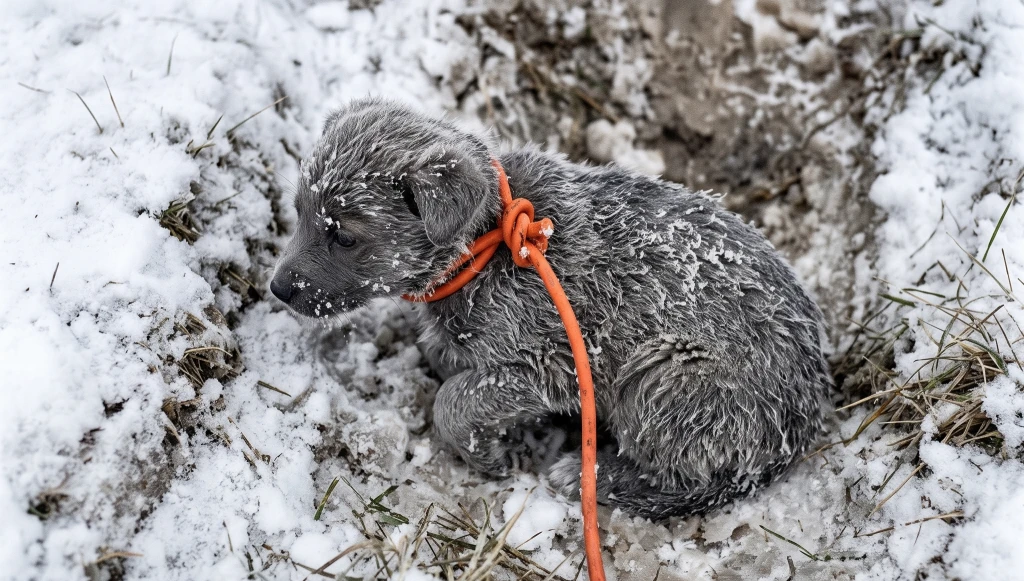
Then I heard it again.
It was not a bark or even a whine. It was one thin note, broken in the middle, as though whatever made it had run out of strength before it ran out of fear.
I pulled onto the shoulder and left the engine running. Snow came over the top of my boots when I climbed down the bank, and for several seconds I saw nothing but cattails, frozen mud, and a black plastic shape caught against a fence post.
The plastic shape lifted its head.
“Easy,” I said, though I was the one slipping down the slope. “I see you.”
The animal was small enough to fit beneath one arm. Its coat was charcoal gray, stiff with ice, and its legs looked too long for the rest of it. One front paw was buried under crusted snow. Around its neck was a length of orange braided cord, the kind used on construction sites, cut off six inches from a crude knot.
It did not try to escape when I reached for it.
That frightened me more than teeth would have.
I had spent four years volunteering at the Bridger Valley Animal Center. I knew the difference between a frightened puppy holding still and an animal whose body had begun shutting down. This one’s gums were pale. Its breaths came so slowly that I lost count between them.
I called Erin Walsh at the shelter with one hand while I worked the cord loose with the other.
“You’re on speaker,” I told her. “I’ve got a puppy, maybe eight or nine weeks. Severe cold exposure. Barely responsive.”
“Don’t take him home,” Erin said immediately. “Elena’s at the emergency clinic. I’m calling ahead.”
“I know.”
“Warm him gradually. Nothing hot against the skin.”
“I know, Erin.”
“I’m saying it because you sound like you’re about to do something heroic and stupid.”
That was also fair.
I wrapped the puppy in the insulated blanket from behind my seat and held him against my chest while I climbed back to the truck. His body had the terrible heaviness of something no longer helping to carry its own weight.
Just before I closed the door, he drew in a shallow breath and made that sound again.
This time it stretched into a faint, uneven note.
Not a howl exactly. More like the memory of one.
Dr. Elena Ruiz met me at the side entrance of Gallatin Emergency Veterinary Clinic. She took one look at the bundle in my arms and waved us past the front desk.
Within minutes, the puppy was on a warming pad beneath layers of towels. A technician placed an IV catheter while Elena listened to his heart and called out numbers I tried not to interpret.
“How bad?” I asked.
“Bad enough that I don’t want to make promises.”
His temperature was too low for the first thermometer to register. The staff warmed him slowly, checked his blood sugar, treated the dehydration, and examined the frost damage on his ears and pads. I sat on the floor outside the treatment area because every chair felt too far away.
At some point Erin arrived with coffee. She handed me a cup and sat beside me without asking whether I wanted company.
“You were coming from the shelter?” she asked.
“Yeah.”
“So he picked the one truck on that road with blankets, gloves, and a man who can’t pass an injured animal.”
“He didn’t pick anything.”
“I know.”
I turned the orange cord over in my hands. One end had been sliced cleanly. The knot was too tight to have slipped over his head, and there was a raw band beneath the fur where it had rubbed his skin.
“He was tied,” I said.
Erin studied it. “Maybe.”
“Animals don’t tie themselves to fence posts.”
“We don’t know that he was tied there. Keep the cord. Don’t build the whole story before he survives the first chapter.”
That was something my wife, Laura, used to tell me.
She had been gone four years, but people still occasionally spoke in her sentences without knowing it. Erin had worked beside her at the shelter long before I started volunteering. After Laura died, I took over her Saturday morning shift because it was easier than sitting in the house while sunlight moved across rooms she had chosen the paint for.
I stayed at the clinic through the night.
Shortly after 3:00 a.m., Elena came into the waiting room with her stethoscope hanging around her neck.
“He’s warmer,” she said. “His blood pressure is improving, and he swallowed a little recovery formula. We’re not clear yet, but those are good signs.”
I stood so quickly that coffee spilled across my jeans.
“Can I see him?”
“For a minute.”
He looked even smaller inside the kennel. His eyes were open now—gray-brown, watchful, no longer empty. When I crouched, one ear shifted toward me.
“Hey,” I whispered. “You stayed.”
His nose moved once against the towel.
That was all. It was enough.
He remained at the clinic for two days. No microchip surfaced. Nobody responded to the shelter’s found-animal notice, and no missing-puppy report matched him. Elena estimated that he was between eight and ten weeks old, underweight but otherwise free of congenital problems she could detect.
“Shepherd mix?” I asked.
“Probably.”
“Probably?”
Elena smiled. “At this age, half the puppies in Montana look like shepherd mixes.”
She turned him sideways on the exam table. His narrow ribs showed beneath the gray fur, but he was standing now, unsteady and offended by the slippery surface.
“He has a long muzzle,” she said. “Big feet. Could have malamute, husky, shepherd—any number of things. Let him grow before you write his résumé.”
The puppy stared at the closed exam-room door rather than at either of us.
“He needs a foster placement,” Erin said.
Elena looked at me.
I looked at the puppy.
“You both planned this conversation before I got here.”
“We discussed possibilities,” Erin said.
“You put my name on the form, didn’t you?”
“I brought the form.”
The puppy finally turned his head. When I offered my fingers, he did not lick them or wag his tail. He leaned forward, breathed in once, and rested his chin against my knuckles.
I signed.
I called him Flint because of the moment his eyes opened in the clinic. There had been nothing dramatic in it—just a small spark returning where I had been afraid there would be none.
For the first week, he slept beside the back door on Laura’s old camping quilt. I moved the quilt twice, thinking the draft would bother him. Twice he dragged it back.
He ate carefully and disliked bowls that slid across the floor. He did not chase balls. Squeaky toys made him leave the room, but he could spend fifteen minutes dismantling a cardboard box with the concentration of a surgeon.
Most foster puppies wanted constant contact after a bad beginning. Flint wanted to know where I was, but he did not always want me close. He followed me from room to room and settled at a distance, usually in a place where he could see both the windows and the nearest exit.
At night, he woke at sounds I could not hear.
I would find him standing in the dark kitchen with his nose lifted toward the gap beneath the back door. When I spoke, his ears turned toward me, but the rest of him remained aimed at whatever was moving beyond the house.
Hannah first saw him over a video call.
My daughter lived in Spokane and taught eighth-grade science. We spoke every Sunday, though our conversations had become careful after Laura died. We discussed weather, work, and whether I had changed the furnace filter. We rarely discussed anything that could hurt us.
“You’re keeping him,” she said when Flint’s head appeared beside my chair.
“I’m fostering him.”
“That’s what you said about the beagle.”
“The beagle was adopted.”
“After you rejected three perfectly good families.”
“One had an unfenced yard.”
“One had a six-foot fence.”
“Next to a highway.”
Hannah laughed, but it faded when Flint looked directly into the phone. “He’s beautiful.”
“He’s strange.”
“All puppies are strange.”
“Not like this.”
She watched him for a moment. “Maybe don’t make strange sound like a problem.”
“I didn’t.”
“You did a little.”
By March, Flint had doubled in size. By April, he weighed more than most dogs twice his age. His chest remained narrow, but muscle moved beneath his coat when he walked. His paws did not slap clumsily against the floor. He placed them with unsettling precision.
He learned commands when they benefited him. He came reliably inside the house, less reliably outside. He could open the lever handle on the laundry-room door and once removed every item from my refrigerator’s bottom shelf without disturbing the carton of eggs above it.
He never barked when the mail carrier came. He watched.
He rarely wagged his tail in the loose, careless way I expected from a domestic puppy. When he was pleased, the change was smaller: his mouth softened, his ears eased sideways, and he pressed one shoulder against my leg before moving away.
The first time I tried to trim his nails, he panicked.
There was no warning growl and no deliberate attack. I touched the clipper to one front paw, and his body went rigid. A second later he twisted free with enough force to knock me backward into a cabinet.
His claws caught my forearm as he scrambled away. Three red lines appeared through my skin.
Flint retreated beneath the kitchen table, breathing fast. I stayed on the floor and set the clippers behind me.
“It’s all right,” I said. “I’m not coming after you.”
He watched me for nearly twenty minutes before crawling out. When he finally approached, he touched his nose to the scratches on my arm and flinched at the smell of blood.
The incident was not severe. That was what made it useful.
Flint had not meant to hurt me. He had only wanted to escape, and I had been as easy to move as a chair.
At his next appointment, Elena watched him pace the exam room. He did not sniff the cabinets or solicit attention from the technician. He traced the walls, tested the lower edge of the door with his nose, then settled in the only corner that gave him a clear view of both exits.
“How old now?” Elena asked.
“About six months.”
“And sixty-four pounds.”
“He’s eating the amount you recommended.”
“I’m not worried about his weight.”
She crouched without moving toward him. Flint looked at her, looked at the door, and looked back.
“There’s a behavioral consultant I want you to meet,” she said. “Dr. Lena Park. She works with captive canids and difficult hybrid cases.”
“You think he’s part wolf.”
“I think guessing from his face would be irresponsible. I also think pretending he’s an ordinary shepherd mix could become irresponsible.”
Dr. Park came to the clinic three days later.
She did not try to pet Flint. She entered sideways, placed her bag on the floor, and sat without looking directly at him. For twenty minutes she watched him watch her.
She asked about his sleep, appetite, fear responses, play, containment, and the way he reacted to unfamiliar people. She wanted to know whether he guarded food, whether he dug, whether he paced, whether he became more anxious when doors were closed.
Then she asked exactly where I had found him.
I showed her the location on my phone and gave her the orange cord, which I had sealed in a plastic bag after Erin suggested it might matter.
“People breed wolf-dog crosses and sell them as exotic pets,” Dr. Park said. “People also mislabel ordinary dogs because the word wolf raises the price. His appearance alone proves nothing.”
“What would prove it?”
“A laboratory can test for recent wolf ancestry. It won’t hand us a magical percentage or tell us his entire family tree. But it may tell us whether a wolf entered his lineage within the last few generations.”
Flint approached while she prepared the sample kit. He sniffed the unopened swab packet, then rested against my shin as she collected cells from inside his cheek.
“And if the test finds it?” I asked.
“Then both words in wolf-dog matter. He may form attachments to people, but that doesn’t make his needs identical to a pet dog’s.”
My phone vibrated while I was walking Flint across the clinic parking lot.
It was a message from Erin.
The first image showed a metal kennel at the shelter. Inside it crouched a young gray female with long legs, a narrow face, and eyes that seemed much too old. The second image was a close-up of her neck. An orange braided cord had cut a raw line through the fur. Beneath the photographs, Erin had written five words. Caleb, where exactly was Flint found?…
To read the rest of the story – CLICK the NEXT button 👇👇👇