


At 5:41 on a wet October morning, an old black Labrador dropped a dead man’s work glove outside the neonatal barn and refused to move. Maya Ellis stopped beneath the security light, one hand still wrapped around her coffee. Hank sat in front of the steel door with rain shining on his gray muzzle. The glove lay between his paws, stiff with age and stained red at the fingertips from years of handling mineral blocks and rusty gate chains.
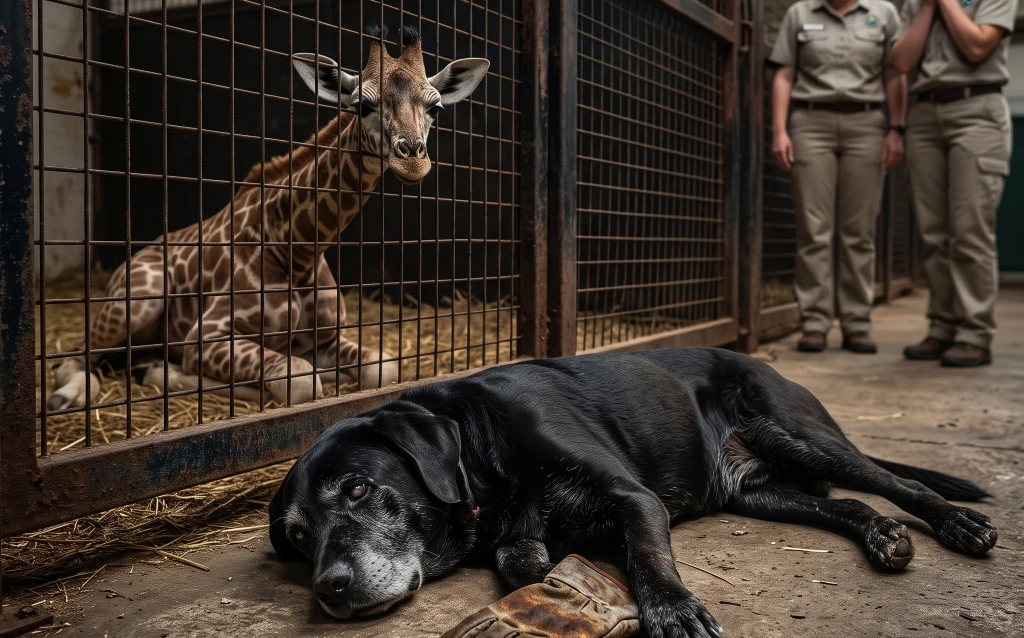
It had belonged to Sam Carter.
Sam had been dead for four months.
“Hank,” Maya said softly. “Where did you get that?”
The Labrador looked past her at the door.
From inside the barn came the thin electronic pulse of a cardiac monitor, followed by the hiss of oxygen and the low murmur of Dr. Claire Bennett speaking to the overnight technician. Hank’s ears lifted. He nudged the glove closer to the threshold and settled his chin over it.
Maya should have taken him back to her truck. She had already been warned twice about allowing a domestic dog near the quarantined animals, even one who had spent most of his life following Red Cedar Wildlife Conservancy’s senior giraffe keeper from barn to barn.
Instead, she opened the door.
Warm, disinfected air rolled into the cold. Hank did not try to enter. He remained on the concrete, watching Maya disappear down the service corridor.
At the far end of the building, beneath dimmed amber lights, a blind giraffe calf lay folded against the padded wall of a neonatal stall.
Her name was Willow.
Even collapsed, she looked too large to be called a baby. Her front legs were longer than Maya’s arms, and the top of her head would have reached a grown man’s shoulder if she had been standing. But eleven days without enough nourishment had hollowed the muscles around her hips and neck. Her spotted coat hung loosely over a body that should have been gaining weight by the hour.
Claire knelt beside her with two fingers resting against the calf’s jaw.
“Nothing?” Maya asked.
“Not since midnight.”
A bottle of warmed formula stood untouched in a metal holder. A thin IV line disappeared beneath a bandage on Willow’s leg, delivering fluids and glucose. The medicine could support her circulation. It could not make her swallow.
Willow had arrived six days earlier from Broken Spur Safari Ranch, a failing roadside attraction three counties west. State inspectors had found her in an unheated shed after her mother died from complications following a difficult birth. By then the calf’s eyes were swollen shut from an untreated infection. Claire’s team had stopped the infection from spreading into the bloodstream, but the damage inside both eyes was permanent.
The blindness alone had not frightened Claire. Animals adapted when they were given consistency, space, and the right social structure.
Willow’s refusal to eat was different.
She did not search for a bottle. She did not respond when a keeper rubbed her neck with a warm towel or when recordings of adult giraffes were played beyond the stall. Each time someone tried to guide the nipple into her mouth, she clenched her jaw or turned her head toward the padded wall.
The staff had supported her in a sling, hoping the position would trigger the instinct to nurse. She had remained rigid until her heart rate climbed dangerously high. They had tried smaller feedings, quieter rooms, familiar bedding transported from Broken Spur, and shifts with only one caretaker present.
Nothing had reached her.
“She was down for seven hours yesterday,” Maya said.
“Eight,” Claire answered.
Willow’s ear moved toward the sound of their voices, then went still.
Rebecca Sloan, Red Cedar’s operations director, stood behind the observation window with a clipboard pressed against her chest. She had spent the night reviewing the calf’s laboratory results, projected costs, and the welfare guidelines no one in the room wanted to discuss aloud.
Claire rose slowly. At forty-eight, she had learned to keep exhaustion out of her posture even when it showed in her eyes.
“Her glucose drops as soon as we reduce the infusion,” she said. “Her kidneys are still functioning, but we can’t keep pretending an IV is nutrition.”
“How long?” Rebecca asked.
“Until noon, maybe tonight. After that, we’re supporting a body that isn’t doing anything for itself.”
Maya looked at Willow. “She’s listening.”
“Listening isn’t enough.”
“No. But it isn’t nothing.”
Rebecca lowered her clipboard. She was not unkind, though people often mistook restraint for coldness. She had approved the emergency transport, found money for overnight staff, and called three specialists before sunrise. She also understood that compassion without limits could become another form of cruelty.
“We agreed on a review this morning,” she said. “If there’s no voluntary intake and no meaningful improvement, we have to decide whether continued treatment is for her or for us.”
Claire did not answer.
A faint metallic sound came from the service corridor.
Chink.
Willow’s right ear turned.
Maya glanced toward the door. “Hank.”
The tags on the Labrador’s collar struck the threshold again as he shifted outside.
Chink.
This time Willow raised her head less than an inch from the mat.
Claire saw it. She stepped closer but did not touch the calf.
“Hank’s at the door?”
“He brought one of Sam’s gloves.”
Claire looked through the glass panel in the stall door. The old dog was visible at the end of the corridor, a black shape against the gray morning.
Sam Carter had worked with giraffes for thirty-two years. He could read a nervous animal by the angle of its neck and recognize individual hoofbeats from the other side of a barn. Hank had followed him through nearly every morning round for twelve of those years, sleeping beneath the desk during medical meetings and waiting outside protected-contact gates while Sam worked.
Four months earlier, Sam had collapsed beside the hay room before dawn. Hank’s barking brought a maintenance worker running, but the aneurysm had taken Sam before the ambulance arrived.
Since then, Hank had returned to the same door every morning at 5:40.
At first Maya had tried keeping him at her house overnight. He had paced until she let him out, then crossed the staff compound and sat beside the barn. He never scratched or barked. He simply waited through the morning round for the man who no longer carried the keys.
Hank had stopped fetching balls. He ate only when Maya sat beside his bowl. His body had healed from age and hard work, but something in him seemed to have gone quiet.
Claire watched Willow’s ear follow another tiny movement of his tags.
“Bring him to the observation corridor,” she said.
Maya stared at her. “No.”
“Not inside the stall.”
“Claire, she hasn’t been screened for everything yet. He’s a domestic dog, and she’s immunocompromised.”
“He’s vaccinated, he lived around the herd for years, and there will be two barriers between them.”
“That isn’t the only risk.”
“I know.”
Willow’s head sank again.
Claire looked at the calf’s IV pump, then at the clock above the sink.
“Ten minutes,” she said. “No direct contact. If either animal shows distress, we stop.”
Rebecca came through the side door. “You’re proposing an unapproved interspecies introduction during quarantine.”
“I’m proposing that an animal she just heard gets to lie outside a fence.”
“And if it makes her panic?”
“Then we end it.”
Maya folded her arms. “And if it works?”
Claire looked through the glass at Hank.
“Then we figure out what ‘works’ actually means.”
They closed the interior doors, cleared the corridor, and rolled a second steel barrier across the calf’s stall. Maya wiped Hank’s paws and lower legs with a veterinary-safe rinse, more for protocol than necessity. He endured it without complaint, his eyes fixed on Sam’s glove.
When Maya unclipped his leash, Hank did not rush toward the calf. He picked up the glove, carried it halfway down the corridor, then stopped.
Willow’s nose lifted.
Hank lowered himself onto the concrete outside the double barrier. He turned his body sideways instead of facing the stall, laid the glove between his paws, and released a long breath through his nose.
The sound was low and rough, almost a sigh.
Willow’s breathing changed.
For six days, every movement around her had been followed by hands, needles, straps, or a bottle pressed against her mouth. Hank asked nothing. He did not reach through the bars. He did not stare. He lay beside the stall as though waiting were the only task he understood.
His tags touched the floor.
Chink.
Willow’s head rose again.
“No one move,” Claire whispered.
Maya stood with one hand over her mouth. Rebecca remained by the door, her clipboard hanging forgotten at her side.
Hank shifted his front paw. His nails scraped once against the concrete. Willow’s ears turned toward the sound, and the muscles along her neck tightened.
Then, with painful slowness, she unfolded one front leg.
Her hoof slid across the rubber mat. The other leg followed, trembling beneath her chest. For several seconds she remained on her knees, swaying as though the entire barn had begun to tilt.
Maya instinctively stepped forward.
Claire caught her wrist.
Hank raised his head. He did not bark or stand. He scraped one paw across the concrete again, giving Willow a sound she could locate.
The calf gathered her hind legs beneath her.
She rose in pieces: chest first, then shoulders, then the long, uncertain lift of her hips. Her knees shook. Her head swung toward the barrier, blind eyes facing the old dog.
At 5:57 a.m., Willow lifted one front hoof and took a single step toward the sound of Hank’s tags…
To read the rest of the story – CLICK the NEXT button 👇👇👇