


At 9:17 on the coldest night Ashfield had seen in years, Ruth Carter heard three knocks that did not sound like a neighbor. The electricity had failed an hour earlier. Wind drove snow against the windows hard enough to lift the plastic Ruth had taped around the frames, and the only light in her living room came from a candle beside her late husband’s photograph. The knocks came again.
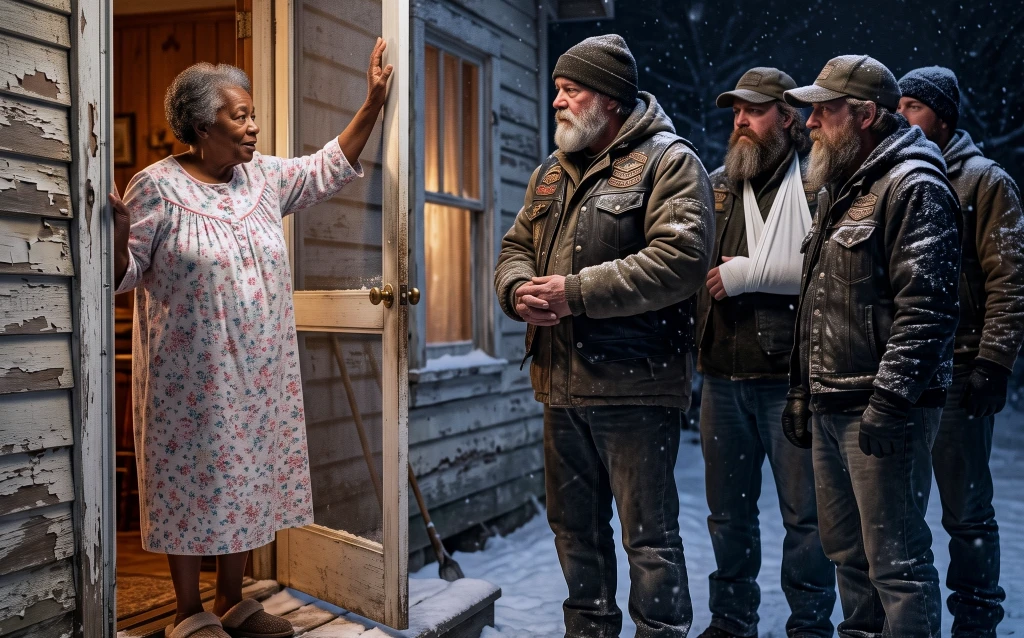
Ruth crossed the room with a flashlight in one hand. She was seventy-three, alone, and wearing two sweaters because her furnace had stopped working before Thanksgiving. She opened the inside door but left the chain fastened.
Five men stood on her porch.
They wore leather vests beneath ice-stiffened jackets. Snow clung to their beards and shoulders, and the patches on their backs read IRON RIDGE—PITTSBURGH. The largest man stood closest to the door, silver threaded through his beard. Behind him, a younger rider sagged against the porch railing with blood running from his sleeve.
“Ma’am,” the silver-bearded man said, struggling to keep his voice steady, “we came off the highway. We need someplace out of the wind. Our friend’s hurt.”
Ruth looked past them. Hawthorn Lane had disappeared beneath blowing snow. No porch lights shone through the storm, and the houses across the street were only dark shapes.
The injured man’s knees buckled.
Ruth slipped off the chain.
“Bring him in,” she said. “All of you. Hurry.”
The youngest rider collapsed onto the linoleum before the last man had crossed the threshold. Ruth pointed the others toward the braided rug by the door.
“Boots there. Wet coats off. Nobody leans against that heater.”
The men obeyed without argument.
The silver-bearded man lowered himself beside his injured friend. Up close, Ruth could see ice caught in his eyelashes.
“I’m Wes,” he said. “That’s Evan. Cal, Boone, and Ray.”
“Ruth Carter.” She set the flashlight on the kitchen table. “You can explain later. Help me get his jacket off.”
Evan’s leather sleeve had torn from elbow to wrist. The cut beneath it was long and ugly, but the bleeding had slowed. Ruth had spent thirty-two years managing an elementary school cafeteria, where burns, falls, split chins, and bloody noses arrived almost as regularly as lunch. She had renewed her first-aid certification every two years until retirement.
She took kitchen shears from a drawer and cut away the fabric around the wound.
“This is going to sting,” she warned.
Evan’s lips had turned pale blue. “Do what you have to.”
Ruth cleaned the cut, pressed sterile gauze against it, and wrapped his arm with bandages from a metal first-aid box she kept beneath the bathroom sink. When she ran short, she tore clean strips from an old cotton sheet.
“You’ll need stitches when the roads open,” she said. “Until then, keep that arm higher than your heart.”
Cal had taken off his boots. His socks were soaked, and several of his toes had gone waxy and white. Ruth stopped Boone from rubbing them.
“No. You warm them slowly.”
She filled a basin with lukewarm water from one of the pots she had drawn before the pipes began freezing. Then she wrapped Cal’s feet in dry towels and tucked a quilt around his legs.
Her house had not been built for five broad-shouldered riders. They occupied every chair and most of the floor, knees nearly touching the coffee table. Meltwater pooled beneath their boots, carrying road salt across the linoleum.
Ruth did not care about the floor.
She cared about the way Ray’s hands would not stop shaking and the way Boone’s words had begun to slur. She turned the gas oven to its lowest setting and left the door cracked. It was not safe, and she knew it, but the kerosene heater in the corner could barely warm one room.
Wes noticed the plastic-covered windows and the blanket pinned over the hallway entrance.
“Your furnace out?”
“It’s resting,” Ruth said.
He looked toward the heater.
Ruth raised an eyebrow. “You worry about staying conscious. I’ll worry about my furnace.”
That ended the discussion.
She pulled every blanket she owned from the bedrooms. One was a wedding gift from her mother. Another had been crocheted by Leon’s sister in shades of brown and gold. Ruth handed them out without deciding which mattered most.
The last warm garment in the hall closet was Leon’s old green work coat.
She had not moved it in ten years.
Leon had worn that coat through twenty-eight winters at the Ashfield stamping plant. He had patched the cuff with black thread after catching it on a loading hook and had never managed to remove the faint smell of machine oil from the collar. After he died, Ruth kept it behind her raincoat, where she could touch the sleeve without having to explain herself.
Wes was still shivering, though he tried to hide it by keeping his arms folded.
Ruth held out the coat.
“This belonged to my husband.”
His eyes settled on the patched cuff. “I can use one of the blankets.”
“You can use what I’m giving you.”
He took the coat with both hands. “Yes, ma’am.”
It fit him closely across the shoulders. Ruth had expected the sight to hurt, but it did not. Leon’s coat looked useful again.
While the men thawed, she went to the stove. A small pot of chicken soup sat in the refrigerator, enough for her dinner and perhaps lunch the next day. She poured it into a larger pot, added water, a can of white beans, the last cup of rice from a jar, and two carrots that had begun to soften.
Wes watched from the living room doorway.
“You don’t have to feed us.”
“You walked through a blizzard.”
“We can pay you.”
Ruth did not turn around. “Sit down before you fall down.”
The riders ate from mismatched bowls at her kitchen table and along the living room floor. Ruth divided half a loaf of bread among them and opened a jar of pickled green beans she had canned the previous summer.
She did not make a bowl for herself.
Evan noticed. “Miss Ruth, you’re not eating.”
“I ate earlier.”
It was not a convincing lie. Wes looked at the empty dish rack, the nearly bare counter, and the single place that had been set before they arrived. He said nothing.
Outside, the storm erased what remained of Ashfield.
The town had once made steel fasteners, rail components, and stamped automobile parts. Its three plants employed nearly everyone Ruth knew when she and Leon bought the little white house on Hawthorn Lane in 1981. Then the contracts moved, the shifts disappeared, and the plants closed one after another.
By the time Leon died, the last building stood empty behind a rusted fence.
Ruth remained.
Her Social Security check covered the mortgage-free house, groceries, kerosene, utilities, and very little else. The roof leaked above the back hallway. An emergency-room bill from a fall the previous autumn remained unopened in a kitchen drawer. When the furnace repairman quoted a price larger than two months of her income, she thanked him, locked the door, and learned how to sleep in two sweaters.
Yet three afternoons each week, children from the neighborhood still gathered around her kitchen table. Their parents worked late shifts at the distribution center outside town, and Ruth believed an empty house was no place for a ten-year-old to wait through winter darkness.
She gave them peanut-butter sandwiches, corrected their manners, and made them finish homework before touching the television.
The riders learned these things slowly, not because Ruth told her life as a story, but because evidence of it surrounded them. Crayon drawings covered the refrigerator. A plastic bin of children’s books sat beneath the window. Photographs from Ashfield Elementary showed Ruth behind a serving line, smiling while generations of students held lunch trays.
Boone studied one of the photographs.
“You worked at the school?”
“Long enough to know children will eat broccoli if you call it tiny trees.”
Cal managed a weak laugh beneath his quilt.
The sound changed the room. The men stopped looking like five strangers who had arrived beneath frightening patches. They became tired people warming their hands around bowls.
Wes told Ruth they had been traveling south for a memorial ride. The storm had arrived hours ahead of the forecast. One motorcycle slid on black ice, two more stalled in the cold, and the men abandoned the machines near the highway after their phones lost service.
“How far did you walk?” Ruth asked.
“About three miles.”
“With him bleeding?”
Evan attempted a smile. “I complained most of the way.”
“He complained all of the way,” Ray said.
“That means he was awake,” Wes replied. “We were grateful for it.”
Ruth glanced toward the black windows. “You saw my candle.”
“It was the only light on the street.”
For a moment, nobody spoke.
Leon had always insisted on leaving a porch light burning when snow was expected. People missed turns, engines failed, teenagers made poor decisions. A light, he said, cost pennies and might keep someone from feeling lost.
The power outage had taken the porch light, so Ruth had placed a candle in the front window instead.
She had not thought anyone would see it.
Near midnight, Ray and Boone stretched out on the living room floor. Cal slept in the recliner with his feet elevated. Evan sat at the kitchen table, arm supported on a folded towel, fighting sleep until Ruth ordered him to stop.
Wes remained awake.
He asked whether the landline worked. It did not. He checked his phone again, but there was still no signal. Then he stood beside the window, wearing Leon’s coat, and watched snow climb the lower half of the glass.
Ruth sat near the heater with her devotional open but unread in her lap.
“You should sleep,” Wes said.
“Somebody has to watch the flame.”
“I’ll do it.”
“You’re a guest.”
“I’ve been called worse.”
Ruth gave him a measuring look. “Wake me if the heater sputters.”
She closed her eyes but did not truly sleep.
Sometime after one, a spoon slipped from the table and struck the floor. Wes bent to retrieve it. The table rocked beneath his hand, and he saw that one leg had been propped up with a folded magazine.
He crouched and pulled it free far enough to straighten the cover.
The issue was several years old. Ruth had folded it twice and wedged it beneath the table without paying attention to the photograph.
Wes did pay attention.
A younger, clean-shaven version of his own face looked back at him beneath the headline:
THE MEN MOVING AMERICA.
Below the photograph, in smaller print, was his full name. Weston Mercer, Founder and CEO, Northline Logistics. Wes looked across the room. Ruth Carter, who had just divided her last loaf of bread among five strangers, slept beside a failing heater while one of Pennsylvania’s wealthiest businessmen wore her dead husband’s coat… He slid the magazine beneath the table before she opened her eyes.
To read the rest of the story – CLICK the NEXT button 👇👇👇