


The puppy was standing on three legs when I first saw her. The fourth was lifted against her chest, not because it was injured, but because a folded piece of notebook paper had been fastened around it with a red hair tie. Every time the wind dragged the paper toward the ground, she bent over it and pressed it beneath her paw.
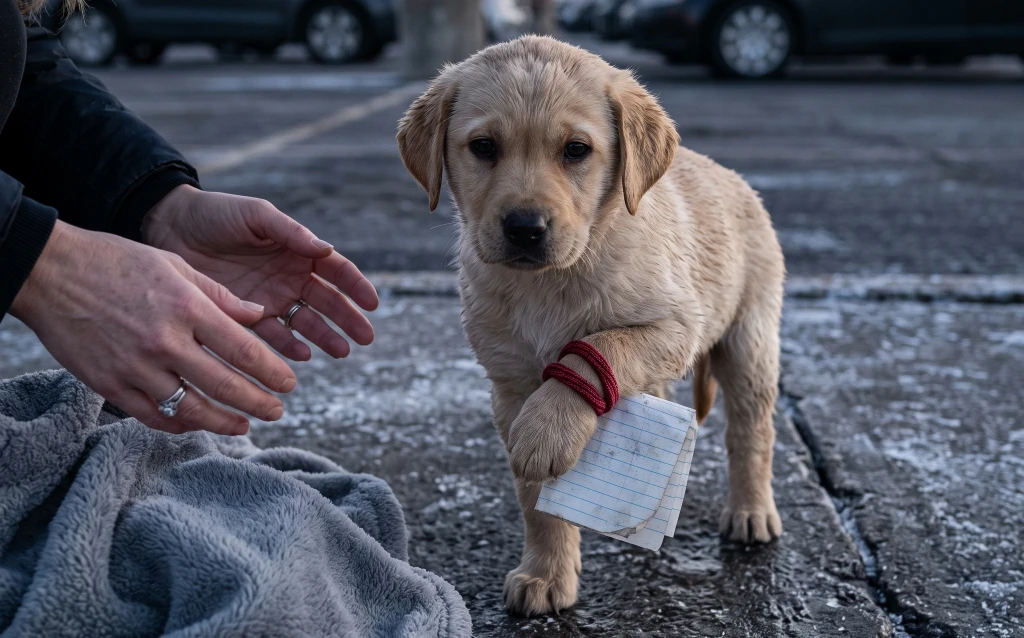
It was 6:42 on a December morning in Albuquerque, and the temperature had fallen below freezing overnight. The sun had cleared the Sandia Mountains, but it had not yet reached the empty strip mall lot where the puppy stood trembling between a boarded-up pharmacy and the back entrance of Canyon View Veterinary Center.
There was no collar. No person calling for her. No box or blanket nearby.
Only the paper.
I had spent eleven years transporting dogs for Desert Haven Rescue. I knew the difference between a puppy wandering toward adventure and one waiting because she had been told to stay. This one had planted herself in the middle of the concrete as if leaving that square of pavement would break a promise.
I pulled my truck over and sat for several seconds with the engine running. Six months earlier, after my old shepherd Henry died, I had told everyone at the rescue that I was done bringing animals home for a while. I would drive, deliver food, help with intake, and answer late-night calls, but I would not foster.
A quiet house, I had discovered, could hurt. It could also protect you from hurting again.
Then the puppy’s knees buckled.
She caught herself before she fell and immediately checked the paper beneath her paw.
I grabbed the fleece blanket I kept behind my seat and approached sideways so I would not look threatening. She watched my hands instead of my face. Her ears lay flat against her small yellow head, and her ribs fluttered beneath fur the color of wheat.
“Hey, little one.”
She did not bark or whine. She only shifted so that her raised paw—and the paper attached to it—remained between us.
I stopped about six feet away and lowered myself to the pavement. My knees complained against the cold, but the puppy did not move. There was a raw line beneath the hair tie where it had rubbed her fur, and her paw pads were dry and cracked.
“I’m not taking anything from you,” I said. “I just need to see what you’ve got.”
Her nose lifted. She could smell the other dogs on my jacket, along with disinfectant, kibble dust, and probably the chicken sandwich I had eaten the night before. None of it tempted her closer.
I set the blanket on the ground and slid it toward her.
The wind caught one corner. The puppy startled, stumbled backward, and planted both front paws on the paper. Her whole body folded over it.
“Okay,” I whispered. “The paper stays.”
I waited until her breathing slowed. Then I moved closer by inches, pausing whenever her shoulders tightened. Up close, I could see that the hair tie had been looped loosely enough not to stop circulation, but tightly enough to keep the note from blowing away.
The paper itself was soft from handling. One edge was damp, and there were smudges on it that looked like fingerprints made by a child.
I reached for the hair tie.
The puppy flinched but did not snap. Her eyes followed my fingers as I eased the elastic over her paw. The moment the paper came free, she lunged—not at me, but at the note. Her nose struck my wrist, and one tiny claw caught in my sleeve.
“I’ve got it,” I said. “Look. It’s right here.”
I placed the note flat on the concrete between us. She covered one corner with her paw.
Only then did she let me unfold it.
The handwriting was printed in uneven block letters with several words traced twice, as though the writer had been working in poor light or inside a moving car.
Her name is Sophie.
She ate at 4. She gets scared when people yell.
Tap twice before you pick her up.
Keep this paper close. It smells like me.
I will call at noon.
Please tell me she is warm.
I read it again.
The final sentence was written smaller than the rest. The last word had been pressed so hard that the pencil had nearly torn through the paper.
Sophie watched my face.
“All right,” I said. “Let’s see whether your person told me the truth.”
I curled two fingers and tapped them gently against the pavement.
Tap. Tap.
The change was small, but unmistakable. Sophie’s shoulders lowered. Her ears loosened from her head, and she looked away from my hands for the first time.
I tapped again.
Her tail did not wag, but its tip shifted once against the concrete.
“Safe,” I said. “That’s what it means, isn’t it?”
I spread the fleece blanket beside the note and placed one hand flat on it. Sophie leaned forward to smell my fingers. Her nose was cold and dry, her breath shallow. When she did not retreat, I slid the paper onto the blanket and folded the fabric around both of them.
She allowed me to lift her.
A puppy that age should have felt round and warm. Sophie felt like a bundle of sticks wrapped in cold fur. She pressed her muzzle against the paper and kept it beneath her chin while I carried her toward my truck.
“You and the note,” I told her. “I understand.”
Inside the cab, I turned the heater on low and tucked the blanket around her without placing her directly in front of the vent. Rapid warming could be dangerous when an animal was severely chilled. I called Canyon View’s emergency number while keeping one hand beside her.
Dr. Lena Ortiz answered on the fourth ring.
“I’m behind your building,” I said. “I found a young Lab in the lot. She’s conscious, but she’s very cold and barely responsive.”
“I’m ten minutes away,” Lena said. “Keep her insulated. Don’t offer food yet. I’ll meet you at the side door.”
As I waited, Sophie’s head began to sink.
I gave the dashboard two quiet taps.
Her eyes opened.
“That’s right,” I said. “Stay with me.”
She shifted her nose toward the note, breathed in, and rested her chin on the paper again.
Lena’s car pulled into the lot nine minutes later. She unlocked the clinic while I carried Sophie inside. The building smelled of floor cleaner and the faint animal musk no veterinary office ever completely loses.
We placed Sophie on a padded exam table over a circulating warm-water blanket. Lena checked her gums, listened to her lungs, and took her temperature while I kept the note near her face.
“Ninety-five point eight,” she said. “That’s low. She’s dehydrated too.”
A technician named Marcus arrived and scanned Sophie for a microchip. He passed the scanner over her shoulders, neck, chest, and legs twice.
Nothing.
He photographed the raw line on her paw, the note, and the place where I had found her. Then he called city animal welfare to file the required found-animal report while Lena started warmed fluids beneath Sophie’s skin and checked her blood sugar.
The number made her mouth tighten.
“How bad?” I asked.
“Low enough that I’m glad you stopped.”
Lena rubbed a small amount of glucose solution against Sophie’s gums. We did not crowd her. Every time someone needed to touch her, I tapped twice on the edge of the table first.
Sophie responded each time. Her body remained weak, but the sound seemed to reach her before our hands did.
Marcus photographed both sides of the note, set it on a clean towel to dry, and later slipped it into a clear archival sleeve. When he placed the sleeve beside Sophie, she pushed her nose against it and released a breath.
It was the closest thing to relief I had seen from her.
By eight-thirty, the clinic had opened. Phones began ringing, dogs barked from the treatment area, and a woman argued in the lobby about why her cat should not need a carrier. Sophie remained in a heated kennel in the quietest room, the note tucked beneath the edge of her blanket.
She would not eat unless the dish touched the sleeve.
We offered a spoonful of warm recovery food. Sophie smelled it, looked at the paper, and turned away. I slid the dish closer until its rim rested against the plastic.
She took one lick.
Then another.
After four bites, she stopped. It was not much, but it was enough to raise her blood sugar and put a little color back into her gums.
I stayed beside her kennel while Lena saw her morning appointments. I told myself I was waiting for the noon call because someone had to answer it. I told myself that once we knew who had left Sophie, I would hand the situation to animal welfare and go home.
At eleven-fifty, Sophie was sleeping with one paw across the note.
At eleven-fifty-five, I began watching the phone on the wall.
At noon, nothing happened.
The minute hand moved.
12:01.
12:02.
I looked down at the childlike printing inside the plastic sleeve. I will call at noon.
Perhaps the writer had lost access to a phone. Perhaps the promise had only been intended to keep the puppy quiet while someone drove away. In rescue work, you learned not to build hope out of sentences written by strangers.
At 12:03, the phone rang.
The receptionist answered, listened, and turned toward me.
“Mara,” she said, covering the receiver. “Someone’s asking about the yellow puppy.”
I took the phone.
Before I could give my name, a child whispered, “Is Sophie alive?”…
To read the rest of the story – CLICK the NEXT button 👇👇👇