


The bottle was still warm when Willow stopped lifting her head. Leah Morgan stood outside the quarantine stall with both hands wrapped around the plastic nipple, listening to the pump beside the door click fluid into the calf’s vein. It was 6:18 on a raw October morning, the kind of cold that crept under barn doors and settled in the joints. Inside the stall, the newborn giraffe lay folded against the rubber floor, all legs and ribs and spotted skin, her neck resting at an angle that made Leah’s own throat tighten.
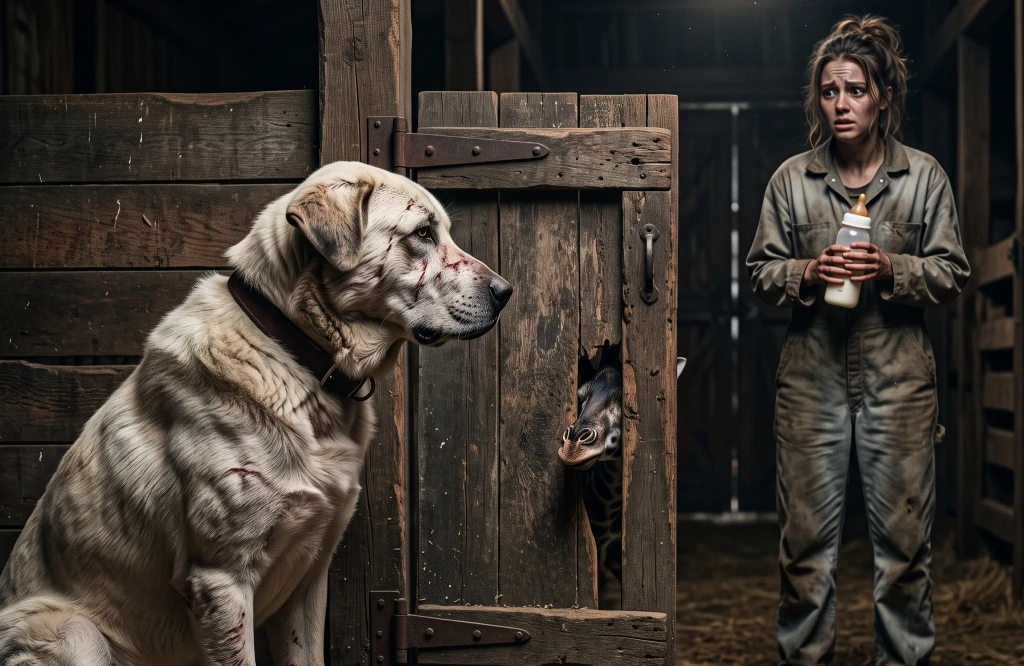
On Dr. Nathan Reed’s desk, two buildings away, the euthanasia authorization had already been printed.
Willow was thirteen days old. When she could stand, she was nearly as tall as Leah. When she could not, she looked like something the world had made too delicately and then abandoned too soon. Her eyes, cloudy from infection and scarring, stared at nothing. She had never seen the barn lights, or Leah’s face, or the mother she had lost before she was old enough to understand hunger.
“Willow,” Leah said, keeping her voice low. “It’s me.”
The calf’s left ear turned.
That tiny movement was the only answer Leah got. It was also the only thing that kept her from walking straight to Nathan and telling him the decision had already made itself. She tapped twice on the stall wall, the way the staff always did before entering Willow’s space, then eased through the gate and waited for the calf to register her. Blind animals learned the world by sound, scent, pressure, and trust. Startling one could be dangerous. Startling a dying baby giraffe felt like an insult.
Leah knelt near Willow’s shoulder and touched the warm bottle to the back of her own wrist. Perfect temperature. Same formula. Same feeding height. Same patient voice that had carried them through the last four days.
“Come on, sweetheart,” she whispered. “Just one swallow.”
Willow’s nostrils moved. Her lips found the nipple for half a second, soft and searching, then slipped away. Leah held still, afraid that even her disappointment might have a smell.
The calf turned her face toward the wall.
By the time Nathan reached the barn, his jacket was half-zipped over his scrubs and his gray hair still showed comb marks from a hurried shower. He had been a wildlife veterinarian for twenty-five years, long enough to distrust the comfort of clear answers. Animals surprised people for a living. The ones who looked finished sometimes lifted their heads at the last possible hour, while the hopeful ones hid damage no medicine could undo.
Willow had given him no clear answer at all.
He checked her catheter, listened to her chest, and slid two fingers against her gums. Her dehydration had worsened overnight. Her glucose had dropped again. The lab report on his phone showed kidneys beginning to strain under the pressure of keeping her alive without enough calories. Fluids could buy time, but time was not nutrition. A body this young could not run on sympathy.
“How long since she tried to stand?” he asked.
“Since just after three.”
“And with the bottle?”
Leah shook her head. “She smells it. She knows it’s there. She just won’t take it.”
Nathan looked toward the untouched feeding bucket. “Pain response?”
“No worse than last night. She still follows my voice a little.”
From the aisle, Erin Walsh watched through the mesh barrier, arms folded tight across her fleece vest. Erin ran Cedar Ridge Wildlife Recovery, which meant everyone brought her their impossible arithmetic: rescue capacity, permit rules, donor expectations, payroll, liability, and the moral cost of saying yes too many times. She loved the animals. She also understood that love could become selfish when it asked a suffering creature to keep fighting for the comfort of the people around it.
“Nathan,” she said quietly, “the board call is still at four.”
He did not look at her. “I know.”
“They’re going to ask whether we have a treatment path.”
“We have supportive care.”
“That’s not the same thing.”
Willow’s ear moved again, barely. Leah saw it and pressed her lips together.
The calf had arrived nine days earlier after state inspectors shut down a roadside safari park outside Amarillo. The place had advertised “family memories” on a sun-faded billboard, but the rescue team found broken fencing, empty water troughs, underfed animals, and medical records that looked more like guesses than care. Willow’s mother, a tall old giraffe named Marigold, had been down beside the shade structure, her head turned toward the calf as if she had been trying to keep watch.
Marigold died before sunrise.
Willow survived the trailer ride, the first night, and the second. A veterinary ophthalmologist saved both of her eyes as organs, but not as windows. The infection had taken too much. Nathan had told the staff blindness itself did not make a life unkind. Animals could learn maps. They could build confidence from routine, scent markers, textured flooring, and reliable sounds.
But Willow had lost sight, mother, milk, herd, and home in the same week.
Now she was choosing stillness.
At midmorning, the senior staff gathered in the small clinic conference room. Someone had left a photo of Willow pinned to the corkboard, taken on the day she first stood at Cedar Ridge. Leah was in the frame with one arm beneath the calf’s chest, laughing from sheer relief while Willow leaned toward the smell of warm milk. The animal in that picture looked like a promise made by people who had forgotten how quickly promises could be broken.
Erin set the medical summary on the table. “I’m not asking anyone to pretend this is easy. I’m asking us to be honest about where the line is.”
“She answered me this morning,” Leah said.
“She moved an ear.”
“That’s an answer.”
“It is,” Erin said, and her voice softened. “But we have to decide whether it’s enough of one.”
Nathan stared at the authorization form. The language was clean and careful. Humane endpoint. Poor prognosis. Persistent refusal to feed. It left out the way Leah had spent three nights sleeping in a folding chair outside the stall. It left out the fact that Willow searched for a sound that no longer existed every time the barn settled.
Forms were tidy because grief was not.
“Give me until tomorrow noon,” Nathan said.
Erin looked at him. “For what?”
“I don’t know yet.”
“That’s not a medical plan.”
“No,” he said. “It’s twelve hours and one night.”
Leah’s face changed, not into hope exactly, but into the kind of attention hope sometimes wore before it dared name itself.
Erin closed the folder. “If she declines faster, we don’t wait.”
“We don’t,” Nathan said. “If her pain increases, if her breathing changes, if the bloodwork crosses the threshold, I’ll sign it myself.”
Erin pushed the form toward him but did not pick it up. “Noon tomorrow.”
After the meeting, Leah went back to the barn. Erin left to warn the board that no one at Cedar Ridge had learned the convenient habit of detaching on schedule. Nathan stayed in the conference room with Willow’s old photo staring at the back of his neck.
At 11:07, his phone buzzed.
The call came from Tessa Bell, director of Randall County Animal Services. Nathan almost let it go to voicemail. He handled difficult surgeries for the shelter when he could, but Cedar Ridge had a blind giraffe calf failing in quarantine and a board waiting for an answer. Then he saw Tessa’s message.
I know you’re buried, but I need your eyes on a livestock guardian. Twelve-year-old Anatolian mix. Owner died. Dog is medically stable, but he’s shutting down. Hasn’t stood since yesterday morning.
Nathan read it once, then again.
He called her back from the hallway.
“What do you mean, shutting down?”
“He’ll eat a little if I sit with him. Won’t walk. Won’t look at toys. Won’t respond to the other dogs. He lies facing the service door all day like he’s waiting for someone to come back.”
“Pain?”
“Arthritis, manageable. Paws were torn up when he came in, but they’re healing. Bloodwork is better than I expected for his age.”
“What happened to the owner?”
Tessa was quiet for a breath. “Stroke. South pasture. Neighbor found him the next morning. Dog was still beside him.”
Nathan looked through the clinic window toward the long roof of the quarantine barn.
“What’s the dog’s name?”
“Boone.”
Two hours later, Nathan drove north under a wide, colorless sky, telling himself he was responding to a shelter consult because that was the only respectable explanation. He did not need another dying animal. He did not need a metaphor. He did not need to prove anything to Erin, Leah, or himself.
Still, before leaving Cedar Ridge, he had asked Leah for a square of clean cotton rubbed against the padded rail where Willow rested her neck.
Tessa met him at the shelter’s side entrance in mud-spattered boots and a denim jacket. Her eyes took one look at his face and narrowed.
“You look like bad news wearing a seat belt,” she said.
“I’ve got a giraffe calf who won’t eat.”
“I’ve got a two-hundred-pound dog who thinks every door is a grave.”
“Then we’re having the same day.”
She almost smiled and led him through the rear corridor. The quiet ward sat behind two concrete walls, away from the public kennel runs and the rising chorus of barking. In the last enclosure, Boone lay on a thick mat with his back against the cinderblock wall. His coat was mostly white beneath the dust and old ranch stains, with tan markings across one shoulder and a gray muzzle that made him look less elderly than weathered. A scar split the fur over his nose.
He opened his eyes when Nathan stopped at the gate.
He did not lift his head.
Anatolian shepherds were not built to beg for approval. They were bred to make decisions alone, to read a fence line, to sleep lightly beside sheep, to place their bodies between danger and whatever had been entrusted to them. Boone did not look frightened of Nathan. He looked past him, toward the service entrance at the far end of the ward.
“He belonged to a man named Caleb Hart,” Tessa said, unlocking the gate. “Goats, mostly. Some sheep. Outside town. His daughter tried to take Boone home, but she lives in a second-floor apartment in Lubbock. First night, he almost went through a window when he heard a truck backfire.”
“What happened to the animals?”
“Sold, or taken in by a neighbor.”
“And the daughter?”
“Grace. She’s doing her best and losing everything one signature at a time.”
Nathan stepped into the kennel behind Tessa. Boone tracked him with his eyes but did not move. Tessa sat on the floor and held out a piece of chicken. After a few seconds, Boone raised his head just enough to take it from her fingers. He chewed, swallowed, and lowered his chin again.
Nathan crouched several feet away. “Boone.”
The dog looked at him.
Nathan let the silence sit. There was a kind of listening that animals trusted more than sound. Boone smelled the air, weighed the stranger, then returned his gaze to the service door.
Waiting for a man whose boots would never come down that hall.
Nathan thought of Willow turning from the bottle. He thought of the ear that still moved toward Leah’s voice while the rest of her body stayed folded on the floor. The comparison was imperfect. Boone had known years of work, routine, weather, and a human hand. Willow had barely known anything before her world went dark.
But both of them had stopped moving toward life.
“I brought something,” Nathan said.
Tessa watched him unzip his bag and remove the sealed cotton square. “Please tell me that’s not from your giraffe.”
“It’s from her stall.”
“You brought giraffe smell into my shelter.”
“Technically, I brought it into a plastic bag.”
“Twelve years in animal services, and that might be the least reassuring thing a vet has ever said to me.”
Nathan opened the seal but did not push the cloth forward. He held it loosely near his knee, allowing scent to do the work people were always too impatient to let it do.
Boone’s nostrils moved.
For the first time since Nathan had entered the ward, the dog turned away from the service entrance. Not dramatically. Not like recognition in a movie. His body simply became alert. One ear lifted. The muscles across his shoulders tightened beneath the heavy coat, and his nose rose several inches from the mat.
Nathan placed the cloth on the concrete between them.
Boone stared at it.
Then the old dog stood.
The effort took time. His back legs trembled, and for a second Nathan thought he might sink down again. Tessa reached toward him, then stopped herself. Boone steadied, crossed the kennel, and lowered his broad head over the square of cotton. He breathed it in for a long time, not excited, not soothed, but awake in a way he had not been when Nathan arrived.
When Nathan reached for the cloth, Boone put one paw over it. Tessa’s hand went to her mouth. Boone lifted his head and looked straight at Nathan. Then he walked past both humans to the kennel gate and waited there, facing the hall…
To read the rest of the story – CLICK the NEXT button 👇👇👇