


The consent form was already clipped to Dr. Daniel Mercer’s chart when the blind giraffe calf stopped reaching for the bottle. At 6:18 on a raw October morning, Nora Martinez found her folded against the rubber floor of the quarantine barn, all knees and trembling joints, her long neck resting beside the padded rail as if even holding up her head had become too much work. The calf’s name was Willow, though most of the staff had started calling her Willa. She was twelve days old, almost six feet tall when she managed to stand, and so thin through the hips that every breath seemed to move her whole body.
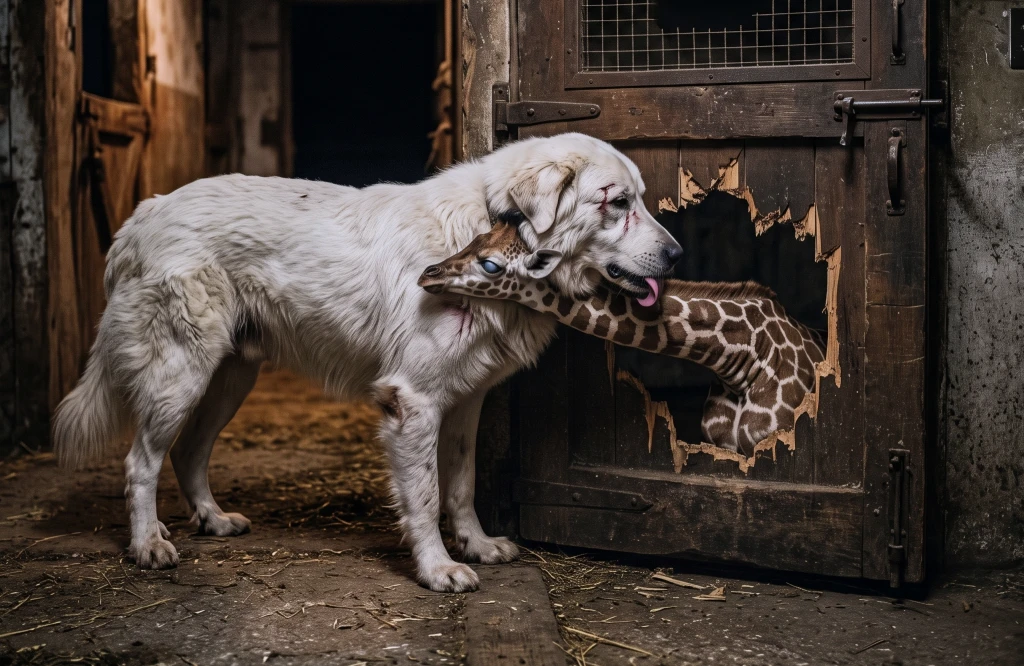
She had refused every feeding since the night before.
Nora crouched several feet from Willa’s shoulder and waited before touching her. A frightened giraffe calf could lash out without meaning to, and blindness made every surprise feel like danger. Even a dying animal could hurt herself trying to escape help.
“Willa,” Nora said, keeping her voice low. “It’s Nora. I’m right here.”
One spotted ear shifted toward the sound. The rest of the calf did not move.
That ear was the reason Nora did not radio Daniel and tell him there was nothing left to try.
She tapped twice against the mat, the way the team always did before entering Willa’s space, then set her palm gently against the calf’s neck. The skin beneath the soft patterned coat felt too cool. A warming bucket near the gate held the morning bottle, still sealed, the formula inside losing heat by the minute.
During Willa’s first days at Prairie Bend Wildlife Recovery Center, two people had been needed for every feeding. One person lifted the oversized bottle to the height a mother giraffe would have offered. Another steadied the calf’s shaking body and spoke to her until she found the nipple. Now three people could do all of that and still end up with the same untouched bottle.
Willa would smell the milk. Sometimes her mouth would brush the nipple. Then she would turn her blind face away, not angrily, not dramatically, just with the awful finality of an animal that no longer believed the world held anything she needed.
Daniel arrived before seven, his scrub jacket open beneath a canvas coat and his silver hair still damp from the shower. He had practiced wildlife medicine for more than twenty years, long enough to distrust both panic and hope when they came too quickly. Some animals arrived looking beyond saving and surprised everyone. Others offered one bright sign after another until the hidden damage finally showed itself.
Willa had stopped offering signs.
Her bloodwork was worse than the evening before. Dehydration had tightened around her body. Her glucose was low enough to make every hour dangerous, and her kidney values had begun drifting in the wrong direction. Fluids could keep her alive for a little longer, but an IV line could not feed a calf who had decided not to live.
Daniel knelt beside her, listened to her heart, checked the catheter taped along her leg, and lifted her lip to study the color of her gums. Nora watched his face because his voice almost never gave him away.
“When was the last time she tried to get up?” he asked.
“About three hours ago.”
“When you brought the bottle?”
Nora shook her head. “She tracked my voice. That was all.”
From the observation aisle, Helen Grant stood behind the mesh with both hands wrapped around a paper cup of coffee gone cold. Helen ran the center, which meant she handled donors, permits, payroll, insurance, angry calls from county officials, and the kind of decisions that made people whisper about you afterward. She loved animals enough to understand that love was not the same as keeping them breathing at any cost.
“Daniel,” she said quietly, “the board call is still at four.”
He did not look up. He already knew what was on his desk.
Willa had come to Prairie Bend eight days earlier after the state closed a collapsing roadside animal park outside Abilene. Inspectors found empty troughs, cracked shade shelters, expired medications, and records so incomplete they might as well have been fiction. Willa was five days old then. Both eyes were swollen from an infection that had been ignored since birth.
Her mother, a nineteen-year-old giraffe named Marigold, had been lying beside a water tank that no longer worked.
The rescue team stabilized them for transport, but Marigold died before sunrise. Infection and neglect had taken too much from her before anyone with authority cared enough to open the gates. Willa survived that first night, then the next. Daniel and a veterinary ophthalmologist saved both eyes as organs, but the damage to her sight was permanent. Scar tissue clouded the corneas so completely that the calf would never see more than changes in light.
Blindness did not make a life unlivable. Daniel had seen animals adapt to missing limbs, missing sight, missing entire pieces of the world people assumed they could not survive without. Animals learned textures, scents, sounds, routines, and the reliability of careful hands.
But Willa had lost her mother, her sight, her herd, and every familiar smell before she was even two weeks old. Since Marigold’s death, the calf had seemed to shrink inward day by day.
By midmorning, the senior staff gathered in the cramped conference room next to the clinic. A photograph from Willa’s second day at the center remained pinned to the corkboard behind Daniel’s chair. In it, Nora stood beneath the calf’s chest with both arms braced upward, and Willa leaned toward a bottle with milk on her chin.
The animal in the photograph felt much farther away than a week.
Helen laid the medical summary on the table. “I’m not asking anyone to make a decision this second. But we need to decide what line we’re using. We can’t move it every time one of us can’t bear to stop.”
“She still responds to sound,” Nora said.
“She moves an ear,” Helen replied.
“That counts.”
“I know it counts.” Helen’s voice stayed kind, which somehow made it harder to hear. “But does it count enough?”
No one answered.
Daniel looked down at the unsigned form. It did not use the word failure. Forms rarely did. It spoke instead of prognosis, suffering, humane intervention, and quality of life, all in language designed to keep a person steady while doing something that never felt steady at all.
He had signed forms like it before. He remembered every animal attached to them.
“What time does the board need an answer?” he asked.
“Four,” Helen said.
“Give me until noon tomorrow.”
Nora turned toward him. Helen did not move.
“For what?” Helen asked.
Daniel looked through the narrow conference-room window toward the quarantine barn. “I don’t know yet.”
“That isn’t a plan.”
“No.” He closed the folder but kept his hand on it. “It’s one night.”
Nora drew in a slow breath. “If her glucose drops again, we don’t wait.”
“We don’t wait,” Daniel agreed. “If she’s in pain we can’t control, if her breathing changes, if her kidneys cross the line, we stop. I’m not asking anyone to stretch suffering because we’re afraid of grief.”
Helen studied him for a long moment. Then she tapped one finger against the chart. “Noon tomorrow. Not because I think you’ve found a miracle. Because I trust you not to pretend.”
The meeting ended without relief. Nora returned to the barn. Helen went to make the kind of phone call that made everyone on a board sound cautious and everyone in a barn sound reckless. Daniel stayed at the table with Willa’s photograph behind him and the form still unsigned beneath his hand.
At 11:12, his phone buzzed.
The call was from Renee Alvarez, director of the Palo Duro County Animal Shelter. Daniel almost let it go to voicemail. He did occasional surgery consults for Renee, but the center was already stretched too thin, and anything that was not bleeding could wait.
Then he read her message.
I know you’re buried, but I need your eyes on a dog. Old livestock guardian. Owner died. Medically stable, but he’s shutting down. Hasn’t stood for staff since yesterday. I don’t like what I’m seeing.
Daniel read the message twice, then called her back before he could talk himself out of it.
“What do you mean by shutting down?” he asked.
Renee did not waste time. “He eats only if I sit in the kennel. Doesn’t care about walks, treats, other dogs, anything. He faces the service entrance all day like he’s waiting for someone to come back through it.”
“Pain?”
“Arthritis, controlled. Torn pads healing. Bloodwork is better than his attitude. He came in overheated and dehydrated, but we’re past the crisis.”
“What happened to the owner?”
Renee went quiet for a beat. “Stroke in the pasture. Ranch hand found him the next morning. The dog had stayed beside him all night.”
Daniel looked toward the barn roof shining pale under the Texas sky. “What’s the dog’s name?”
“Boone.”
Two hours later, Daniel was driving north through pastureland scrubbed flat by wind. He told himself he was going because a shelter director had asked for a veterinary opinion. He told himself it had nothing to do with a blind giraffe calf lying on a rubber floor, refusing the only thing that could keep her alive.
He did not believe himself.
The shelter’s quiet ward sat behind the main kennel building, insulated from the barking by two concrete walls and a corridor that smelled of bleach, laundry soap, and tired animals. Renee met him at the side door with her hair tucked under a faded ball cap.
“You look awful,” she said.
“I have a giraffe calf who won’t eat.”
“I have a hundred-and-forty-pound dog who thinks every person leaving the building is abandoning him.”
Daniel rubbed one hand over his face. “Good. Something simple, then.”
Renee gave a tired half smile and led him to the last kennel.
Boone lay on a raised cot with his back against the wall. He was broad and white, an old Great Pyrenees and Anatolian mix built for long nights in open country. Red dirt stained the fur around his legs. One ear was the color of storm clouds, and a pale scar crossed the bridge of his nose, old enough to belong to another life.
He opened his eyes when Daniel stopped outside the gate.
He did not lift his head.
Dogs like Boone were not bred to perform for strangers. They watched. They decided. They stood between vulnerable animals and anything that came too close. A good livestock guardian did not ask a person what needed protecting; he read the fence line, the weather, the flock, and the dark.
Boone did not look suspicious of Daniel. He looked through him.
Renee unlocked the kennel and went in first. “Hey, old man.”
One ear shifted. Boone kept staring at the service door at the end of the ward.
Renee sat on the floor and offered a piece of chicken. After several seconds, Boone raised his head, took it from her fingers with careful politeness, chewed once, swallowed, and set his chin down again.
“Owner was Tom Whitaker,” Renee said. “Sheep and goats on a place east of here. His daughter signed the intake because she lives in a second-floor apartment in San Antonio. She tried to keep him one night. Boone nearly broke through a window trying to get outside.”
“What happened to the stock?”
“Most sold. A neighbor took the rest until the property clears probate.”
Daniel stepped into the kennel and crouched near the door, giving the old dog space. “Any of Tom’s things?”
“His daughter brought a blanket from the truck. It’s under him.”
Daniel waited without calling again. Silence, he had learned, could be more useful than coaxing. Boone breathed in, studied him briefly, then returned his attention to the service entrance.
Waiting for a man who would never open it.
Daniel thought of Willa turning away from warm milk. He thought of that single ear moving toward Nora’s voice while the rest of the calf remained flat against the mat. The comparison was not clean. Boone was old, trained, shaped by years beside a person and a flock. Willa was a newborn prey animal who had lost the world before she understood its edges.
Still, both of them had stopped answering the things meant to keep them alive.
“I brought something,” Daniel said.
Renee looked at him. “You brought something for my depressed dog?”
“Not exactly for him.”
He opened his medical bag and removed a sealed plastic pouch. Inside was a square of cotton cloth Nora had rubbed against the padded rail where Willa rested her neck.
Renee stared at it. “Tell me you did not bring giraffe scent into my quiet ward.”
“I brought it in a sealed pouch.”
“That sentence got less comforting as it went.”
Daniel opened the pouch but did not move toward Boone. The old dog’s nostrils worked almost immediately. His eyes shifted from the service door to Daniel’s hand.
For the first time since Daniel had entered the ward, Boone turned his whole head.
There was no sudden brightness in him. No sweet, convenient transformation. His body simply became attentive, one piece at a time. The muscles along his shoulders tightened beneath his heavy coat. His nose lifted from the cot.
Daniel set the cloth on the floor between them and drew his hand back.
Boone stared at it.
Then the old dog stood.
It took effort. His back legs shook, and halfway up he paused as though his body had objected to the decision. But he rose, crossed the kennel, and lowered his massive head over the cloth.
He smelled it for nearly a minute. When Daniel reached to return the cloth to the pouch, Boone placed one paw over it.
Renee stopped moving. Boone lifted his head and looked directly at Daniel. Then he stepped around him, walked to the kennel gate, and waited…
To read the rest of the story – CLICK the NEXT button 👇👇👇