


The scraping started at 2:08 a.m. Caleb Hart woke with his hand already reaching beneath the bed, where he used to keep a sidearm before he decided a man living alone in the mountains should not make it too easy to answer fear with steel. The sound came again, slow and uneven across the porch boards. Wood against wood. A pause. Then a soft, worn-down whimper beneath the bedroom window.
For a few seconds, he listened to the storm throw snow against the cabin. Wind pressed hard at the seams, and the power had been out since midnight, leaving only the orange pulse of the woodstove in the next room. Caleb had lived five winters outside Elk Fork, Montana, and nothing good had ever dragged itself to his door after two in the morning.
He pulled on jeans, took the flashlight from the dresser, and opened the front door into blowing white.
A German shepherd stood on his porch with her head low and her legs shaking. A child’s red sled was tied to her padded harness with a rope that had frozen stiff. Beside the sled, half buried in loose snow, a shepherd puppy crouched and trembled so hard his whole body clicked against the boards.
The adult dog did not bark. She stared at Caleb as if barking would waste strength she had already spent.
“What did you bring me?” he said.
Then he heard it. Not the puppy. Not the wind. A thin, broken sound came from inside the sled, from beneath a blanket crusted with snow.
Caleb dropped to one knee. The shepherd stiffened, but she did not stop him when he brushed the blanket aside and found an infant carrier buckled into the sled with a belt and two knotted scarves. Inside lay a newborn boy wrapped in a woman’s flannel coat, his face pale in the beam of Caleb’s flashlight.
For one awful breath, Caleb saw another baby who had never made it home.
Then training took over.
“Easy,” he murmured, though he did not know whether he was speaking to the dog, the child, or the part of himself that had already begun to come apart.
He unfastened the carrier and lifted the baby against his chest. The dog held herself upright until the infant was inside Caleb’s coat. Only then did her back legs fold, and she sank onto the porch with a sound too soft to be a cry.
Caleb carried the carrier in first, set it on the kitchen table, and went back for both dogs. The puppy scrambled inside as soon as the door opened and skidded toward the heat. The older shepherd tried to rise on her own, failed, and allowed Caleb to lift her under the ribs. She was lighter than she looked beneath all that wet fur.
Inside, she did not go to the stove. She lay on the braided rug near the door, facing the table where the baby made small, weak sounds under Caleb’s hands.
“You did your part,” Caleb told her. “Let me do mine.”
He had spent fourteen years as an Army medic before retirement became less a choice than an order from his own body. He knew cold injuries, shock, bad breathing, worse silence. He also knew panic, and how it liked to disguise itself as hurry. So he slowed down. He warmed blankets near the stove, replaced the soaked layers one at a time, checked the baby’s breathing, and kept heat gradual instead of desperate.
The boy’s fingers curled and uncurled against the air.
“There you are,” Caleb whispered.
A diaper bag had been lashed beneath the sled handle. Inside, he found diapers, two unopened bottles of ready-to-feed formula, a tiny sleeper with bears on it, a folded hospital receiving blanket, and a photograph sealed in a sandwich bag.
The photo showed a young woman sitting on the steps of a yellow duplex somewhere flat and ordinary, the kind of rental with winter-dead flower boxes and a railing that needed paint. She held the newborn against one shoulder. The adult shepherd sat pressed to her knee, proud and alert, while the puppy sprawled across her boot like he had simply given up on standing.
The woman looked exhausted.
She also looked like she had made herself smile so the baby would one day have proof she had tried.
On the back of the photo, someone had written one word in blue ink.
JUNE.
Caleb looked toward the shepherd. “That your name?”
Her ears shifted toward him, but she kept her eyes on the baby.
The puppy, warmed enough to become foolish, crept from the stove and tucked himself against her belly. June did not look down. Her whole attention stayed on the newborn, as if she had delivered him but not yet surrendered responsibility.
Caleb tried his cell phone. Nothing. He tried the satellite phone he kept for emergencies, and the screen showed searching until the battery warning blinked. The radio in the mudroom gave him only static. Somewhere in the storm, a line had come down, or the ridge was blocking what little signal the night had left.
He checked the road through the kitchen window. There was no road anymore, just a white slope where the service track disappeared between pines.
The nearest neighbor was nearly five miles away. The nearest real town was farther, down a county road that turned ugly in clean weather and dangerous in storms. No ambulance would reach him before morning. No deputy would either, even if he could reach dispatch.
The baby gave another weak cry.
“I know,” Caleb said. “I’m not happy about it either.”
He warmed a bottle in a bowl of water, tested it against his wrist, and fed the child slowly. The baby took only a little at a time, then paused with his mouth barely moving, as if even hunger required permission. Caleb kept one hand behind the tiny head and listened to the stove pop and settle.
June raised her head every time the baby stirred.
When the boy’s color improved, Caleb wrapped him in a dry blanket and lined an old dresser drawer with folded towels. He hated the look of it on the floor beside the stove. He hated, more, that it was the safest place he had.
He had once believed his house would have a bassinet in it. He had watched his wife, Anna, stand in the doorway of a half-painted nursery with one hand pressed to her stomach and blue tape stuck to her sleeve. She had laughed because he had put together the crib backward and refused to admit it for an hour.
Three months later, a deputy chaplain had found Caleb in a field clinic overseas and told him there had been black ice on a two-lane road outside Billings.
Anna had died before he could board the first flight.
Their daughter had never taken a breath.
Caleb had come home to rooms he could not enter and casseroles he could not swallow. In time, people stopped knocking. In more time, he sold the house, bought a cabin, and taught himself how not to be necessary.
Now a newborn slept in a dresser drawer beside his stove, and a wounded dog watched him like she had crossed miles of mountain snow on a question.
June’s harness had rubbed deep raw patches into her chest and shoulders. Caleb cleaned the wounds as gently as he could with warm water and medical gauze from an old field kit. She flinched only once, when he touched the worst place near the strap buckle. The puppy tried to climb into the open medical bag, sneezed on the scissors, and backed away as if the bag had insulted him.
Despite himself, Caleb let out one quiet breath that was almost a laugh. “You’re not the tactical support, are you?”
The puppy blinked at him.
By four-thirty, the wind had begun to thin. Snow still fell, but it came down straighter now, less like a wall and more like weather. The baby slept. The puppy slept. June did not. She lay with her front paws braced and her ears working toward the door.
At first Caleb thought she needed to go outside. Then he noticed she was not watching the door for herself. She kept glancing from the baby to the night beyond the windows.
“You left somebody out there,” he said.
June rose.
Her hind legs shook so badly she almost went down, but she made it to the door and scratched once. The puppy lifted his head, whined, and tried to follow. June turned, placed her muzzle firmly against his chest, and held him back. He sat. She scratched again, harder.
Caleb stood still with one hand on the doorframe.
He had followed working dogs in places where men trusted them with their lives because the animals noticed what people missed. A dog asking to go out looked different from a dog giving orders.
June was giving orders.
Caleb dressed the baby in the dry sleeper, secured him inside a cloth sling beneath his parka, and packed the diaper bag with formula, blankets, and medical supplies. He left the puppy shut inside the mudroom with food and water. The little dog pawed at the door until June gave one low sound through the wood, and then he went quiet.
Morning had only begun to blue the snow when Caleb stepped onto the porch.
The red sled had carved a deep groove through the drift leading away from the cabin. June did not follow it forward. She followed it backward, her paws sinking into her own old trail. Caleb moved behind her, one hand over the baby beneath his coat, counting distance the way he had counted steps across unsafe ground.
A hundred yards from the cabin, the sled trail veered from the service road and disappeared into the timber.
He saw the first sign beneath a broken pine limb: a dark place in the snow too large to be shadow. A few yards later, a knit hat hung on a low branch, frozen hard along one edge. June paused beneath it but did not sniff. She only looked deeper into the trees.
Caleb did not want to continue.
He continued.
The woman from the photograph lay in a shallow hollow under the pines where the branches had kept some of the snow from covering her. One arm reached toward the path. The other was curved inward, not holding anything anymore. The rope marks around the sled trail showed where she had tied June’s harness with hands that must have barely worked.
Caleb knelt beside her. He checked because a medic checked, even when the answer was already written in the cold.
Her name was in the pouch clipped to the torn strap of the diaper bag. Natalie Wells. The hospital bracelet listed a baby boy born four days earlier: Eli Wells. There was also a folded receipt, the back of it covered in handwriting that had been done while moving or freezing or both.
My name is Natalie Wells. My son is Eli.
Please don’t let Harlan Price take him.
He will tell you he’s family. He is not.
Please believe the dog.
Caleb read the last line twice.
June lowered herself beside Natalie and rested her chin on the woman’s sleeve. She did not whine. She did not paw at the body. She simply pressed close, as if there was one last warmth she could offer and no time left to give it.
Caleb covered Natalie with the emergency blanket from his pack. He marked the tree, memorized the path, and left everything else untouched. The law would need this place as it was. Natalie deserved to be found by more than a stranger and a dog who had done what she asked.
“I have him,” Caleb told June quietly.
The dog stayed where she was.
He waited in the snow, the baby warm against his chest and the cold working through his boots, until June finally rose.
The walk back took longer. June limped badly now, and Caleb shortened his stride for her. When the cabin appeared through the pines, the puppy began barking inside, sharp and frantic.
Then Caleb saw the footprints.
Two sets of boot tracks crossed the edge of his service road and climbed straight to his porch. They were fresh enough that wind had not softened the edges. June saw them a moment later, and the change in her was immediate. Pain left her posture. Her head lowered. The fur along her spine lifted in one hard ridge.
Caleb got the baby inside and secured the door. The puppy ran to June, but she moved past him and placed herself between the entrance and the dresser drawer where Eli slept.
The radio still gave only static.
Caleb had just checked the kitchen window when the knock came.
Three slow strikes.
Not urgent. Not lost. Not frightened.
A man on the porch expected to be answered.
Caleb looked through the side glass. Two men stood outside in the pale storm light. The one nearest the door wore a black parka too clean for the woods and leather gloves too nice for hauling anyone out of a ditch. The second stayed back, scanning the window frames and the roofline instead of the trail.
June began to growl.
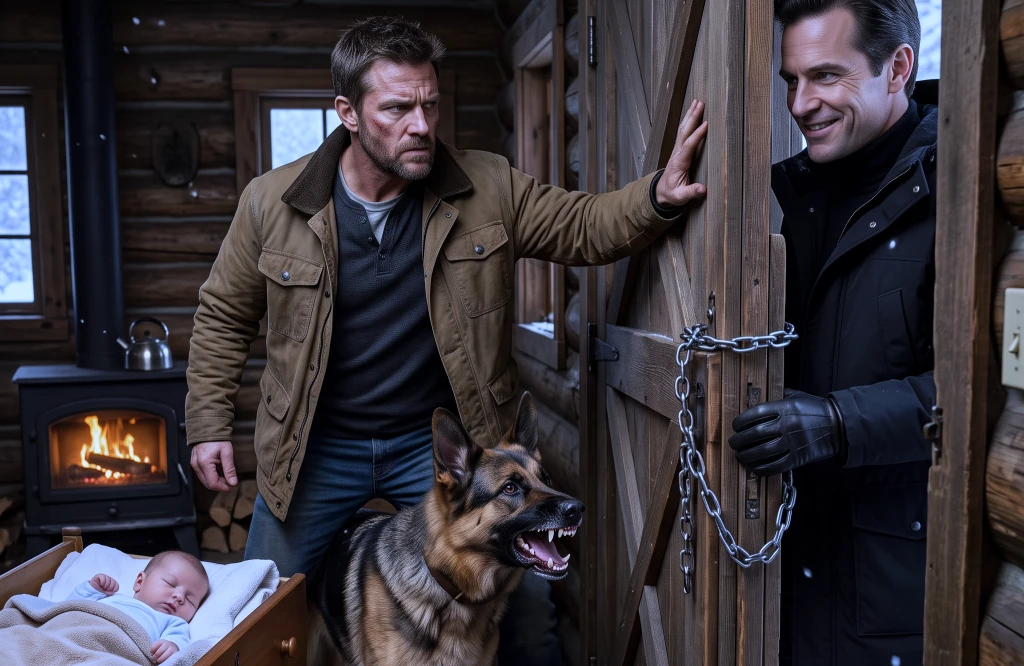
Caleb touched the folded note inside his shirt pocket, then opened the door only as far as the chain allowed.
The first man gave him a tired, careful smile. “Sorry to bother you this early,” he said. “I’m Harlan Price. I’m looking for my cousin Natalie and her baby.”
Behind Caleb, June’s growl stopped. The man leaned toward the opening, saw the dog, and smiled at her like he had found something he owned. – “June,” he said softly. “Come on, girl. Come here…”
To read the rest of the story – CLICK the NEXT button 👇👇👇