


Mrs. Vivian Hart set the black metronome on the grand piano as if she were placing evidence on a table. It was Friday afternoon in the music room at Harbor Ridge Elementary, twenty minutes before dismissal, and twenty-six fourth graders had been struggling through clapped rhythms for the spring concert. Mia Bennett had spent most of the class in the last row, small and quiet in a gray hoodie with a frayed cuff, tapping the correct pattern against the inside of her sleeve where no one was supposed to see.
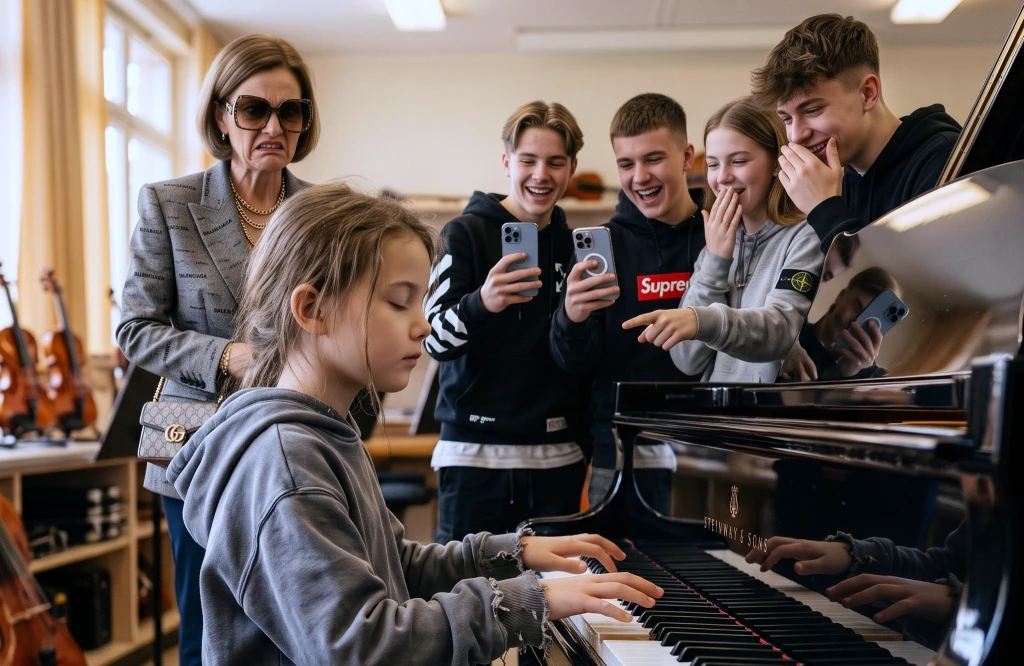
Mrs. Hart saw.
She turned the piano bench toward the class and smiled with only the lower half of her face. “Mia, since you’ve been conducting a private lesson back there, why don’t you come up and show everyone how it should be done?”
Every chair seemed to turn without moving. Mia felt the attention land on her shoulders, then on her hands, which she slid quickly beneath the desk. She had learned, over the past year and a half, that attention could be almost as hard to survive as pity.
“I wasn’t trying to,” she said.
“That isn’t what I asked.” Mrs. Hart tapped one finger on the piano bench. “Come on. A simple scale will be fine.”
Mia looked toward the door. The hallway beyond it held lockers, drinking fountains, the nurse’s office, all the ordinary exits a child was allowed to use only with permission. She could feel Jaden Miller watching from two rows over. He was the boy Mrs. Hart stopped whenever his snare rhythm sped up, the boy who always looked as if he were bracing before he made a mistake.
Ava Whitmore, who took private piano twice a week and used a zippered folder with her initials on it, sat straighter. Ethan Park lowered his violin bow into his lap. Sophie Alvarez’s school tablet, still propped against a stack of rhythm cards from the exercise they had been recording, showed a small red light near the top edge.
Mia kept her voice as flat as she could. “I don’t want to play.”
Mrs. Hart’s expression sharpened. She had been teaching music in Millstone, Pennsylvania, long enough to make disappointment sound like good manners. She liked children who arrived with polished shoes, tuned instruments, parents who volunteered, and lesson histories that came typed on registration forms. Mia had arrived in January with none of those things.
“This is not a punishment,” Mrs. Hart said, although it felt exactly like one. “You spend a great deal of time watching the piano. You correct other students under your desk. If you understand something the rest of us don’t, this is your chance to share it.”
A few students shifted. No one laughed out loud, which somehow made the moment worse.
The music room had been the first place in the school Mia had almost loved. It smelled like dry-erase marker, brass polish, and the lemon oil the night custodian used on the piano. Ukuleles hung on hooks along the far wall. Hand drums sat in bright plastic bins under the windows. In the center of the room stood the grand piano, black and glossy, with one tiny chip near the fallboard and a middle pedal worn smooth by years of careful shoes.
Mia had noticed those details on her first day.
She had noticed the piano before she noticed where to sit, before she noticed Ava looking at her patched backpack, before she noticed Mrs. Hart asking, “Mia Bennett?” in the tone adults used when they had already decided a quiet child would need managing.
“Here,” Mia had said.
“Speak up, please.”
“Here.”
That had been the beginning. Since then, Mia had made herself as small as possible. She sang softly during warmups. She completed theory worksheets in pencil and erased so thoroughly the paper grew thin. She never volunteered for solos, never asked to try an instrument, never mentioned that she could read every staff line on the classroom posters faster than she could read the lunch menu.
But she watched the piano because not watching it took more strength than she had.
Before her mother got sick, there had been an upright piano in the living room of their small rental house outside Lancaster. It had been old, brown, and always a little stubborn in damp weather. Her mother, Lillian Bennett, taught neighborhood children there on weekday afternoons and played for church services, school choirs, and community theater rehearsals when someone needed an accompanist who could follow anybody through anything.
At night, when the last student left and Mia’s father finished washing dinner plates, Lillian sat beside Mia on the bench.
“Don’t pounce on the note,” she would say, touching Mia’s wrist with two gentle fingers. “Give it a place to land.”
Mia had loved the way her mother made music feel like weather, like a room, like something alive enough to listen back. A rest was not emptiness. A rest was the music taking a breath. A wrong note was not shame. It was a door that opened into practice.
Then came the appointments, the insurance letters, the orange prescription bottles lined along the kitchen windowsill. Mia learned the names of hospital parking garages before she learned long division. Her father, Aaron Bennett, missed shifts at the auto parts warehouse to drive Lillian to treatment. Bills gathered in white envelopes on the counter, and the adults who came to the house stopped saying, “Let us know if you need anything,” because everyone already knew what they needed was too large to fit in a casserole dish.
Lillian died in November, three weeks before Mia turned nine.
By February, the piano was gone.
Two movers carried it out with straps around its body, their boots leaving wet marks on the front steps. One of them kept saying, “Careful, careful,” as if the instrument could still be spared. Mia stood beside her father in the doorway and watched the upright tilt into the truck. Aaron had one hand on her shoulder and the other pressed over his mouth.
“We’ll get another one someday,” he said.
Mia nodded because he needed her to, not because she believed him.
After that, they moved twice. The first apartment had a neighbor who banged on the wall whenever Aaron’s alarm went off at 5:15 a.m. The second had a leak above the bathroom sink. The place they had now in Millstone was cleaner and safer, but it was still small enough that Aaron slept on the pullout couch and kept his work boots in a plastic tray by the door so they would not track grease across the kitchen.
On their third night there, he came home with a roll of poster paper from the dollar store, a ruler, and a blue marker.
Mia watched him clear the kitchen table. “What are you doing?”
“Something probably ridiculous.” Aaron drew one long line, frowned, measured again, and started over. “But your hands have been practicing on air for three weeks, and I’m tired of watching them get nothing back.”
He stayed up past midnight making a paper keyboard. The white keys were outlined in blue. The black keys were filled in with pencil because the marker bled through the paper. He measured the octaves twice and taped extra sheets to the end when he realized he had made it too short.
It made no sound. It slipped if Mia pressed too hard. One section wrinkled where Aaron’s coffee mug had been too close.
Still, she practiced on it every night.
Scales. Broken chords. Pieces her mother had taught her. Measures she remembered only as finger patterns and grief. She moved silently across the paper while the refrigerator hummed, while Aaron folded laundry, while the traffic from Route 22 hissed beyond the windows.
She had not touched a real piano in fifteen months.
At Harbor Ridge, she had told herself she would not start. She would not press one key and let the sound come rushing back like a person opening a door she had braced shut. But on the second week, after class, when Mrs. Hart was in the hall speaking to a parent volunteer, Mia had stood beside the grand and placed one finger on middle C.
She did not press it.
The next time, she did. So softly the note seemed embarrassed to exist.
Mrs. Hart had been at her desk, half-hidden behind spring concert forms. She had said nothing that day. Afterward, though, the questions began.
“Have you had training, Mia?”
“A little.”
“How much is a little?”
Mia kept her eyes on the worksheet. “I don’t take lessons anymore.”
“With whom did you study?”
“My mom.”
“And now?”
Mia had not answered. She did not know how to explain that her teacher was dead, her piano had been sold, and the closest thing she had to lessons now was a paper keyboard taped at the seams and a memory that hurt when touched.
Silence did not soften Mrs. Hart. It made her suspicious.
For three weeks, the teacher watched Mia watch the piano. She saw Mia’s fingers move beneath her desk when Ava rushed a left-hand pattern. She saw Mia look up one measure before Ethan missed an entrance. She saw, without understanding, the difference between a child showing off and a child trying not to disappear completely from the only thing that still recognized her.
Now the bench waited.
“Mia,” Mrs. Hart said, “we don’t have all afternoon.”
The class waited too.
Mia’s stomach tightened. She imagined refusing again, being sent to the office, having Aaron called away from work. He would come in his navy uniform shirt with BENNETT stitched over the pocket, scared before he was angry. He would apologize to people who owed him an apology because that was what tired parents did when they had no margin left.
Then she remembered him bent over the kitchen table, redrawing one crooked octave because he wanted the silent keys to be the right size.
Your hands have been practicing on air.
Mia pushed her chair back.
The room changed with the scrape of its legs. Mrs. Hart moved aside, still wearing that careful teacher smile, the kind that said she already knew how the lesson would end. Ava’s eyes flicked from Mia’s sleeves to the piano. Ethan looked down, as if he did not want to be caught witnessing whatever came next. Jaden’s jaw tightened.
Mia walked to the front.
The floor did not actually slope, but it felt as if it did. She stopped by the bench, set her backpack beside one leg, and looked at the instrument. The piano reflected the fluorescent lights in long white streaks. Beneath the raised lid, strings crossed in gold lines, quiet and waiting.
“Anything simple,” Mrs. Hart said. “Start with C major.”
Mia sat.
She did not look for middle C. She adjusted the bench back two inches, lowered it half a notch, placed both feet where the pedals would be, and let her shoulders drop the way her mother had taught her. Her hands rose, not high, not dramatic, just enough for her fingers to find the air above the keys.
Mrs. Hart’s smile faltered.
She had watched hundreds of children sit at pianos. Beginners landed too close or too far away. Beginners held their elbows stiffly, flattened their fingers, stared at the keyboard as if it might move. Beginners did not settle into the bench as if the distance between body and instrument lived somewhere in the bones.
Mia closed her eyes for one breath. Then she played the first note so softly that Mrs. Hart leaned forward to catch it…
To read the rest of the story – CLICK the NEXT button 👇👇👇