


The casket looked like it had been made for a dollhouse. That was the first thought I could hold on to as the straps tightened and the cemetery workers began lowering my nine-year-old son into the ground. Not prayer. Not memory. Not even disbelief. Just that terrible, practical observation: Noah had been too small for so many things in life, and now even his coffin seemed too small for the weight of goodbye.
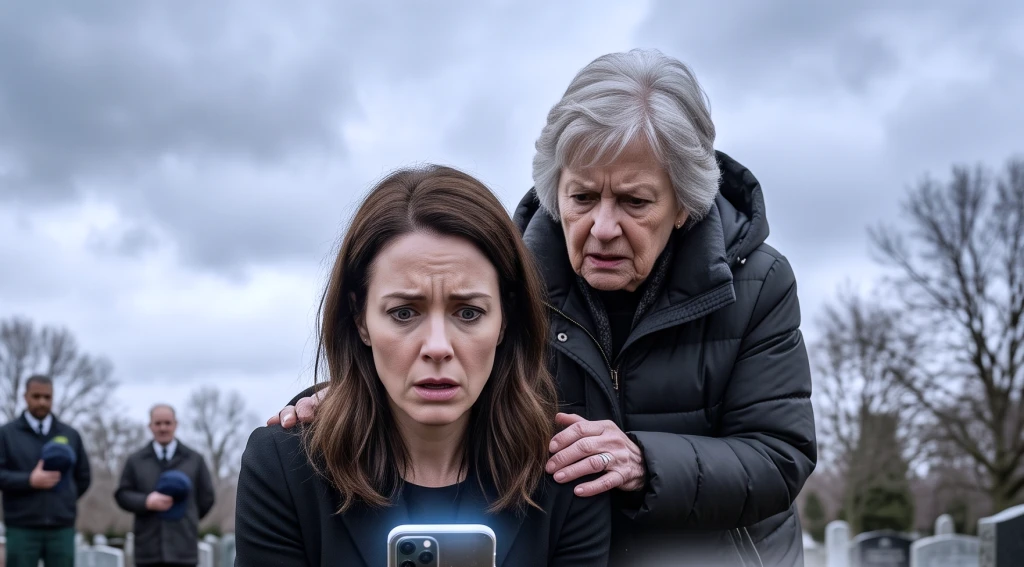
I stood in my black dress with my hands locked together so hard my fingers ached. The minister’s words had blurred into the wind ten minutes earlier, soft phrases about peace and rest and God’s keeping. I wanted to believe him. I wanted to feel that Noah was somewhere beyond pain, somewhere his blood could no longer betray him, somewhere nurses did not come in at 3:00 a.m. with gentle voices and worried eyes.
But all I could see was the white casket dipping lower, inch by inch, into a rectangle of dark Ohio dirt.
Beside me, Ruth Ellis touched my elbow. She was my next-door neighbor, seventy-six years old, five feet tall in her winter coat, and the only person standing with me who had ever sat beside Noah when the fever made him shake. She had brought soup in Mason jars, folded laundry without being asked, and learned how to silence his infusion pump when I was too exhausted to lift my head from the hospital chair.
She had come.
My parents had not. My sister Brooke had not. Jenna, my best friend since third grade, had not.
Ruth didn’t ask whether I was all right. She knew better. She only stood close enough that if my knees gave out, I would not hit the ground alone.
Eight months earlier, a pediatric hematologist at St. Catherine’s Children’s Hospital had pulled a rolling stool close to Noah’s bed and told us the name of the rare marrow-failure disorder that had been draining color from my boy’s face. Noah had listened with his hands folded on top of his superhero blanket, serious in the way children become when adults stop pretending.
“Is it the kind that goes away?” he asked.
The doctor looked at me before answering him. “Sometimes we can push it back for a long time.”
Noah nodded as if that was a reasonable arrangement. “Then we should do that.”
He said “we,” and for eight months, it was the two of us against everything. Against transfusions that left bruises up both his arms. Against medications with side effects printed in tiny, frightening paragraphs. Against insurance denials, late-night fevers, and the kind of hope that makes you bargain with the ceiling while your child sleeps.
My family called me dramatic when I insisted something was wrong before the diagnosis. Afterward, they called me overprotective when I refused to miss appointments. My mother, Marianne, mailed a card after the first hospital stay. My father, Paul, left voicemails saying he was sure the doctors had it handled. Brooke sent a stuffed bear with the tag still attached and a text that read: Tell him Auntie loves him! So scary. Keep us posted.
She never visited.
Noah noticed, though he tried not to let me see it. He stopped asking whether Grandma was coming. He stopped checking the hallway when he heard footsteps outside his room. Toward the end, when his body was thin under the blankets and his eyelashes rested like dark brushstrokes against his cheeks, he asked if Ruth could bring her cinnamon apples again because “she remembers the extra brown sugar.”
That was the kind of family he understood by then. The kind that showed up.
The straps stopped moving. The workers waited at the edge of the grave with their caps in their hands, giving me the quiet dignity of a few final seconds. I looked down into the open ground, where the casket rested on the bottom like a closed door.
Ruth leaned closer. “Take your time, Claire.”
My name sounded unfamiliar. For months, I had mostly been Mom. Mom, my stomach hurts. Mom, can you sit on this side? Mom, don’t tell the nurse I’m scared because I don’t want her to feel bad.
I reached into my coat pocket and closed my fingers around the little plastic astronaut Noah had carried through every hospital stay. The white paint had rubbed off one boot. A nurse had once taped it to his IV pole and told him the astronaut was checking the spaceship systems. Noah laughed so hard that day he had to hold his side.
I knelt carefully beside the grave. The ground was damp and cold through my tights, but I barely felt it.
“You were braver than all of us,” I whispered. “I hope you knew that.”
The astronaut landed softly on top of the casket. I kept my hand there for a moment, my palm hovering over the last physical distance between us. Then my phone buzzed in my coat pocket.
I flinched like it had shouted.
Ruth saw my face. “Don’t look right now.”
“I won’t,” I said, and then I did.
It was a reflex, the same reflex that had kept me checking lab results, pharmacy messages, and hospital updates at all hours of the night. I pulled out my phone with dirt on my fingers. The screen lit with my mother’s name.
Before I opened the text, Instagram refreshed in the background.
There was Brooke, standing beneath a chandelier at the Grand Aster Hotel in downtown Briarwood, one hand lifted so the diamond caught the light. Her fiancé, Tyler, had his arm around her waist. My parents stood on either side of them, smiling with the fixed brightness people save for expensive photographs. Jenna was there too, holding a champagne flute and laughing at something just outside the frame.
The caption read: Best night with the people who matter most.
It had been posted twenty-three minutes earlier.
Twenty-three minutes earlier, the minister had been saying Noah’s name.
For a moment I couldn’t breathe. Not because I had expected them to come. Some part of me had already understood they would choose Brooke’s engagement party; they had called it “impossible to reschedule,” as if a ballroom deposit mattered more than a child in a casket. But seeing them polished and laughing while the dirt waited at my feet made the truth sharp enough to cut through the numbness.
Another message appeared from my mother.
We need to talk tomorrow. Bring the trust documents.
I stared at the words until they stopped looking like language.
Ruth’s face changed when I showed her. The softness went out of her eyes. “Today?”
I nodded.
Noah’s trust had been set up after his father, Adam, died in a car accident four years earlier. Adam and I had already divorced by then, but he loved Noah with the kind of devotion that did not end because a marriage did. His life insurance, a settlement, and his savings had gone into a protected education trust worth just under nine hundred thousand dollars. If Noah lived, it would pay for college, medical school, a first apartment, whatever future he chose. If he didn’t, the remaining funds would pass to me as the residual beneficiary.
Adam’s attorney had explained that part gently, years before I could bear to imagine why it mattered.
My mother sent a second text before I answered the first.
Don’t make this difficult, Claire. This affects the whole family.
The whole family.
I looked at Brooke’s glittering ring again. My parents’ practiced smiles. Jenna’s champagne glass lifted in celebration. Then I looked down at the grave, where my son had just been lowered into the earth with only one neighbor there to say goodbye.
Something cold moved through me. It was not strength yet. It was not anger. It was the first clear thought I had managed all day that did not collapse under grief.
They had skipped his funeral, but they wanted his paperwork.
I turned off my phone and put it back in my pocket. The cemetery worker shifted a few feet away, waiting for permission to finish. I wanted to climb down into that hole and curl around the casket like I had curled around Noah in hospital beds too narrow for both of us. I wanted the world to stop asking me for decisions.
Ruth stepped between me and the worker. “She needs another minute.”
The man nodded. “Of course.”
I stood slowly. The plastic astronaut looked impossibly small against the white casket. I thought of Noah at seven, announcing that he was going to become a doctor because “somebody has to fix kids who get the weird stuff.” I thought of him pressing his palm to my cheek during his last lucid afternoon and saying, “You’ll be okay, Mom. Ruth will make you eat.”
He had been worried about me.
That was what finally steadied me. My son, dying by inches, had still been trying to take care of the people he loved. My family, alive and healthy in a hotel ballroom, had spent his funeral asking about money.
I wiped my cheeks with the back of my hand and bent close to the grave one last time.
“I’ll protect what’s yours,” I said. “I promise.”
The next morning, rain dragged silver lines down my windshield as I drove to my parents’ house in Oak Hollow, the kind of neighborhood with brick mailboxes and lawns maintained by companies that arrived before breakfast. I had slept maybe forty minutes in Ruth’s guest room, waking again and again to the sound of machines that were no longer there.
My mother had texted three more times before dawn. My father had left a voicemail in the tone he used when he wanted obedience to sound like concern. Brooke had sent one message: Please don’t come in emotional. We need to be practical.
Practical. The word sat in my mouth like metal.
I parked at the curb because the driveway was full. My parents’ Lexus. Brooke’s white SUV. Tyler’s black truck. And behind it, angled beneath the maple tree, Jenna’s silver BMW.
For a second, seeing her car hurt worse than the others.
Jenna had held my hand when Adam died. She had brought wine and takeout after my divorce. She had once known where I kept the spare key and which side of the couch was mine. During Noah’s illness, she had faded slowly, each absence wrapped in a reasonable excuse. Work. The twins. Her separation. A migraine. A meeting she couldn’t move.
I still hadn’t understood that she had chosen a side.
The front door opened before I rang. My father stood there in a navy sweater, his face arranged into a solemn expression that did not reach his eyes.
“Claire,” he said. “We’ve been waiting.”
No one hugged me. No one said Noah’s name.
In the living room, my mother stood beside the fireplace with a tissue balled in one hand, though her mascara was perfect. Brooke sat on the cream-colored sofa, legs crossed, her engagement ring displayed against her knee. Tyler stood behind her with his arms folded. Jenna perched on the edge of an armchair and looked at the rug.
On the coffee table, folders had been arranged in neat stacks.
I did not sit. “What is this?”
My father picked up a pen. “A way to prevent this from becoming uglier than it needs to be.”
Brooke leaned forward, her voice soft in the way people speak to someone they have already decided is irrational. “Claire, nobody is trying to hurt you. You’ve been through something awful. We all understand that.”
I looked at each of them. “Do you?”
My mother’s mouth tightened. “This is exactly what we were afraid of. You’re raw right now, and you’re hearing everything as an attack.”
“Because you texted me about trust documents while I was standing at my son’s grave.”
A flicker of irritation crossed Brooke’s face before she smoothed it away. “The timing wasn’t ideal.”
Ruth had told me to let them talk first. People reveal themselves when they think you are too weak to listen. So I stood there in my damp coat and watched my father slide the top folder toward me.
“These papers authorize Brooke to serve as temporary administrator of the trust assets,” he said. “You’ll retain a reasonable allowance while you recover.”
“A reasonable allowance.”
“It’s for your protection,” my mother added. “You haven’t been yourself for months.”
My hand moved to the folder before I could stop it. The first document was not a trust transfer. It was worse. The heading read Petition for Temporary Conservatorship of Person and Estate.
My name appeared beneath it.
So did the date.
The petition had been drafted six weeks before Noah died. For one long moment, the rain against the windows was the only sound in the room. Then Brooke reached for the folder, too late to hide what I had already seen…
To read the rest of the story – CLICK the NEXT button 👇👇👇