


The wolf was sitting where no living thing should have waited—on a gray patch of lake ice Grant Harlan had marked dangerous three days earlier. Snow had gathered across the animal’s back in a hard ridge, not the light powder a wolf picked up while moving through brush. It clung to his shoulders and spine like a second pelt, wind-packed and frozen. He had been still long enough for the weather to start covering him.
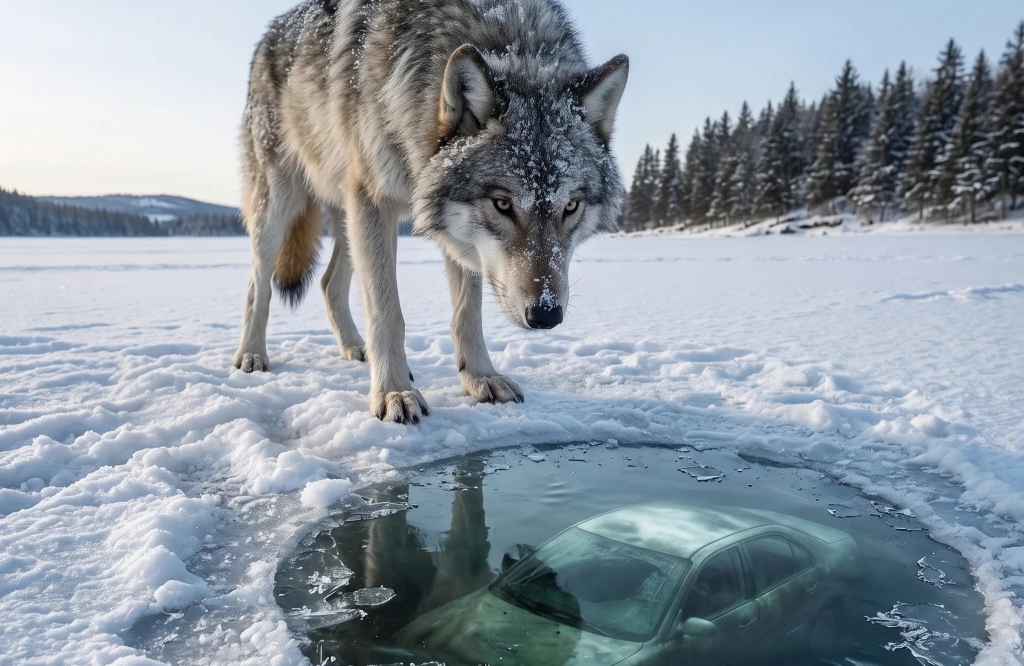
Grant eased his snowmobile into the black spruce and killed the engine. The sudden quiet made the whole lake feel larger. Copperline Lake stretched out in front of him, white and empty beneath a low January sky, its far shoreline blurred by blowing snow.
The wolf did not run.
That was the part Grant could not make sense of. Wolves in the Upper Peninsula did not wait around to be studied by men in fluorescent parkas. They faded into trees, crossed ridges without leaving more than a rumor, and let people argue about what they had seen afterward.
This one stayed.
His left front paw hovered above the ice. Dark blood had stiffened the fur around the toes, and an older pale scar crooked across his side. He watched a patch of ice several yards ahead of him with the concentration of an animal listening to something no one else could hear.
Behind Grant, a second snowmobile coughed once and went quiet.
Nora Fields pulled off her helmet and followed his gaze. She worked seasonal contracts for the state wolf-monitoring project and had a habit of going silent when she was thinking hard. Grant had learned to respect that silence more than most people’s opinions.
“That’s the same male?” she asked.
“Third day,” Grant said. “Same place.”
Nora raised her binoculars. “How long did he sit there yesterday?”
“Long enough for me to check the south ridge and come back. He hadn’t moved.”
“And the day before?”
“Timber crew saw him from the logging cut. They called it in because he looked hurt.”
The wolf finally turned his head toward them. His ears tipped forward, then flattened just a little, not in the clean language of threat but in something more guarded. Grant had spent twenty-one years around wild animals and still trusted uncertainty more than confidence.
Inside his coat pocket was a folded bulletin with two photographs on it.
Dr. Samuel Keene, fifty-four. Wildlife biologist. Last confirmed location, the Copperline drainage. Missing since Friday afternoon.
June Keene, eighteen. His daughter. College freshman deferred for one semester after her mother’s death. Last seen by her roommate in Port Alder on Friday morning. Missing since the same day.
For the first twelve hours, everyone believed Samuel had gone alone to retrieve cameras before the storm. Then deputies found June’s last text to a friend: Going into the field with Dad. Pray we make it home without killing each other.
Grant had known Samuel Keene for nearly a decade. They had argued about wolf collars, public meetings, ranchers, trail closures, and whether giving research animals nicknames made people softer or simply more honest. Samuel believed names helped the public care. Grant believed names made people invent stories that could get them hurt.
Their final argument had been about the lake.
A thaw before Christmas had softened the spring-fed inlet on Copperline’s north end. The cold returned hard after New Year’s, sealing the surface under fresh snow, but Grant had warned Samuel that the ice there could look sound while running thin underneath.
Samuel had sighed into the phone. “I know that lake.”
“You know the summer lake,” Grant told him. “This is different.”
“I’ll use the old trail.”
“Then use it.”
Samuel had promised. Grant had let himself believe the promise because it was easier than imagining a man that experienced making a mistake a teenager would pay for.
Now Samuel’s truck was missing, his daughter was missing, and a wounded wolf had spent three days staring at bad ice.
Nora lowered the binoculars. “That scar.”
“You recognize it?”
“I don’t want to say that unless I’m sure.”
“Say what you’re thinking.”
“Two winters ago, Samuel helped cut a young male out of an illegal cable set near the burn scar. Left side torn open. Gray coat. He kept calling him Cinder when he thought the rest of us weren’t listening.”
Grant looked back at the wolf. “A lot of wolves carry scars.”
“Not that one.”
The animal stood.
His body was narrower than it should have been, hunger drawing sharp lines under the fur. He set the injured paw down, flinched, and stepped sideways until he stood directly between Grant and the darker seam in the ice.
Nora’s voice dropped. “He’s not guarding food.”
“No.”
“There’s no carcass. No ravens. No drag marks.”
Grant unhooked a coil of rope from the snowmobile rack. “Stay on the shoreline until I say otherwise.”
Nora looked at the rope, then at the wolf. “That won’t help you if he decides to come in.”
“It’s not for him.”
He tied one end around a spruce trunk and clipped the other to his harness. Nora did the same with a second line, her face tightening as she understood. They each took an ice chisel and stepped out from shore, keeping several yards between them.
The lake gave small, mean sounds beneath the snow.
Grant tested every step. The chisel punched through crust, then solid ice, then stopped. He moved forward slowly, letting his weight settle before trusting the next footfall. Nora matched him from his left, her eyes moving from the ice to the wolf and back again.
At sixty yards, the wolf lowered his head.
At fifty, he growled.
It was not loud. It was almost restrained, a rough thread of sound that traveled across the frozen lake and reached something old inside Grant’s ribs. He stopped because ignoring a warning from a wild animal was not bravery. It was arrogance wearing a uniform.
“Easy,” he said, though the word was for himself.
The wolf shifted when Grant shifted. Nora moved two steps left, and the wolf moved with her, still holding himself between them and the seam. His injured paw left a small dark mark on the snow.
“He’s blocking the approach,” Nora murmured.
“Or protecting his own space.”
“From us?”
Grant did not answer. A gust of snow swept between them, erasing the animal for several seconds. When the air cleared again, Grant saw something straight under the ice.
Nature made rings, cracks, bubbles, shadows. It did not usually make a clean black bar.
He dropped carefully to one knee, spreading his weight, and brushed snow from the surface with his glove. The ice below was darker than the surrounding lake, newly sealed and thin enough that he could see through it in broken pieces. Under the water, distorted by depth and cloudy ice, two parallel strips ran across a dark shape.
Roof rails.
Grant’s throat closed.
“Nora.”
She went down on her stomach and crawled closer, distributing her weight. Together they cleared a narrow window without moving toward the center of the seam. The shape sharpened slowly, like a photograph developing under water.
A dark pickup rested nose-down beneath the ice. Its rear end sat higher, roof only a few feet below them. An orange field case was wedged against the back window, and a peeling university research sticker clung to the glass.
Nora whispered Samuel’s name.
Grant reached for his radio with hands that did not feel like his own. “Command, this is Harlan. We’ve located the Keene vehicle under the north inlet ice at Copperline Lake. We need rescue, divers, medical, and shore-based extraction. Possible occupants unknown.”
The wolf backed toward the shoreline as Grant spoke, but he did not leave. He climbed the low rise above the boulders and sat again, paw lifted, snow blowing around his legs.
Within forty minutes, the empty lake was full of human noise. County rescue arrived by snowmobile and tracked utility vehicle. Deputies marked the unsafe ice. Paramedics unpacked warming gear. Ben Carver, the rescue chief, tested the edges from shore and swore under his breath at every result.
“No heavy equipment out there,” Ben said. “We’ll lose another rig.”
“The back window looks broken,” Nora said.
Ben looked through the cleared strip. “Could mean somebody got out.”
Grant kept his eyes on the truck. “Or tried to.”
They searched for tracks, but the storm had been erasing the lake for two days. The only pattern left belonged to the wolf: a restless loop between the ice seam and the boulder shelf near shore.
Nora walked that shoreline slowly, staying clear of the weak edge. When she came back, she carried something blue and small in her glove.
“Part of a plastic whistle,” she said. “Broken.”
Grant looked at the boulders. The wolf had risen.
He stood on the slope with the intensity of an animal about to bolt, except he did not run. He stared at Nora, then turned his head toward a drift packed against the rocks below the rise. A low sound came from him, too rough for a whine and too thin for a howl.
Nora stopped walking. “Grant.”
“I see him.”
Cinder limped down three steps. He stopped beside the drift, scratched once with his wounded paw, and pulled away as if the motion had cost him. Blood marked the snow. Then he backed uphill again and watched them.
Ben glanced at Grant. “What’s he doing?”
Grant hated the only honest answer. “I don’t know.”
He clipped a fresh line around his waist and approached from the forest side, using the rocks as cover from the unsafe lake. The drift was nearly six feet high where wind had rammed snow beneath a granite overhang. From a distance, it looked like any other winter pile.
Up close, Grant saw a dark slit near the bottom.
He drove his shovel into the packed snow, then stopped and lifted one hand. “Shut down the engines.”
The order moved down the shoreline. One by one, the machines died until the lake held only wind, breath, and the creak of trees behind them.
Grant dug slowly. Nora knelt beside him, passing chunks of hardened snow back to Ben’s crew. They widened the slit by inches, careful not to collapse the roof of the drift. The wolf watched from the rise without blinking.
The shovel struck stone.
Grant changed angles and found a hollow beneath the overhang, a narrow pocket sealed by the storm. He dropped to one knee, pulled off his glove, and pressed his bare fingers near the dark opening.
Air moved against his skin.
“June?” he called. “June Keene?”
For a moment, nothing answered.
Then three faint taps came from behind the wall of snow.
Grant leaned close, his pulse suddenly loud in his ears. “Search and rescue. Can you hear me?”
A soft scraping came from the darkness. After that, a girl’s voice, cracked by cold and barely more than breath, reached him from under the ice-rimmed rock.
“Is Cinder still out there?”…
To read the rest of the story – CLICK the NEXT button 👇👇👇