


The bobcat cub was so cold he didn’t blink when Dr. Erin Calder slid the needle beneath his skin. That was what scared her most. Not the sleet hammering the roof of Juniper Ridge Wildlife Hospital. Not the mud frozen into the cub’s spotted fur, or the smoke still clinging to him so thickly Erin could smell it through her mask. Not even the way his ribs rose under her hands like the thin slats of a broken basket.
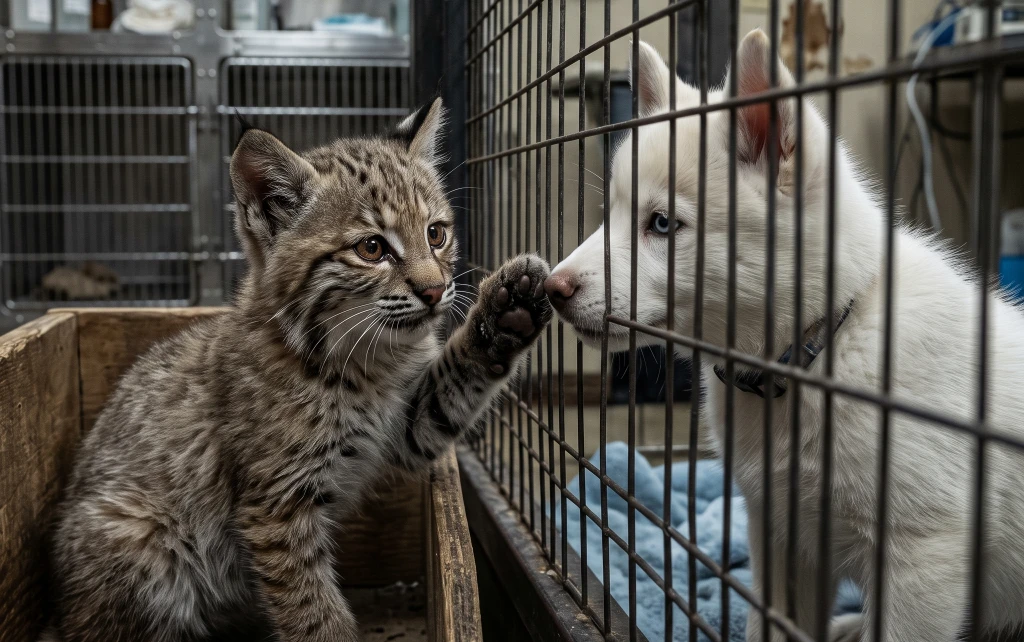
It was the stillness.
A wild animal that small should have hissed. Bitten. Scrambled backward. Tried, with every terrified ounce of strength, to get away from the humans leaning over him under the bright exam light.
This cub did nothing.
He lay on the heated table with his paws folded against his chest, eyes open but unfocused, as though the room had nothing to do with him anymore. When Erin lifted one tiny foot to check his pads, it fell back against the towel without resistance. When she touched the syringe of warm fluids to his mouth, the liquid slid over his lip and down the side of his jaw.
“Come on,” she whispered. “Give me one swallow.”
The cub stared past her shoulder.
Nate Moreno, her night technician, adjusted the oxygen line and looked at the monitor. “Temp’s still low. Heart rate’s ugly.”
“I know.”
“Erin.”
“I know,” she said again, quieter this time.
The volunteer who had brought him in stood near the door, soaked from the drive, twisting her gloves in both hands. Jenna Pike was twenty-three, stubborn, and usually brave enough to crawl under porches after injured raccoons without flinching. Tonight she looked like a person who had carried something heavier than an animal through the storm.
“I got there as fast as I could,” Jenna said. “The roads were iced over by the ridge.”
“You did right,” Erin told her, though her eyes stayed on the cub. “Without you, he’d already be gone.”
The words were meant to comfort Jenna. They did not comfort Erin.
She had been a wildlife veterinarian for almost twenty years, long enough to know the difference between an animal too weak to fight and an animal that had stopped believing fighting mattered. This cub’s body was failing, yes. Exposure, dehydration, hunger, shock. All of that was written in his pale gums and limp muscles.
But there was something else in him. Something medicine did not measure.
Nate brought another towel from the warmer. “You want to name him?”
Erin glanced up sharply. She hated naming them too soon. Names made tiny bodies feel like promises, and promises were dangerous on nights like this. But the cub’s face, streaked with ash and meltwater, looked unbearably young under the light.
“Rowan,” she said at last.
Nate’s expression softened. “Rowan.”
“A tree that grows back after fire,” Erin said, more to herself than to him.
The sleet struck the windows harder, making the whole old building tick and shudder. Juniper Ridge sat at the edge of a forest service road in northern Idaho, close enough to town for emergencies but far enough into the timber that storms still made the world feel cut off. On nights like this, the hospital became a little island of heat and fluorescent light surrounded by black pines.
Erin worked steadily. Warm fluids. Oxygen. A heat dome. A careful check for fractures, burns, punctures, anything that might explain why a bobcat cub had collapsed so completely inside himself.
There were no major wounds. A few singed whiskers. Smoke irritation. Raw paws from cold ground. Malnutrition so severe his hip bones pushed against his skin.
“He’s been alone for more than a day,” Nate said.
“At least.”
“Where was the mother?”
Jenna lowered her eyes.
Erin heard the silence and looked back over her shoulder. “Jenna?”
The young volunteer swallowed. “I found her too.”
Nate’s hands paused over the tubing.
“In the shed,” Jenna said. “Or what was left of it.”
Erin looked down at the cub. Rowan’s eyes did not move, but one ear gave the faintest flick, as if some part of him had heard a word from the place he had been trying to leave behind.
“Tell me from the beginning,” Erin said.
Jenna stepped closer, careful not to raise her voice. “County dispatch called after a hunter reported smoke from an abandoned equipment shed off Miller Cutoff. Fire crew handled it last night, but this morning they asked us to check for animals. I went with the sheriff’s deputy because people dump pets out there sometimes.”
Erin kept one hand lightly against Rowan’s side, counting breaths.
“The shed was mostly gone,” Jenna continued. “Tin roof buckled in. Snow blowing through the frame. I almost missed him because he was tucked under a fallen shelf, right against the back wall.”
“The cub?”
Jenna nodded. “He wasn’t alone.”
Something in Erin’s chest tightened before Jenna said the rest.
“There was a puppy beside him,” Jenna whispered. “A little white one. Maybe five or six weeks old. He was already dead.”
The room seemed to hold its breath.
Nate slowly set down the roll of tape. “A puppy?”
“I don’t know where he came from,” Jenna said. “Maybe dumped there before the storm. Maybe somebody thought the shed was shelter. He didn’t look burned. Just frozen. Rowan was curled around him like he’d tried to keep him warm.”
Erin closed her eyes for half a second. In that brief dark, she saw it too clearly: the burned shed, the collapsed metal, the snow blowing through smoke, a wild cub pressed against a domestic puppy because warmth was warmth and terror did not care about species.
“And the mother?” Nate asked softly.
Jenna’s mouth tightened. “Near the door. I think she tried to get out.”
Rowan’s body trembled once under Erin’s hand. Not a shiver from cold. Not a seizure. A small ripple, gone almost as soon as it began.
Erin looked down at him. “You heard that, didn’t you?”
His eyes stayed dull.
Jenna wiped her cheek quickly with the back of her wrist. “When I picked him up, he tried to crawl back to the puppy. He couldn’t even stand, but he kept dragging himself through the ash.”
Nate looked away.
Erin had seen grief in animals. Wolves pacing after losing a mate. A doe returning again and again to the place where her fawn had been hit. A raven who refused to leave its injured partner until both were nearly taken by a storm. People liked to believe grief belonged mostly to humans because it made suffering feel organized and explainable.
It did not.
Grief lived wherever attachment lived.
Erin warmed a small syringe of formula in her palm and tried again. She touched the tip to Rowan’s mouth and waited. He did not turn away, which should have helped. Instead, his passivity frightened her more. Resistance meant there was still a boundary inside him, still a self that could say no.
Rowan did not say no.
He simply did not answer.
The formula spilled down his chin.
Nate exhaled through his nose. “He’s not swallowing.”
“I can see that.”
“We can place a feeding tube if we have to.”
“Not yet.” Erin wiped Rowan’s fur with a corner of towel. “His body can barely handle what we’re doing.”
“He won’t last if he doesn’t take nutrition.”
“I know.”
The words sharpened this time, and Nate went quiet. He had worked with Erin long enough to recognize when her anger had nowhere useful to go.
They moved Rowan into a recovery kennel lined with fleece and heating pads. Erin lowered him in carefully. Most young bobcats, even sick ones, would retreat from a human hand with some spark of wildness. Rowan folded into the blanket and turned his face toward the back wall.
By 2:00 a.m., the sleet had changed to wet snow. The hospital quieted except for the furnace and the occasional shift of animals in the other wards. Erin checked on an owl with wing trauma, gave pain medication to a fox with an injured leg, and changed the bedding for three orphaned squirrels that should have been asleep but were not.
Every few minutes, she returned to Rowan.
He had not moved.
At 4:30, Nate found her sitting on an overturned feed bucket outside the cub’s kennel, her arms folded against the cold that always collected near the floor.
“You should lie down for twenty minutes,” he said.
“I’m fine.”
“You look like you’re trying to keep him alive by staring at him.”
Erin almost smiled. “Maybe I am.”
Nate crouched beside the kennel. “Rowan. Hey, little man.”
The cub gave no sign he heard.
“He made it this far,” Nate said.
Erin watched Rowan’s narrow side rise and fall. “That doesn’t mean he wants to go farther.”
Nate rubbed both hands over his face. “Don’t say that.”
“It’s true.”
“Then we give him a reason.”
Erin looked at him. “That’s what I’m trying to figure out.”
Morning arrived gray and hard. Snow clung to the trees outside the ward windows, and the sky over the ridge looked like wet wool. Jenna came back after only three hours of sleep, carrying a thermos and a paper bag from the gas station. She had always been too tender for this work and too determined to quit.
“How is he?” she asked.
Erin did not soften the truth. “Still here. Not improving.”
Jenna nodded as if she had expected worse and feared exactly this. She knelt by the kennel, her fingers resting against the mesh. “Hi, Rowan.”
The cub’s ear flicked.
Jenna froze.
Erin turned from the chart. “Say that again.”
“Hi, Rowan,” Jenna whispered.
Nothing.
Nate leaned against the counter. “Maybe just a reflex.”
“Maybe,” Erin said.
But she did not think so.
Later that morning, while an assistant walked one of the center’s older rehab dogs past the back lot, a bark carried faintly through the wall. It was only one sharp sound, muffled by snow and distance.
Rowan came apart.
His body jerked so violently that his paws scraped the fleece. His head lifted for the first time, not in curiosity but in terror. His eyes widened, suddenly alive and full of a panic so old and immediate that Erin reached the kennel before she realized she had moved.
“Easy,” she said. “Easy, sweetheart. It’s outside. You’re safe.”
Rowan pressed himself into the back corner, trembling so hard the blanket shook beneath him. His mouth opened, but no cry came out. His gaze fixed on nothing Erin could see.
Jenna covered her mouth. “The puppy.”
Nate’s face changed. “He remembers.”
Erin kept her hand near the mesh but did not force contact. The cub was too far inside the memory to be reached by touch. After a few seconds, the tremors faded. His head dropped. The spark disappeared again, leaving him limp and exhausted.
But Erin had seen it.
Fear, yes. Pain, yes. But also recognition.
Something in Rowan was still connected to the world through the shape of what he had lost.
By afternoon, the entire staff knew not to bring dogs anywhere near the recovery wing. The ward lights stayed dim. Voices stayed low. Erin charted vitals, adjusted heat, tried small feedings, and kept failing.
At 3:17 p.m., the phone rang at the nurses’ station.
Nate answered, listened, then looked through the glass toward Erin. “It’s Little Fork Animal Rescue,” he said, covering the receiver. “Their furnace is out in the puppy room. They’re asking if we can emergency-board one special-needs pup until they get repairs done.”
Erin almost said no. Juniper Ridge was a wildlife hospital, not a domestic shelter, and the last thing Rowan needed was the smell or sound of a dog close by. Then Nate’s expression shifted.
“What kind of special needs?” Erin asked.
Nate listened again. His eyebrows rose slightly. “Deaf. Husky mix. Underweight. Quiet, they say.”
The room changed around her.
Jenna looked from the phone to Rowan’s kennel.
Erin should have refused. Every professional instinct told her that mixing domestic animals and wildlife, even in proximity, created complications. Disease protocols, stress, imprinting risks, behavior problems. A hundred reasons stood between that puppy and the recovery ward.
But Rowan had trembled at the memory of a puppy he had tried to keep warm in a burned shed.
And now, somewhere down the road, another lost puppy needed a heated room.
Erin took the phone from Nate. “How soon can you get him here?”
Forty minutes later, a rescue worker came through the side entrance with a bundle of fleece in his arms. The puppy inside was smaller than Erin expected, all soft white fur and too-big paws, with pale blue eyes that did not quite focus on sound. One ear stood halfway up; the other folded at the tip. He smelled faintly of milk replacer and damp blanket.
“This is Blue,” the rescue worker said. “He doesn’t respond to noise, but he tracks movement and vibration. Sweet little guy. Just… unsure.”
Blue’s nose twitched. His head turned, not toward the voices, but toward the hallway leading to recovery.
Rowan’s hallway.
Erin felt the hairs lift along her arms.
“We’ll set him up in isolation first,” Nate said quickly, as if speaking fast could keep this from becoming what they were all starting to imagine.
“Right,” Erin said. “Isolation.”
But Blue had gone still in her arms. His cloudy eyes fixed on the corridor. His little body leaned toward it with a quiet urgency that made Jenna inhale sharply.
From the far end of the recovery ward came a sound.
It was so small Erin might have missed it if the hospital had not been holding its breath. A thin, broken chirp. Nate looked toward the ward door. Jenna whispered, “That was Rowan.” Blue lifted his head higher, his nose working hard against the air, and Rowan chirped again from behind the closed door. This time, there was no mistaking it…
To read the rest of the story – CLICK the NEXT button 👇👇👇