


The front door of the little blue house was standing wide open when I pulled into the driveway. That was the first thing I noticed. Not the ocean beyond the dunes, not the white porch rail I had sanded myself the week before, not the anniversary cake sliding slightly on the passenger seat because I had taken the last turn too fast. The door was open, and the screen door kept clapping against the frame in the wind like someone was trying to get my attention from inside. Then I saw the SUV.
It was black, oversized, and parked crooked across the shell driveway, one tire pressed into the low ornamental grass my mother had loved because it looked “soft enough to pet.” I knew that SUV. My sister’s husband drove it like every road had been built for him personally.
I left the cake in the car and walked up the porch steps slowly, already hearing voices through the open door. A cartoon blared from the living room. A dog barked somewhere down the hall. A child laughed, then someone snapped, “Move that box before your grandmother trips over it.”
My mother was in the kitchen, both hands locked around a dish towel. Her name was Ruth, and in all my thirty-eight years of life, I had seen her cry quietly maybe a hundred times and openly only three. This was open crying. Her cheeks were wet, her mouth was pressed thin, and she looked at me the way people look at an exit sign in a burning building.
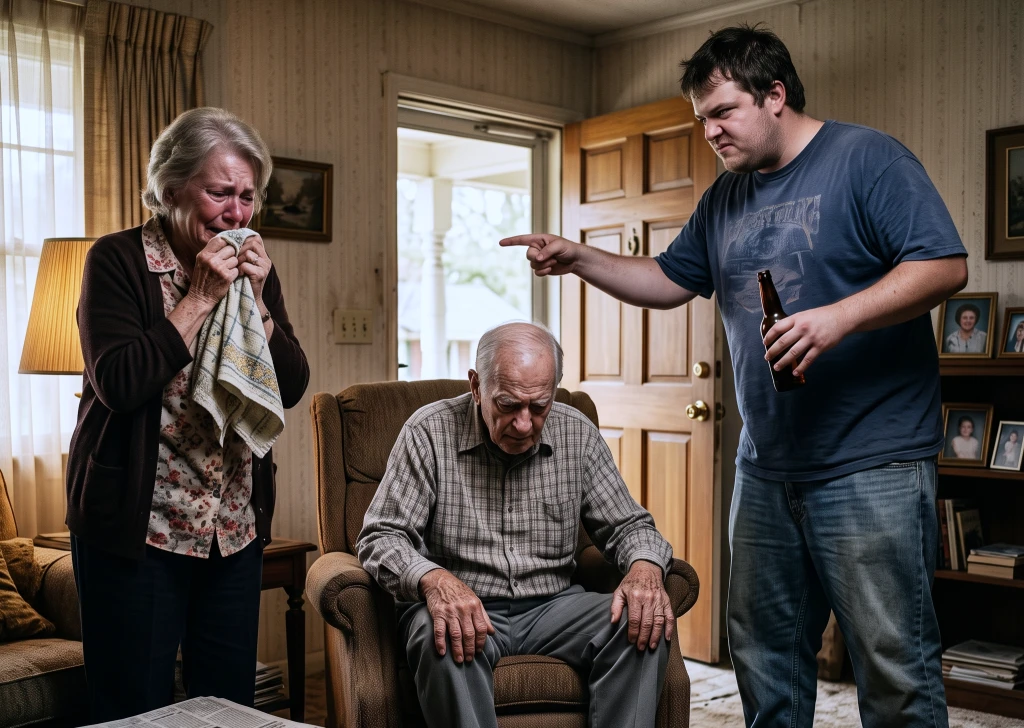
My father, Paul, sat near the front window in the chair he had chosen on his first visit. His hands were trembling against his knees. He was staring at the floor, his jaw working, his whole body pulled inward as if someone had told him he was taking up too much space.
Then my brother-in-law came out of the hallway barefoot, holding a beer and wearing one of those faded college football shirts men wear when they want the world to know they peaked loudly. Derek looked past me at my father and jabbed a finger toward the open door.
“This is our place now,” he said. “You need to get out of the way.”
My sister, Lauren, was lounging on the sofa with her feet tucked under her, scrolling on her phone. She actually laughed.
Then she looked up and saw me.
The laugh vanished so fast it left a silence behind.
My name is Nathan Hart. I am a pediatric neurosurgeon, which means my workdays are built around steady hands, long hours, and parents who stand beside hospital beds trying not to fall apart. At work, people trust me with the most delicate tissue in the human body. At home, for most of my life, my family trusted me with the bills.
That pattern started long before I could name it. When I was ten, I learned the sound my mother made when a rent notice came in the mail. When I was twelve, I learned that my father could work sixteen hours and still come home with dust in his hair and an apology in his voice. When I was fifteen, I learned to make macaroni and stretch one pound of ground beef across three dinners because nobody wanted to say out loud that the checking account was empty.
Lauren learned something different. She learned that if the room became uncomfortable enough, someone would fix it for her.
At first, she was “sensitive.” Then she was “creative.” Then she was “going through a hard time.” By the time she married Derek, my parents had become fluent in excuses, and I had become fluent in transfers. Textbooks. Rent. Car insurance. A deposit on an apartment they lost six months later. Braces for my niece Harper because Lauren said their coverage had “glitched.” A used SUV after Derek’s credit application got rejected. School camp fees. Utility shutoff notices. Emergency groceries that somehow always included things my parents never bought for themselves.
For years, I told myself I was preventing disaster. That was easier than admitting I was helping disaster learn my phone number.
My parents’ fiftieth wedding anniversary was supposed to be different. I wanted to give them one thing Lauren and Derek couldn’t turn into another crisis. One quiet win. One place where my father could wake up without listening for a collection agency call, and my mother could open a cabinet without calculating whether the cereal needed to last until Friday.
The house was in Harbor Point, North Carolina, a small coastal town where the streets smelled like salt, fried shrimp, and sun-warmed pine. It wasn’t grand. It had two bedrooms, a narrow white deck, a blue-gray exterior that needed painting on the west side, and a view of the water that made my mother stop speaking the first time she saw it. The price was $432,000, which was more money than my parents had ever imagined spending on anything, and less than I had spent over the years trying to keep Lauren’s chaos from landing on their doorstep.
I bought it through a trust. That part mattered. I had learned, slowly and expensively, that love without structure becomes a door other people kick open. The trust named Paul and Ruth Hart as the only lifetime residents. It covered the property taxes for twenty years, paid the homeowners association dues in advance, and gave me the authority to protect the house from anyone who tried to use it against them.
I did not tell Lauren. I did not post a picture. I did not make an announcement. I drove my parents down a week before their anniversary and handed them the keys at the edge of the porch while the wind came off the water and lifted my mother’s white hair around her face.
Dad turned the key over in his palm as if he expected it to disappear.
“Son,” he said, and then nothing else.
Mom opened the kitchen cabinets one by one, not because she needed to see inside them, but because she seemed unable to believe they were hers. When she reached the pantry, she stood there for a long time, touching the clean wooden shelves.
“It smells like lemons,” she whispered. “Lemons and air.”
I slept there that first night on an air mattress after checking the locks, the water heater, the breaker panel, and every appliance. The next morning, I drove back to Raleigh before dawn for a scheduled surgery on a seven-year-old boy with a tumor pressing against his spinal cord. I remember feeling lighter than I had in years as I crossed the bridge out of Harbor Point.
The feeling lasted two days.
Lauren found out because Dad posted one blurry picture on Facebook. It was just the sunset from the porch, but he captioned it, “First evening at our new place. Fifty years with my girl.” By dinner, Lauren had called Mom six times. By the next afternoon, she had worked the location out from the marina sign in the background. By Friday evening, she, Derek, their two kids, their dog, and half their apartment were inside the house.
Mom called me while I was walking into rounds.
“They just wanted to see it,” she said, her voice too careful. “They’re excited for us.”
“For you,” I said. “Not for them.”
“Well, of course. But they asked if they could stay the weekend, and the kids were already unpacking, and I didn’t want to be rude.”
“Mom, it’s your house. You’re allowed to be rude in your own house.”
She laughed weakly at that, but the laugh did not hold. “We’ll talk when you come down for the anniversary dinner.”
Then Dad texted me Saturday morning.
There’s confusion about the house. Lauren keeps calling it a family asset. Can you come as soon as you can?
I was already scrubbed in. I saw the message forty minutes later, when a nurse held my phone up during a break so I could read it without contaminating my gloves. Underneath Dad’s text was a missed call from Mom, then another from Dad, then a picture Lauren had posted from my parents’ new kitchen.
Home sweet home, the caption read. Finally speaking abundance into our family.
Derek had commented under it: Beach management era begins.
I texted Dad one sentence before going back into the operating room.
Do not sign anything. Do not agree to anything. I’m coming.
For the next two hours, I worked with the part of my mind that has saved children’s lives while the rest of me burned. After the surgery, after I spoke to the family, after I wrote the necessary notes, I drove straight to Harbor Point with an anniversary cake on the passenger seat and a folder full of documents on the floor.
I had planned to be calm. I had planned to sit everyone down. I had planned to explain, in a tone even Lauren could not turn into an attack, that the house belonged to our parents and only our parents.
Then I walked in and found my father shaking while Derek ordered him toward the door.
“Mom?” I said.
Ruth turned toward me, and her face folded with relief so raw it almost stopped me where I stood.
Derek swiveled slowly, like I was the inconvenience. “Great. The money guy is here.”
Lauren stood, smoothing her shirt. “Nathan, before you start, nobody is stealing anything. We’re making this workable.”
“Workable for whom?” I asked.
“For everyone,” she said, with the bright, practiced patience she used when she wanted to sound injured before anyone had hurt her. “Mom and Dad can’t manage a place like this. Dad has stairs now. Mom gets overwhelmed. Derek and I have the kids, we know the rental market, and honestly, it’s irresponsible to let a property this valuable just sit here.”
My mother’s fingers tightened around the dish towel. “It isn’t sitting here. We live here.”
Derek laughed under his breath. “You’ve been here a week.”
Dad lifted his head then. His voice was rough but clear. “It was a gift to us.”
“Exactly,” Lauren said. “And gifts can help the whole family.”
That was the sentence that did it. Not because it was the worst thing she had ever said, but because I could hear every year behind it. Every “just this once.” Every “you know how Lauren is.” Every transfer I had sent while standing in hospital corridors, telling myself money was easier than conflict.
I walked back to the car, got the cake and the folder, and returned to the living room. The cake went on the counter, ridiculous and bright under its plastic dome. The folder went on the coffee table.
“Everybody sit down,” I said.
Derek rolled his eyes. “Don’t do the doctor voice with us.”
“It’s not the doctor voice,” I said. “It’s the trustee voice.”
Lauren’s face twitched. Just once.
The children went quiet. The dog stopped chewing the corner of a throw pillow. My father slowly set both hands flat on his knees, as if he had decided to hold himself in place.
I opened the folder and took out the first page. Then the second. Then the third, the one I had printed in the hospital parking garage before I left Raleigh.
It was the online listing Derek had posted that morning.
The headline read: Entire Coastal Cottage — Sleeps 8 — Steps From Water.
Under house rules, he had written: No owner on site.
Under availability, he had opened every weekend through Labor Day.
And under the booking calendar, there was a check-in scheduled for that evening at 6:00 p.m.
I looked at Lauren. She was no longer pretending to smile.
“Tell me,” I said, laying the page where everyone could see it, “where exactly were you planning to put Mom and Dad when the renters arrived tonight…”
To read the rest of the story – CLICK the NEXT button 👇👇👇