


Mara Ellison knew her husband had meant to hide her behind the white orchids. It was not an accident. Graham Mercer had chosen the table himself, had smiled at the event coordinator as if he were doing Mara a kindness, and had guided her wheelchair into the soft shadow between a marble column and an arrangement so large it could have belonged in a funeral home. From there, she could see the stage. The room, however, could barely see her.
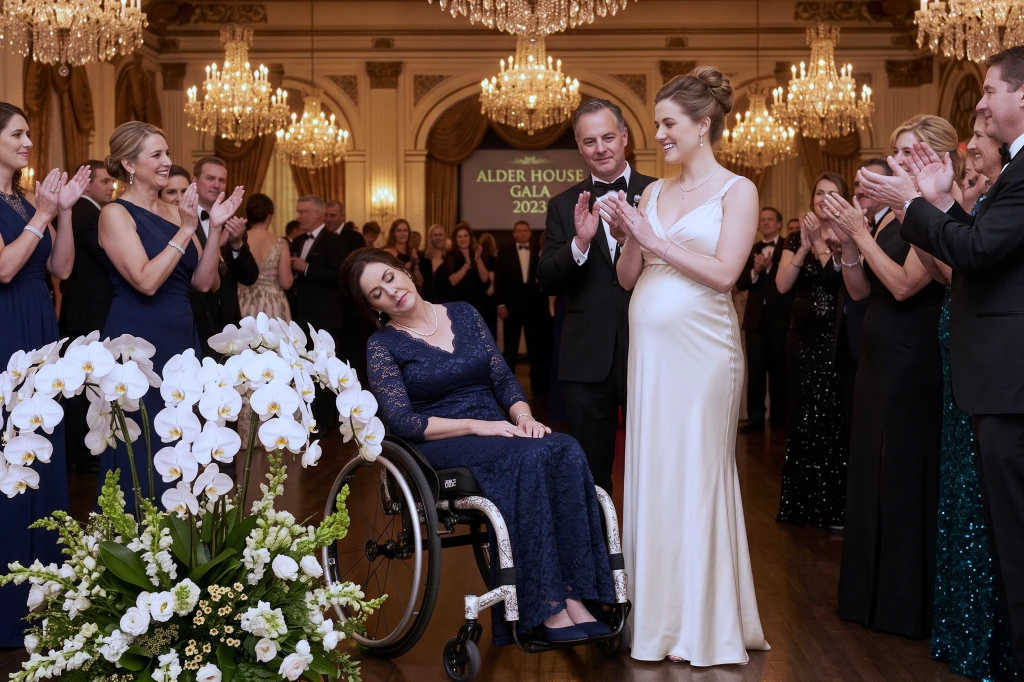
The Alder House ballroom glittered around her, all glass, brass, and expensive restraint. Two hundred people from Port Ellery’s architecture, philanthropy, and development circles lifted champagne flutes beneath the old hotel’s chandeliers. They had come for the Civic Futures Foundation dinner, an annual evening where money wore a tuxedo and called itself compassion.
Graham stood near the podium as if the room had been built around him. His tuxedo fit perfectly. His silver-threaded hair was combed back from a face that still photographed well. Every few seconds, someone touched his elbow, laughed at something he said, or leaned in as if Graham had a private door to the city’s future and might open it for them.
Mara had designed that future, or at least the best parts of it. She had designed the riverfront housing that brought light into old warehouses. She had drawn the first plans for schools with ramps that didn’t look like apologies. She had built a career on the belief that accessibility was not charity. It was architecture doing its job.
Now she sat behind orchids while Graham prepared to accept an award for “visionary inclusive design.”
A woman at Mara’s table leaned close with the soft, careful voice people used around hospital beds. “You must be so proud of him.”
Mara folded her hands in her lap. The left one still trembled when she was tired, a lingering betrayal from the fall. “It’s been a long road,” she said.
The woman nodded with immediate sympathy. “I can only imagine. Graham speaks so beautifully about your courage.”
Mara looked toward the stage. Graham was speaking to Councilwoman June Porter, whose zoning vote could decide the future of their Westline project. His hand moved in broad, assured gestures, explaining a concept Mara had developed at three in the morning two winters earlier while her back spasmed and the rest of the house slept.
He never glanced her way.
Three years earlier, the city had known them as a matched pair. Mara Ellison, the exacting architect with a gift for making concrete feel humane. Graham Mercer, the charming strategist who could convince investors that conscience had a profit margin. Their firm had begun as Ellison Mercer Studio in a rented second-floor office above a bakery. By the time the city papers started calling them “Port Ellery’s design couple,” Graham had already begun suggesting that “Mercer Urban Development” sounded stronger to national clients.
Mara had argued for three weeks before agreeing. She had told herself names mattered less than buildings. She had been wrong.
The accident happened on a wet Thursday morning at the Riverfront Yards site. A temporary platform gave beneath her on the eleventh floor, and the world reduced itself to metal noise, gray sky, and the terrible calm of knowing her body had landed before her mind had caught up. The surgeons repaired what they could. The rest became a life of braces, medication schedules, pain management, and a wheelchair Graham called “temporary” in public and “realistic” in private.
At first, he played devoted husband well. He hired specialists, installed an elevator in their glass house above Pine Ridge, and gave interviews about resilience with his hand resting on Mara’s shoulder. He cried once on camera. People remembered that.
Behind the doors of the house they had designed together, the devotion thinned into management. Graham arranged her appointments. Graham spoke to doctors before she entered the room. Graham decided which meetings were too draining, which visitors would upset her, which plans could wait until she was stronger. The word “stronger” became a room with no exit.
“Here she is,” Graham said suddenly.
Mara looked up. He was approaching with Councilwoman Porter beside him and a younger woman in a cream satin dress just behind them. The young woman was tall, polished, and visibly pregnant beneath the loose cut of her gown. Mara had seen her once from a distance in the office lobby, framed by glass doors and Graham’s laughter.
“Mara, darling,” Graham said, placing a hand on her shoulder. The pressure was light, but possession lived in it. “June wanted to say hello. And this is Paige Lawson, our new senior project lead. She’s been invaluable on Westline.”
Paige’s smile held for half a second too long. “It’s an honor to meet you. Your early work is why I studied urban design.”
Early work.
Mara smiled because it was easier than showing the room what the words had done. “Then you know Westline started as an accessibility-first proposal, not a luxury redevelopment with a few compliance features added at the end.”
Councilwoman Porter blinked. Paige glanced at Graham.
Graham’s fingers tightened on Mara’s shoulder. “Mara still likes to keep us honest when her health allows,” he said, warm enough for everyone else and sharp enough for only her. “What she means is that we’re all committed to thoughtful design.”
“What I mean,” Mara said, keeping her voice level, “is that thoughtful design should survive the budget meeting.”
For the first time that evening, Graham looked directly at her. His expression stayed pleasant, but his eyes went flat. “Of course.”
Councilwoman Porter cleared her throat and gave Mara a polite smile. “I’d be happy to review any notes you want to send my office.”
“I’ll do that,” Mara said.
Graham guided the conversation away within seconds. He drew the councilwoman toward the bar, with Paige at his side, and Mara watched the three of them move through the crowd like a small, sealed weather system. Graham leaned toward Paige to hear her over the music. His hand found the small of her back. Paige did not move away.
Mara’s phone buzzed in the slim bag attached to her wheelchair.
Tessa Kim, her physical therapist, had texted. Did you take the 9 p.m. dose, or is Prince Charming still guarding the pill bottles?
Mara almost laughed. Tessa was one of the few people in her life who refused to treat her like a breakable object. She was brisk, blunt, and warm in ways she tried to hide. During sessions, she made Mara work until sweat gathered at the base of her neck. Afterward, she sent memes about stubborn women outliving men who underestimated them.
Not yet, Mara typed back. He handed me sparkling water and said champagne interacts badly with my “little pharmacy.”
Tessa replied immediately. I hate that phrase. Also, tomorrow at 1. Wear sneakers. We’re testing stairs.
Mara stared at the word stairs, feeling a strange little flare of fear and hope. She had not told Graham about the gains she had been making. Not the longer stands at the parallel bars. Not the three steps between Tessa and the mat table. Graham always seemed relieved by bad news and irritated by progress.
Before Mara could answer, another message appeared.
Unknown Number: I’m sorry. I tried to stay out of it, but you deserve proof.
Mara’s thumb stopped over the screen. Around her, laughter rose and fell. A waiter passed with a tray of tiny crab cakes. Graham stepped onto the stage to accept his award, and applause gathered like rain on a roof.
Another message arrived.
Unknown Number: Don’t ask him first. Save this somewhere safe.
The attachment loaded slowly.
Mara felt the room narrow to the size of her phone. At first, the image made no sense. Graham stood outside a private medical clinic on Hawthorne Street, one hand holding open a car door, the other resting with unmistakable tenderness against Paige Lawson’s pregnant belly. Paige’s face was turned up toward him, laughing. Graham’s expression was the part Mara could not look away from.
She had not seen him look that gentle in years.
The timestamp on the image was 2:17 p.m. that afternoon. At 2:17, Graham had told Mara he was in a closed-door finance meeting across town with Calvin Rusk.
Onstage, Graham began speaking about love as the foundation of all meaningful design. People applauded again.
Mara lowered the phone into her lap and looked at her husband beneath the lights. He smiled with perfect humility, accepting praise for a mission he had quietly taken away from her. The orchids blocked most of her from the room, but not all of it. From where Graham stood, if he looked carefully, he could see her.
So Mara lifted her head and smiled back. For one suspended second, Graham lost his place in the speech. Then Mara’s phone buzzed one more time. Unknown Number: That baby is his…
To read the rest of the story – CLICK the NEXT button 👇👇👇