


The girl had tied the cardboard sign with blue yarn because her fingers were too cold to make a knot. Officer Nathan Cole noticed that first. Not the price. Not even the words, though they stopped him a second later. He noticed the little strip of yarn looped twice around a German Shepherd’s collar, trembling against the dog’s thick neck while snow gathered on both of them outside the closed laundromat on Mason Street.
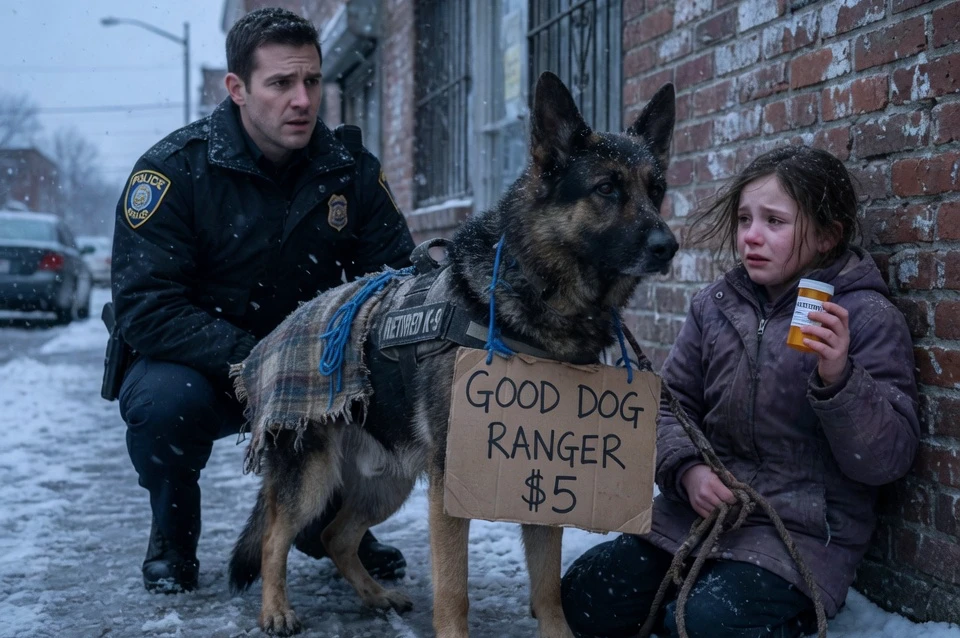
The sign read:
POLICE DOG FOR SALE
$5
PLEASE BE KIND
Nathan stood on the sidewalk with a paper cup of coffee going cold in his gloved hand. It was barely eight in the morning in Riverton, Ohio, the kind of January cold that made people walk fast with their heads down. Cars rolled by in dirty slush. Storefront windows were fogged from the heat inside. A city bus hissed at the curb, opened its doors, then pulled away without anyone noticing the child sitting against the brick wall.
The dog noticed Nathan.
His ears lifted. His body shifted, just enough to put himself between the officer and the girl. He did not growl, did not lunge, did not bare his teeth. He simply squared his shoulders with a practiced calm that Nathan recognized before his mind had time to name it.
Training.
Old training, maybe. But still there.
Nathan set his coffee on the top of a newspaper box and took one slow step closer. “Morning,” he said, keeping his voice low. “You two waiting for somebody?”
The girl looked up.
She could not have been more than nine. Maybe ten, if hunger had made her look smaller. Her cheeks were red and chapped from the wind, and her knit hat had slid sideways, leaving strands of brown hair frozen against her forehead. She wore a purple coat with a broken zipper and boots that were too thin for the weather.
Her left hand was buried in the dog’s fur.
“No, sir,” she said.
The “sir” caught at him. Not because it was polite, but because it sounded practiced, the way children spoke when they were trying hard not to be trouble.
Nathan glanced at the sign again. “That’s a beautiful dog.”
The girl swallowed. “His name is Ranger.”
At the sound of his name, the German Shepherd flicked his eyes toward her but did not move. His muzzle had gone gray around the edges, and one ear carried a small notch near the tip. Beneath the old blanket wrapped around his back, Nathan saw the worn outline of a retired K-9 harness, faded black with a strip where lettering had once been.
“Ranger,” Nathan repeated. “That suits him.”
The girl’s chin quivered. She pressed her mouth closed, fighting something hard, and Nathan crouched several feet away so he would not tower over her. He had worn a badge long enough to know when a child was afraid of him and when a child was afraid of what would happen if she told the truth.
“My name’s Nathan,” he said. “I’m with Riverton PD.”
“I know.”
“You do?”
She nodded toward his sleeve. “My dad had the same patch.”
Nathan looked again at the dog. At the sign. At the girl’s hand clenched white around the fur at Ranger’s shoulder.
“Your dad was an officer?”
She looked down. “K-9 unit.”
A bus rolled past, throwing gray slush against the curb. Ranger stepped forward just enough that none of it hit the girl’s boots. It was such a small movement, almost invisible, but Nathan felt it in his chest. This dog was not simply sitting beside her. He was guarding the last thing he still understood as his job.
“What’s your name?” Nathan asked.
“Lily.”
“Lily, why are you selling your dad’s dog?”
Her eyes filled so quickly that she blinked hard and looked away, ashamed of the tears before they had even fallen. Ranger leaned his head against her shoulder, and she wrapped one arm around his neck.
“I’m not selling him because I don’t love him,” she whispered.
“I didn’t think you were.”
She looked at him then, searching his face for the trick, the scolding, the adult sentence that would send her away. “I need money.”
“For what?”
“My dad’s breathing medicine.”
Nathan kept his expression steady, but the cold seemed to settle deeper under his coat. “Where is your dad now?”
“At home.”
“Is there another grown-up with him?”
Lily shook her head. “It’s just us. Me and Dad and Ranger.”
The dog’s eyes stayed on Nathan. There was intelligence there, but not magic, not some fairy-tale understanding. Just years of watching human bodies, human voices, human fear. Ranger knew this conversation mattered because Lily was shaking harder with every word.
Nathan removed his gloves, even though the cold bit immediately into his fingers. “Can I see the sign?”
Lily hesitated. Then she touched the cardboard, as if apologizing to the dog, and lifted it away from his chest.
The writing had been done in green marker. The letters were uneven, some big, some small, with smudges where snow had melted into the cardboard. At the bottom, in smaller writing, she had added:
He saved my dad twice.
Nathan’s throat tightened.
“Your dad tell you that?”
“All the time.” Her voice warmed for the first time, just a flicker. “He says Ranger is the reason I still have a dad. He says when bad people ran, Ranger ran faster. And when Dad got hurt in the fire, Ranger pulled him until other officers found them.”
Nathan’s hand stilled.
Riverton had stories like that. Every department did. Names that lingered in locker rooms and at retirement dinners, men and women who were spoken of with a certain quiet respect because they had once stood where others could not. Nathan had transferred to Riverton four years ago, after the warehouse fire on the east side, but he remembered the photographs in the hallway by the K-9 office.
A handler in a soot-blackened uniform.
A German Shepherd with bandaged paws.
The plaque beneath it had read: Sergeant Thomas Carter and K-9 Ranger.
Nathan looked at Lily more carefully. “Your dad is Tom Carter?”
She nodded, and the motion seemed to cost her.
The cold street, the closed laundromat, the cardboard sign—all of it shifted into something heavier. Tom Carter was not just a sick man in a house somewhere. He was the handler whose story new officers heard when trainers explained loyalty. He was the officer who had never fully come back after smoke and heat scarred his lungs. And now his daughter was sitting on a sidewalk trying to sell the dog that had once dragged him out alive.
Nathan sat down on the curb, not caring that snow soaked into his pants. “Lily, does your dad know you’re here?”
“No.”
“Did he ask you to sell Ranger?”
Her head snapped up. “No. He’d never do that.”
“I believe you.”
“He’d be mad.” She wiped her nose with her sleeve, embarrassed. “Not yelling mad. Just sad mad. The kind where he gets quiet and looks at the floor.”
Nathan knew that kind of shame. He had seen it in injured officers who could no longer chase calls, in parents who skipped meals while pretending they had already eaten, in people who thought needing help meant they had failed some invisible test.
“How did you get here?”
“I walked.”
“How far?”
She shrugged. “Not far.”
Ranger’s paws told another story. Snow had packed between the pads, and the blanket on his back was damp all the way through. Nathan reached slowly toward the dog, palm down, letting Ranger decide. The Shepherd sniffed him once, then allowed Nathan’s hand to rest against his neck.
The dog was cold.
Not outside-for-ten-minutes cold. Longer.
“Lily,” Nathan said, “when did you leave home?”
Her eyes moved to the empty street. “Before Dad woke up.”
“And why this morning?”
For a moment, she did not answer. She kept stroking Ranger’s fur in short, desperate motions, smoothing the same patch again and again. When she spoke, her voice had become almost too small to hear.
“The heat stopped last night.”
Nathan waited.
“Our furnace makes this clicking sound when it tries to start. It clicked all night, but nothing happened. Dad said we could call somebody in the morning, but he was coughing so hard he couldn’t finish talking.” She pulled the blanket tighter around Ranger. “I put my coat on him because he was shaking.”
“Ranger was shaking?”
She nodded. “Dad didn’t see. He fell asleep sitting up. I stayed awake because I thought if Ranger froze, Dad would know. And if Dad knew, he’d think it was his fault.”
Snow landed on her eyelashes. She blinked, and two tears slid down her raw cheeks.
“So I made the sign.”
Nathan looked at the price again. Five dollars. Not because she thought Ranger was worth five dollars, but because five dollars was a number a child could imagine someone handing over without asking too many questions.
“What would you buy first?” he asked quietly.
“Food for Ranger,” she said at once. Then, as if remembering why she was supposed to be brave, she corrected herself. “No. Medicine for Dad. Then food for Ranger.”
“What about food for you?”
She shrugged again.
It was the smallest gesture, and it told him too much.
Nathan glanced toward his patrol SUV parked half a block away. He was on his way to the station, not officially on a call yet, but none of that mattered now. He could call it in. He could bring in social services. He could do every procedural thing in the right order. But the first thing this child needed was not a clipboard.
It was warmth.
“Lily,” he said, “I’m not going to buy Ranger.”
Her face crumpled before he could finish.
“No, please.” She grabbed the cardboard sign and held it out as if she could make him understand by making the offer clearer. “He’s good. He doesn’t bite unless he has to. He knows sit and stay and track. He can open doors sometimes if they have handles. He’ll listen. I promise he’ll be good.”
“I know he’s good.”
“You don’t even have to give me five dollars. You can give me less if you promise he’ll be warm.”
Ranger pressed his body into hers as she began to cry, but his eyes stayed on Nathan, alert and uncertain. Nathan folded the sign once, carefully, and placed it on his knee.
“I’m not buying him because he isn’t for sale,” he said. “He belongs with you and your dad.”
Lily stared at him, not understanding whether that was kindness or refusal.
“And because,” Nathan continued, “you don’t need someone to take Ranger away. You need someone to help you keep him.”
She went very still.
“Can I do that?” he asked. “Can I help?”
Children did not trust with speeches. Nathan knew that. They trusted with inches. Lily looked at his badge, then at Ranger, then at the sidewalk between them.
“If you help,” she whispered, “will they take me from Dad?”
The question landed harder than he expected. “Who told you that?”
“No one.” She looked down. “I heard Dad on the phone. He said if people knew how bad it was, they might say he couldn’t take care of me. But he does take care of me. He’s just sick.”
Nathan chose every word carefully. “My job is to keep you safe. Keeping you safe means checking on your dad, too. It does not mean I’m here to punish him for being sick.”
“He tried,” she said fiercely.
“I believe that.”
“He was a good officer.”
“I know.”
“He’s a good dad.”
Nathan nodded. “Then let’s go help him be your dad a little longer.”
For the first time, something like hope moved across her face. It was not a smile. It was too fragile for that. But she loosened her grip on Ranger’s fur and tried to stand.
Her knees buckled.
Nathan caught her before she hit the sidewalk. Ranger gave one sharp bark, stepping close, but he stopped the moment he saw Nathan steadying her. Lily’s body felt light in his hands, too light beneath the damp coat.
“When did you last eat?” Nathan asked.
“Yesterday.”
“What did you have?”
She would not answer.
Ranger nosed at the pocket of her coat. Lily pushed him away gently, but Nathan had already seen the corner of an orange prescription bottle sticking out. He held out his hand.
“Can I look?”
Lily hesitated, then pulled it free.
The label was water-stained but readable.
THOMAS CARTER
ALBUTEROL INHALER
USE AS DIRECTED
The bottle was empty.
Nathan turned it over in his palm. “When did this run out?”
Lily’s lips trembled. “He used the last puff before the sun came up.”
Nathan looked toward the street. “How was he breathing when you left?”
She opened her mouth, but no sound came at first. Ranger suddenly lifted his head. His ears angled toward the east, toward the older blocks past the church and the boarded-up hardware store. A low whine came from deep in his chest.
Lily turned pale.
“He sounded like that,” she whispered.
Ranger pulled once against the yarn and frayed leash Lily had wrapped around her wrist. Not hard enough to drag her, but with purpose. He stepped into the falling snow and looked back at Nathan as if there were no more time for questions.
Nathan was already on his feet, one hand reaching for his radio, the other guiding Lily toward his SUV. – “Show me where you live,” he said. – Ranger did not wait for the address. He started running…
To read the rest of the story – CLICK the NEXT button 👇👇👇