


The first person to laugh was my cousin Grant. It came out as one sharp breath across the long oak table, right after Mr. Price slid the envelope toward me and said my grandfather had left me “a personal travel arrangement.” The funeral rain was still drying on my jacket. My shoes were still muddy from the cemetery. Across from me, Grant sat in a navy suit that probably cost more than my car, covering his mouth like he was trying to be polite.
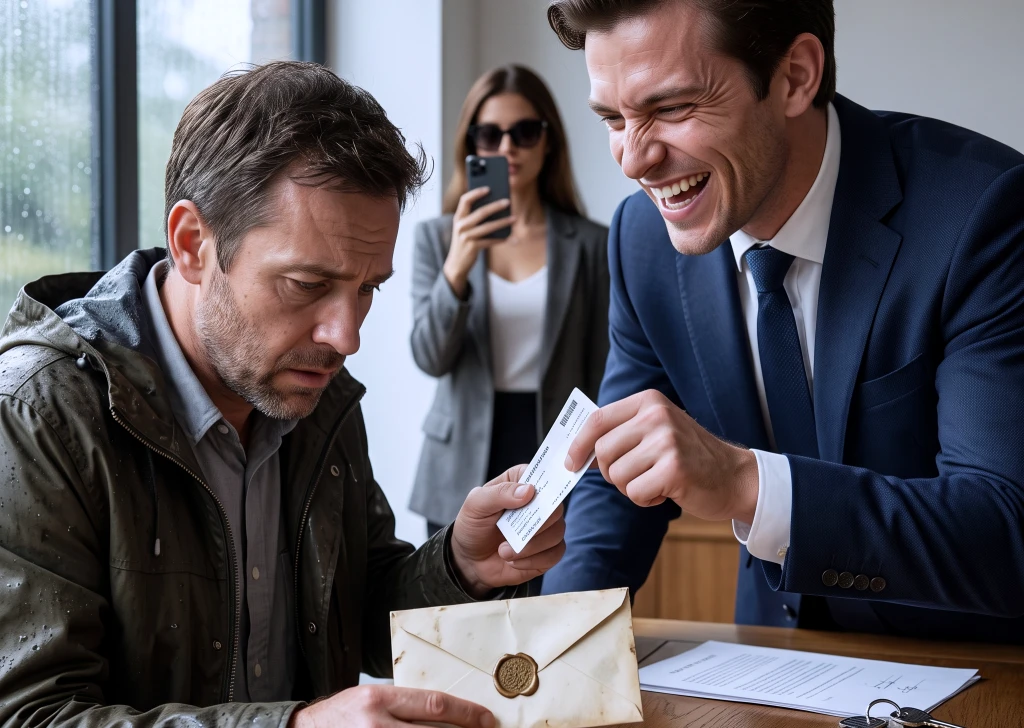
He wasn’t trying very hard.
“Wait,” he said, looking from the envelope to the lawyer. “That’s Daniel’s inheritance?”
My cousin Blaire leaned over her phone, already amused before she knew why. “Open it,” she said, her sunglasses pushed up into her hair even though we were indoors. “Come on, Daniel. Don’t be dramatic.”
I looked down at the envelope. It was cream-colored and soft at the edges, as if my grandfather had carried it around for a while before finally letting it go. My name was written across the front in Arthur Mercer’s unmistakable hand: careful block letters, steady even near the end, when the rest of him had begun to fail.
Daniel.
Not Daniel Mercer. Not grandson. Just Daniel.
Two hours earlier, we had buried the only man in my father’s family who had ever seemed curious about me without wanting something in return. Arthur Mercer had built Mercer Marine & Logistics from one rented tugboat on Lake Erie into a company with warehouses, shipping contracts, rail partnerships, and enough money to make grown adults whisper his name differently. At the cemetery, my uncle Warren stood by the casket like a man waiting for the opening bell on Wall Street. His wife, Celeste, complained about the rain spotting her heels. Grant checked messages between prayers. Blaire recorded a discreet video of white roses sliding down the polished lid.
I had driven from Cleveland in a twelve-year-old Honda with a brake light that had started blinking somewhere outside Toledo. I was a public high school history teacher. My apartment ceiling leaked in March. My students knew exactly which vending machine stole dollar bills and which substitute teachers could be talked into movie days.
I had come because Arthur Mercer had taught me chess on Sundays.
That was all I expected from him. Maybe that was why, when the lawyer handed me the envelope, the room shifted in a way I couldn’t explain. Not louder. Not colder. Just attentive, as if my grandfather had moved one last piece and every person at that table had leaned forward without meaning to.
Mr. Alden Price, the family attorney, had been reading for twenty minutes by then. To Warren and Celeste, Arthur had left the Harbor Springs house and the investment account attached to it. Celeste had pressed a manicured hand to her chest and whispered, “Oh, Arthur,” like she had not spent most holidays saying he was impossible.
To Grant, Arthur left controlling shares in Mercer Marine & Logistics, provided the company maintained its current employees for one calendar year. Grant stood so fast his chair knocked the table leg.
“I won’t waste it,” he said, already glowing with the future he’d been rehearsing since business school. “Granddad knew I was ready.”
Blaire got the Chicago penthouse and the family yacht, a sleek white thing named The Meridian that she had used as a backdrop for more photos than any of us could count. She squealed once, then remembered she was at a will reading and pressed two fingers to her lips.
Then Mr. Price looked at me.
“And to my grandson, Daniel Peter Mercer,” he said, “Arthur leaves this envelope and the travel enclosed within it. A second letter, written in his hand, is to be given to Daniel upon arrival at the destination.”
That was when Grant laughed.
I opened the flap carefully because my grandfather had sealed it carefully. Inside was a single plane ticket folded around a smaller card.
Cleveland to San Francisco.
One way.
Departure: Saturday, 7:15 a.m.
The date was two days away.
Blaire leaned across the table. “Are you serious?”
Grant reached before I could stop him and plucked the ticket from my hand. “Coach,” he announced. “Of course it’s coach.”
“Give it back,” my mother said.
She was sitting beside me in her black dress with her hands folded around a worn leather purse. Ellen Mercer had worked thirty-four years as an ER nurse and had the kind of voice that could cut through panic without ever rising. Grant glanced at her, remembered himself, and set the ticket down with exaggerated care.
“I’m just saying,” he said, smiling at me. “Granddad had a sense of humor. The teacher gets a field trip.”
Blaire tilted her phone away from me, but not before I saw my face on the screen. “San Francisco is cute, Daniel. Maybe there’s a museum conference.”
Warren let out a patient sigh, the kind he used when pretending not to enjoy someone else’s embarrassment. “Arthur always respected your choices. You wanted a simple life. He gave you something simple.”
My mother’s hand tightened around her purse.
I kept staring at the ticket because I was afraid if I looked at any of them, I would say something that could not be taken back. The ticket seemed too small for the room. Too ordinary. A boarding pass wrapped in cream paper while everyone else had been handed houses, yachts, companies, and bank accounts.
But then I noticed the card tucked behind it.
It was blank except for one penciled number in the corner.
1948.
I knew that year. Arthur had mentioned it only once, during one of our chess games when I was thirteen and too young to understand why he stopped talking afterward. He had come home from the Navy in 1948, used his discharge pay to buy half of a broken tugboat, and began the story our family repeated at every anniversary dinner. That was the official version. Arthur Mercer, war veteran. Arthur Mercer, self-made man. Arthur Mercer, builder of an American shipping dynasty.
The number on the card looked like a crack in that story.
“Mr. Price,” I said, “what’s in San Francisco?”
The attorney closed the folder with both hands. He did not look surprised by the question. “Your grandfather instructed me not to speculate.”
“Of course he did,” Grant muttered.
“There is a driver arranged at the airport,” Mr. Price added. “Your expenses at the destination have been prepaid. He asked that you bring only what you can carry.”
Blaire laughed under her breath. “That sounds ominous.”
“It sounds ridiculous,” Warren said. He pushed back from the table, already finished with me. “Daniel, you don’t have to turn this into a symbol. If you can’t afford to take off work, I’m sure we can have the ticket refunded and donate the amount to one of your school programs.”
He said “school programs” the way other people said “yard waste.”
My father would have lowered his eyes. Peter Mercer had spent his life cleaning up Warren’s mistakes and thanking him for the privilege. When I was fifteen, Dad died at his desk in a company office that did not even have his name on the door. A heart attack, they told us, brought on by stress, long hours, and a heart defect nobody had caught. Three weeks later, my mother learned he had signed away most of the small equity he had in Mercer Marine to cover a set of bad contracts Warren had authorized and denied.
The last thing my father ever said to me was not dramatic. He had been standing in our kitchen, loosening his tie with one hand while trying to smile for my mother.
“Don’t let this family decide what matters to you,” he said.
At the time, I thought he meant money. Years later, I understood he meant fear.
Arthur understood more than he ever admitted. After Dad died, he started coming by our apartment on Sundays with a wooden chessboard under his arm. He never apologized for Warren. He never explained what he could have stopped and didn’t. He simply placed the board between us, set his pieces in order, and said, “Show me what you see.”
Most Sundays, I lost.
Every now and then, he let me get close enough to believe I might win. Then he moved a bishop I had forgotten existed and took the board apart while I sat there stunned.
“The move that matters,” he told me during our last game, two weeks before his heart finally gave up, “is usually the one your opponent has already dismissed.”
Now all of them were dismissing this envelope.
I picked up the ticket and folded it back into the paper.
“I’m going,” I said.
Grant blinked. “You can’t be serious.”
“My grandfather gave me a ticket. I’m going to use it.”
Blaire lowered her phone. For once, she looked genuinely confused. “Daniel, it’s one plane ticket.”
“No,” my mother said quietly. “It’s Arthur Mercer asking him to trust him.”
Warren’s expression hardened at that, not because he disagreed, but because he could not stand the idea that Arthur might have asked me for anything meaningful. He had spent half his life trying to be chosen by a man who never gave praise without making it feel like debt.
“Sentimental,” he said. “Just like Peter.”
That decided it.
I stood, slid the envelope into the inside pocket of my jacket, and looked at the four of them sitting under the framed oil painting of my grandfather as a younger man. They had the company, the house, the penthouse, the yacht, the accounts. I had a coach ticket and a number written in pencil.
Somehow, mine was the only inheritance in the room that still felt alive.
On Saturday morning, I boarded the first flight with a carry-on bag, three days of approved personal leave, and my father’s old journal tucked between two shirts. My principal, Dr. Washington, had not loved the timing, but I had not missed a week of school in seven years. My mother drove me to the airport before sunrise. At the curb, she kissed my cheek and pressed a twenty-dollar bill into my hand like I was seventeen again.
“Call me when you land,” she said.
“I still don’t know what I’m doing.”
She looked toward the terminal doors. “Your grandfather was many things, Daniel. Careless wasn’t one of them.”
The flight was full. I sat in the middle seat between a software salesman who slept with his mouth open and a college student watching cooking videos without earbuds. Somewhere over Nebraska, I unfolded the envelope again and rubbed my thumb over the penciled 1948 until the number blurred.
By the time the plane landed in San Francisco, the city was gray with coastal fog. I followed the crowd through the terminal, past families with strollers and business travelers walking too fast, feeling increasingly foolish with every step. I had no hotel reservation. No address. No clue what came after baggage claim.
Then I saw my name on a white sign.
DANIEL MERCER.
The man holding it was in his late sixties, neatly dressed in a dark suit that looked old but cared for. His hair was silver at the temples, and when his eyes found mine, his expression changed with such relief that I stopped walking.
“Mr. Mercer?” he asked.
“Yes.”
He lowered the sign. “Thank God. Mrs. Mercer was afraid you wouldn’t come.”
I frowned. “Mrs. Mercer?”
The man looked past me, as if worried someone from the plane had followed. Then he stepped closer and spoke gently, like a person delivering news that might break in someone’s hands. “Your grandmother,” he said. “She has been waiting a very long time…”
To read the rest of the story – CLICK the NEXT button 👇👇👇