


The night the first sleet sealed the woodpile shut, Clara Whitcomb made her children stand back from the kitchen table. Outside, the storm clawed at the cabin like it wanted in. Ice tapped the single window over the washbasin, and the stack of split pine along the north wall had already become one white, frozen hump. Henry lay on the rope bed near the stove with his bad leg propped on folded blankets, watching his wife move the chairs aside without saying a word.
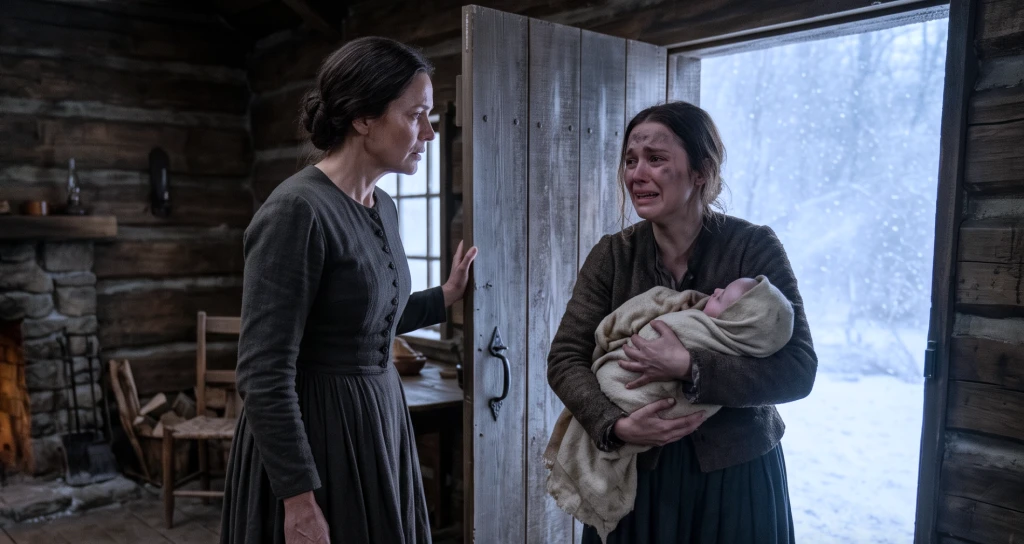
Caleb, twelve and thin from a summer of chores that had made him look older than he was, helped drag the table across the floor. Little Ruth gathered the rag rug in both arms and held it to her chest as if it were something alive. Beneath it, set into the pine boards, was an iron ring nobody outside the family had seen.
“Is it going to smell bad down there?” Ruth whispered.
“It shouldn’t,” Clara said.
That was the thing about every plan a person made on the frontier. It either worked when the weather turned cruel, or it became one more foolish story people told at the trading post.
Clara hooked two fingers through the iron ring and pulled. The trapdoor lifted with a soft groan, stubborn against the leather seal she had nailed around its edge. Cold air rose from beneath the floor, carrying the scent of clay, pine bark, and something else she did not want to smell.
Rain.
Six months earlier, nobody in Willow Creek Valley would have believed she would cut a door in her own kitchen floor and hide most of the family’s winter fuel beneath the cabin. Some had laughed outright when they heard. Others had been kinder, which was sometimes worse. Kindness came wrapped in warnings, in pity, in offers that made a woman feel smaller every time she accepted one.
It had started in April, when Henry’s plow horse spooked at a flash of lightning and dragged him sideways before Clara could reach the field. His right leg snapped below the knee. There was no doctor closer than a hard day’s ride, and the trail was mud, so Clara set the bone herself with trembling hands and two shaved boards while Caleb held the lantern and Ruth cried into her apron.
Henry did not make a sound until it was over. Then he covered his face with his arm and said, “I’m sorry.”
Clara had wanted to be angry at the horse, the storm, the bad luck of it all. Instead, she tied the splint tighter and told him, “Be sorry when you try to stand before I say you can.”
The Whitcomb homestead was 160 acres of promise and trouble in Montana Territory. The cabin leaked near the west corner. The garden still needed fencing. The nearest neighbor, Amos Reed, lived four miles east, and the settlement of Pine Crossing was far enough away that a person measured the trip in daylight, not miles.
Henry had split two cords of wood before the accident. Two cords might keep a careful family alive through a soft winter. Willow Creek did not have soft winters.
Clara had heard the stories. Families burning chairs before New Year’s. Men chopping up wagon boxes in February. Smoke so thick in cabins that babies coughed all night because the only wood left was green, wet, and half-rotten.
She had no intention of waiting for that kind of mercy.
The idea came because of a chicken.
In May, one of Ruth’s hens vanished under the cabin, and Clara had to crawl after it on her stomach with a candle stub in her hand. Henry had built the cabin up on fieldstone piers, leaving a low crawlspace beneath the main room. He had done it because he was particular about rot and airflow, though Clara had teased him for building a house that looked as if it were trying to stand on tiptoe.
Under there, with her cheek nearly brushing the earth, Clara noticed something. The ground was dry. Not just less muddy than the yard, but truly dry, protected by the roof overhang and the way the land sloped away toward the creek bed.
By the time she came out with the squawking hen tucked under one arm, she had already begun measuring the dark with her eyes.
When Amos Reed stopped by two days later to ask after Henry, Clara told him she meant to dig out the space beneath the main room and use it for wood storage. Amos had survived eight winters in the valley, which gave him the confidence of a man who had earned his opinions honestly.
“You want to dig under your own house?” he said, sitting tall in the saddle. “Clara, that isn’t thrift. That’s inviting the roof to sit in your lap.”
“The piers will stay,” she said. “I’ll work around them and widen the bases.”
“And when the spring melt comes?”
“The slope carries water away.”
“Until it doesn’t.” Amos looked past her toward the cabin, where Henry was pretending not to listen through the open door. “I can spare some wood. Maybe the Bell boys can too. No shame in taking help when your man’s laid up.”
Clara thanked him because she had been raised to be civil. But she had learned about help during their first year in America, before the homestead claim, when she and Henry had lived in a Minnesota boardinghouse while he cut timber for cash. Help had come with soft voices and sharp hooks. A bowl of stew meant owing someone your silence. A borrowed coat meant letting a woman speak down to you in front of your children.
Charity was never only what it was. It remembered itself.
So Clara dug.
She started with a short-handled spade, a lantern, and a bucket tied to rope. Caleb hauled the dirt out after his morning chores. Ruth picked stones from the pile and sorted them by size because she liked tasks that had rules. Henry sat near the open floorboards, pale with frustration, and talked through bracing angles until Clara told him she needed less worrying and more arithmetic.
The first week nearly broke her. She worked hunched and breathless in the dark, dirt in her hair, shoulders burning, every bucket heavier than the last. At night, she lay beside Henry and felt her hands throb so hard she could count her heartbeat in each finger.
By June, the crawlspace had become a chamber.
Not a pretty one. The walls were clay, curved by the scrape of her shovel. The floor sloped just enough that any water should run toward the lower vent. Around every original stone pier, Clara stacked additional fieldstones in wide circles, spreading the weight the way her father had taught her when he built boat cradles in a shipyard on the Maine coast.
That was another thing people forgot about Clara. Before she had been Henry Whitcomb’s wife, before she had crossed half a continent in a wagon and learned to make coffee from burned barley when money ran thin, she had been a ship carpenter’s daughter. Her father had taught her that dampness was patient, air had to move, and wood lasted only as long as a person respected both.
Jacob Miller, who ran the sawmill north of Pine Crossing, found her crawling out from beneath the cabin one afternoon with clay streaked across her cheek.
“You building a cellar under your floor?” he asked.
“For wood.”
Jacob wiped his hands on his coat and looked at the dark opening as if it might bite. “Wood underground rots.”
“Wet wood rots. Dry wood stays dry if air moves through.”
“And how are you making air move through a hole in the ground?”
Clara showed him the two shafts she had begun cutting, one upslope beneath the eaves, one downslope beyond the drip line. She explained how the cooler air would enter low, how the warmer damp air would draw out through the far side, and how the steady ground temperature would help prevent the freezing and thawing that turned stacked wood into a block of ice.
Jacob listened without smiling. That was the best thing about him. He did not flatter and he did not mock.
“I’ve seen clever ideas kill people out here,” he said at last. “But I’ve also seen stubborn people live because they noticed what everyone else stepped over. Keep three feet clear around those piers, Mrs. Whitcomb. More if the clay changes.”
“I will.”
“And if you smell rot, stop pretending you don’t.”
That almost made her smile. “I’m not a fool, Mr. Miller.”
“No,” he said, looking once more into the dark. “That’s why I’m worried less than I planned to.”
By August, Henry could sit on the porch with his leg stretched stiff before him, though walking still cost him dearly. Clara had finished the chamber, built the vents, and fitted wooden grates over the openings to keep out mice. The trapdoor took three days. She used pine from broken packing crates, wool from a moth-eaten quilt, and strips of leather cut from an old saddle she bought for fifty cents.
When it shut, it sealed tight enough that Ruth claimed the floor was holding its breath.
Then came the wood.
Clara walked to the dead stand of lodgepole pine at the west edge of the claim before sunrise, her axe over her shoulder. She learned the grain of each round. She learned where to strike and where not to waste strength. Her hands blistered, split, hardened, and healed around the handle until the axe felt less like a tool than an argument she had finally learned to win.
Neighbors saw. Neighbors talked.
Maggie O’Leary, who lived across the creek road with her husband and three children, came one afternoon with bread and worry in equal measure. She found Clara stacking split wood near the trapdoor while Caleb handed pieces down into the chamber.
“You’re really filling it,” Maggie said.
“I didn’t dig it for decoration.”
Maggie looked at the opening in the floor. “I’m not saying you can’t do it. I’m saying I’ve seen cabins fail in ways nobody expected. A house is a small thing between a family and the weather.”
Clara leaned on the stack for a moment, letting her back rest. “That’s exactly why I’m doing it.”
Maggie studied her face, and something softened. “Because of Henry?”
“Because of all of us.” Clara glanced toward the bed where Henry was mending a harness, pretending not to hear. “Because if February comes mean, I don’t want to be waiting on who still feels generous.”
Maggie nodded slowly. She understood that in a way some men never would. “Then promise me you’ll let someone know if the walls start shifting.”
“If the walls shift, you’ll hear me shouting from here to Pine Crossing.”
The Reverend Silas Crane was less amused. He arrived in September while Clara was splitting the last of the fourth cord and stood near the chopping block with the tight expression of a man trying to rescue civilization one opinion at a time.
“Mrs. Whitcomb,” he said, “surely there are men who could take on this kind of labor.”
Clara set another round upright. “There’s one right there, Reverend. His leg is still healing.”
“That isn’t what I meant.”
“No,” Clara said, lifting the axe. “I know what you meant.”
The Reverend cleared his throat. “There is a natural order to family life. Men are intended to provide the heavy labor. Women keep the home.”
Clara brought the axe down. The pine split cleanly, each half falling away from the blade. “This is me keeping the home.”
Henry laughed once from the porch, then covered it with a cough.
By the end of September, most of the good wood was stacked beneath the cabin in careful rows, with spaces left for air to pass between them. The chamber was not beautiful, but Clara loved it in a way she could not explain. It was not a room people would admire. It was proof in clay and stone that her family’s survival did not have to wait for permission.
Then October came hard.
The first storm dropped the temperature nearly thirty degrees before dusk. Rain hammered the roof, turned to sleet, then to heavy snow that pressed itself against the cabin walls. By morning, the outside pile was armored in ice.
That evening, with the stove burning low and the children watching, Clara lifted the trapdoor for the first true test. She expected the clean, resinous smell of seasoned pine. Instead, the chamber breathed up cold clay. And rain…
To read the rest of the story – CLICK the NEXT button 👇👇👇