


The abandoned forge had one fresh thing left in it. Hoofprints. They cut clean through the mud behind the sagging wooden shop, deep enough that Hannah Tate could see rainwater shining in the bottom of each one. Everything else on the Sutter place looked as if it had been giving up for years—the leaning fence, the rusted pump, the farmhouse chimney standing alone in a field of weeds—but those hoofprints were new.
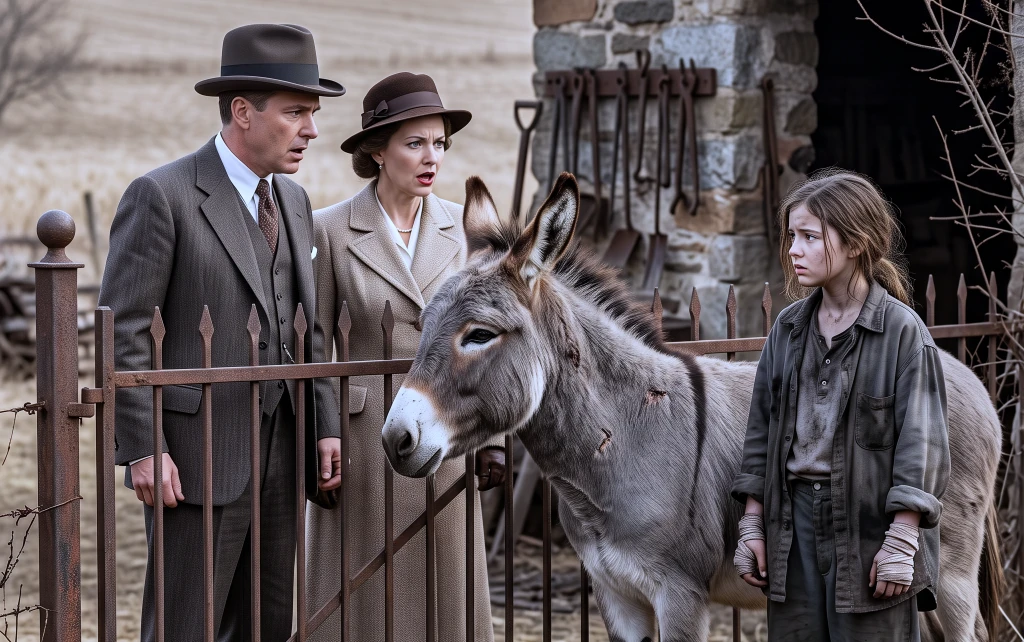
Hannah stood with a flour sack over one shoulder and listened.
At first, she heard only the wind moving through the tall grass and the loose sheet of tin knocking softly on the roof. Then came a sound from behind the forge wall. Not a voice. Not a dog. A slow, rough breath, like something old had been waiting there too long.
She should have turned around.
But there was nowhere left to turn around to.
That morning, Aunt Marlene had handed Hannah the flour sack as if she were returning something defective to a store. Two shirts had been shoved inside, along with Hannah’s cracked comb and the photograph of her mother that she kept beneath the cot by the pantry. The photograph had been wrapped in a dish towel, not out of kindness, but because Aunt Marlene did not like loose things.
“Fourteen is old enough to stop being carried,” Uncle Ray had said from the kitchen doorway. He had not looked angry. That was worse. Anger might have meant he still cared what became of her. “You can find work somewhere. Plenty of farms need hands.”
Hannah had looked to her aunt first, then to her two cousins standing near the stove with biscuits in their hands. No one corrected him. No one said a girl who had scrubbed floors, hauled water, mended clothes, fed chickens, and slept beside sacks of potatoes was not being carried.
“I can sleep in the shed,” Hannah had whispered. “I won’t come inside. I’ll still do the work.”
Aunt Marlene’s mouth tightened. “This is exactly what I mean. Always bargaining. Always making things harder than they have to be.”
“I’m not trying to—”
“You broke my plate.”
The plate had been chipped already. Everyone in that kitchen knew it. Hannah had been washing breakfast dishes with hands cold from the pump when it slipped and split against the floor. She had knelt so quickly to gather the pieces that one edge cut her thumb, and she had still said she was sorry before the blood reached her wrist.
Uncle Ray had opened the back door. “You heard your aunt.”
So Hannah had taken the sack.
She had not cried on the porch. She had not cried at the pump, or at the gate, or when the bolt slid into place behind her with a hard little sound that seemed to travel straight into her bones. Her mother used to say dignity was not the same as pride. Pride made noise. Dignity kept walking when no one walked beside you.
By noon, Hannah had passed the church with the cracked bell tower and the locked side door. A notice curling on the board said services were canceled until repairs could be made. She tried the handle anyway, then pulled her hand back as if the wood might scold her for asking.
Across the road, Mrs. Whitcomb from the general store stepped out with a basket over one arm. She saw the flour sack. Hannah knew she saw it because the woman’s face changed for half a second before smoothing over into polite distance.
“Hannah,” Mrs. Whitcomb said.
“Ma’am.”
“You headed somewhere?”
Hannah almost told the truth. She almost said, No, ma’am, I was just put out and I don’t know where dark is going to find me. But Mrs. Whitcomb’s eyes had already moved past her toward the store window, toward the clean counter and the customers waiting inside.
“Yes, ma’am,” Hannah said. “Just down the road.”
Mrs. Whitcomb nodded with relief she tried to hide. “Well. You be careful.”
Hannah walked on.
Near the schoolhouse, children’s voices spilled out through open windows. Someone was reciting multiplication. Someone else laughed too loudly and was hushed by the teacher. Hannah slowed long enough to see the corner of the blackboard through the window, chalk dust floating in a bar of sun, then kept moving because looking too long made the wanting worse.
Past Miller’s orchard, three green apples lay in the grass outside the fence. Her stomach pinched so sharply she had to stop. No one was around. The apples were small and hard, probably sour enough to make her jaw ache, but they were food.
She bent toward one.
Then she heard her mother’s voice in memory, low and tired after a day of washing for other people. Hunger can empty a body, Hannah. Don’t let it empty your name.
Hannah straightened and left the apples where they were.
By midafternoon, the town thinned into fields. The good fences ended first, then the painted barns, then the wagon ruts that showed regular use. Her shoes pinched where the leather had cracked, and the twine around the flour sack cut a red groove across her palm. She stopped at a ditch and ate half the piece of cornbread she had wrapped in cloth the night before.
The other half she saved for morning, though she had no idea where morning would find her.
A pickup truck rattled past just after that, the old kind with more rust than paint. Mr. Pruitt from the feed store slowed when he recognized her. He had once paid her a nickel to stack crates behind his shed.
“You all right, Hannah?” he called.
She stood up too fast, brushing dirt from her skirt. “Yes, sir.”
His eyes moved to the sack. Then to the road behind her. Then to the empty road ahead.
“You got people expecting you?”
There it was again, that careful hesitation. The thin place before a person decided whether your trouble would become theirs.
“Yes, sir,” she said. “Not far.”
He nodded. Too quickly. “Best get there before weather turns.”
The truck went on, leaving dust where help might have been.
After that, Hannah stopped hoping anyone would ask twice.
The Sutter track appeared near the edge of evening. A gray board leaned beside it, paint peeled down to splinters. Only part of the old name remained. SUTT— REPAIR. Children in town said the place was haunted. Adults said Henry Sutter had been a fool with a hammer, patching poor men’s tools for beans and promises until his own roof rotted through. His daughter had gone north years ago and never looked back.
Hannah stood at the mouth of the track with the whole town behind her lighting supper lamps.
Doors were closing. Stoves were warming. Mothers were calling children in from yards.
None of those voices called her name.
She turned down the track.
At first, she meant only to find a tree thick enough to sleep under. The sky had begun to bruise purple along the west, and rain pressed against the air. Briars dragged at the flour sack. Mud sucked at her shoes. Once, her right foot sank so deep she fell to her knees and sat there breathing hard, both palms planted in the cold ground.
For a moment, a sound rose in her throat. Not quite a sob. Not quite a laugh.
She swallowed it.
Crying would not pull her shoe free.
She worked the leather loose, tied the peeling sole with a torn strip from one of her shirts, and stood again. The knot was ugly, but it held. Her mother had taught her that too—when you had very little, usefulness began in your hands.
Then she saw the hoofprints.
They started near a broken gate and pressed through the mud in a line toward the back of the property. Not old tracks. Rain had not softened them. Grass had not folded back over them. Something with hooves had passed that way recently, and for reasons Hannah could not have explained, the sight pulled her forward harder than fear pushed her back.
The Sutter place rose out of the weeds in pieces. The farmhouse itself was gone except for the stone chimney. A barn leaned open at one side, roof caved like a tired shoulder. A storage shed had nearly disappeared beneath honeysuckle. Farther back stood the forge, squat and stubborn, with a crooked tin roof and a stovepipe black against the sky.
It had not fallen.
That was the first thing Hannah noticed. Everything around it had surrendered, but the forge still stood.
The front door hung half open. Inside, the room smelled of damp ash and old iron. Dust covered the anvil. Hammers hung in rows from the wall, their handles dark from hands that had not touched them in years. A long workbench sat beneath a cracked window. The forge itself, built of brick and stone, was cold.
Hannah stepped inside only far enough to set the flour sack where rain could not reach it.
Then the breath came again.
She turned.
It came from behind the shop, slow and rough and close enough now that she could hear the catch inside it. She picked up a short length of wood from beside the doorway, not because she wanted to use it, but because fear sometimes needed a handle.
The rain began as she moved along the outside wall. A few drops first, cold on her face. Then more, tapping on the tin roof. She rounded the corner slowly, her tied shoe slipping in the mud.
Behind the forge, in the narrow yard between the wall and a collapsed cart, stood an old gray donkey.
He was thin, not starved to bone but close enough that his ribs showed through his wet coat. One wheel of the cart beside him had sunk deep into the mud; the other pointed upward uselessly. A rope ran from the donkey’s halter to a post so short he could not reach the grass growing bright and wet just beyond his nose.
He did not bray when he saw her.
He only lifted his head.
The rope had rubbed a raw red line into the fur beneath his jaw. Rainwater slipped down his face and gathered at the end of his muzzle. One ear turned toward Hannah, then the other, as if even hope had to be considered carefully.
Hannah lowered the stick.
“Hey,” she whispered.
The donkey blinked.
“I don’t have much,” she said, and felt foolish the moment the words left her mouth. “But I’m not going to hurt you.”
She took one careful step. The animal shifted, and she stopped at once. In the wet dirt near the post, Hannah saw the knot.
Fresh.
The rope itself was old, but the knot was not. It had been tied by hands that had been there recently enough to leave the mud sharp beneath their boots. Somebody had brought this donkey back to the post, tied him too short to graze, and walked away while he was still breathing.
Hannah looked toward the silent forge, then back at the animal. The town had not abandoned this place years ago. Someone had abandoned it today…
To read the rest of the story – CLICK the NEXT button 👇👇👇