


The sound coming out of Blackwater Sink was too thin to belong to an animal that large. Cal Mercer stopped on the deer trail with one hand on the stock of his old shotgun and the other braced against a white pine slick with rain. The late-October woods had gone quiet around him. No crows. No squirrels in the leaves. Even the wind seemed to wait.
Then it came again.
Not a roar. Cal knew what a roar sounded like. He had heard one shake the ribs of a transport trailer fifteen years earlier, just before a gate failed and his wife died on the wrong side of it.
This was worse because it was smaller. A long, broken sound dragged out of the fog, hoarse at the edges, almost like an animal trying not to cry and failing. It rose from the old peat bog below the ridge, a place locals called Blackwater Sink because cattle had vanished there before Cal was born and the ground never gave back what it took.
He should have turned around.
He was sixty-two, alone, three miles from his cabin, with the temperature falling hard enough to glaze the puddles by dark. The county alert two days ago had warned everyone from Bradford to the state line: exotic cat missing, do not approach, call authorities immediately. Cal had deleted the message after reading it twice. He had spent half his life as a Pennsylvania wildlife officer, and he had no interest in helping another rich man’s tiger.
The cry came again, weaker this time.
Cal moved downhill.
The mud took him by degrees. First it softened under the leaves, then it pulled at his boots, then it opened into patches of black water that reflected the gray sky in broken pieces. The smell changed too. Wet moss, cold clay, sour rot, and something sharp beneath it. Fear had a smell when it came from a trapped animal. Cal had known that long before he had a badge.
He came out at the edge of the sink and stopped breathing.
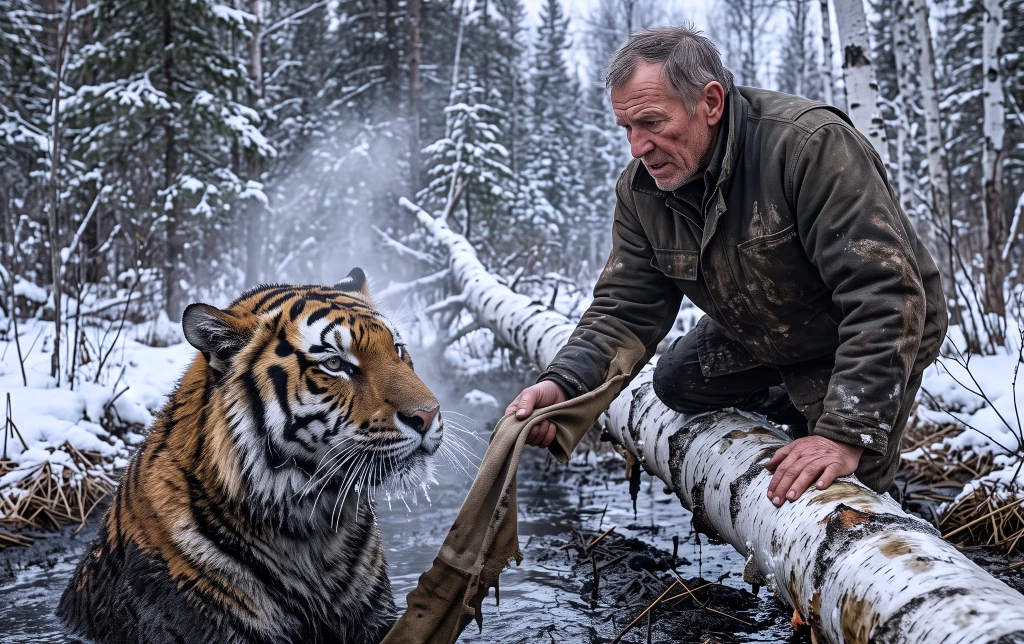
The tiger was chest-deep in the bog, twenty yards from solid ground.
Even half-swallowed by peat and freezing water, the animal was enormous. A young male, broad through the head and shoulders, striped in black and dark orange, with white fur around the cheeks now clumped with mud. His whiskers had crusted with ice. Every breath came out in a white burst that shivered away over the water.
He was not fighting anymore. That was what tightened something behind Cal’s ribs. The cat’s front paws moved now and then, slow and useless, only enough to make the muck seal tighter around him. The rest of his body had become part of the bog, held under a skin of black mud that trembled whenever he tried to shift.
Cal lifted the shotgun halfway without meaning to.
He could end it. One clean shot. Better than letting the animal freeze inch by inch while the swamp drank him down. That would be mercy, or close enough to mercy that a man could sleep after it if he had trained himself not to think too long.
The tiger raised his head.
His eyes found Cal’s across the sink, and the years folded in on themselves so sharply that Cal almost stepped back. He saw another tiger behind a sagging fence at a roadside cat refuge outside Erie. He saw the yellow emergency lights. He saw Ellen’s boot in the straw before he saw the rest of her, and he heard a deputy saying his name as if calling him back from the bottom of a well.
Ellen had loved dangerous things in the careful way some people love storms from a porch. She had volunteered with neglected animals, argued with owners who should never have been allowed near them, and believed that cruelty was mostly ignorance waiting to be corrected. Cal had believed in fences, tranquilizer rifles, signed permits, and distance.
He had been right about the distance.
He had been too late about everything else.
After Ellen, he stopped answering calls about big cats unless the law required it. He wrote reports, gave statements, signed forms, and carried his grief with the neat, mean efficiency of a man who had no patience left for softness. Tigers were not symbols to him. They were muscle, teeth, speed, and bad decisions made by people who liked owning what they did not understand.
The tiger in the bog blinked once. There was no challenge in his face, no wild promise of violence. Only cold, pain, and a plea that had no language.
Cal lowered the shotgun.
“Damn you,” he said, though he did not know whether he meant the tiger, Ellen, himself, or the whole ruined world that kept asking old men to choose between the thing that hurt them and the thing that needed them.
The bog answered with a wet, tired bubble.
On the ridge above the sink, hidden where the spruce grew thick against a line of boulders, two men watched through binoculars.
The taller one smiled without warmth. Silas Vale had been called Snake since he was nineteen, and it suited him better than the name his mother had given him. He had a narrow face, pale eyes, and the patient stillness of a man who had learned to wait until other people made mistakes.
“Well,” he murmured, lowering the binoculars. “That saves us a hard afternoon.”
Beside him, Tyler Dunn shifted his weight and rubbed his gloved hands together. He was young enough to still show nerves and old enough to know better than to complain about them. “We going in after it?”
Snake looked at him as if the question had an odor.
“You planning to wrestle him?”
“No. I just mean—”
“You don’t mean. That’s your problem.” Snake lifted the binoculars again. “Buyer wants him alive. Cat’s too weak to climb out and too strong for Mercer to move by himself. So we let the old man do what old men with guilt do.”
Tyler looked down toward the bog. “You know him?”
“I know enough.”
Cal did not see them. He was already backing away from the sink, not from fear now but from arithmetic. Distance to cabin: a hard three miles if he cut through the old logging road. Gear: boards, cable, a come-along winch, maybe the tow straps hanging from the rafters. Time: too little. Temperature: dropping.
He took one last look at the tiger.
“Stay breathing,” he said.
The animal’s head sank a fraction, as if even holding Cal’s gaze had cost him. Cal turned and went uphill faster than he had moved in years, boots slipping, breath tearing white in front of him. Branches slapped his coat and left cold rain down his neck. His knees complained on the climb, then quit complaining because the rest of him gave them no room.
He had pulled deer from ravines, horses from creek ice, a neighbor’s tractor from a washed-out ditch, and once a black bear cub from a culvert with the mother pacing fifty yards away. A tiger was different. A tiger weighed four hundred pounds or more, and this one was packed in suction that could steal a boot off a standing man.
The word if kept time with his steps.
By the time Cal reached his cabin clearing, the sky had lowered into a flat iron lid. His lungs burned. His cabin stood at the end of a rutted track with a woodshed, a rusted water pump, and a sagging porch Ellen had wanted to repaint the summer she died. He had never repainted it. He told himself the boards were sound enough.
He dropped the shotgun against the porch post and went straight to the shed.
The planks were stacked where he had left them, dry under a tarp. He dragged out the two longest and kicked aside a coil of baling wire. The cable was in the back corner, oily and stiff, looped around itself like a sleeping snake. Cal grunted as he lifted it. The come-along hung from a nail under a shelf of paint cans, heavier than he remembered but still moving clean when he tested the ratchet.
He needed an ax. He needed the tow strap. He needed to stop thinking about the cat’s eyes.
Cal swung the shed door wider and froze.
A branch near the back gate had been snapped clean, white wood showing fresh against the wet bark. It had not been broken that morning. Cal knew that because he noticed small things; small things had kept him alive through thirty-six years of finding men who thought remote land meant unowned land.
He turned slowly.
The yard looked empty. Porch. Pump. Woodpile. Rain barrel. His shotgun leaning five steps away, where he had left it like an idiot.
Then he smelled cigarette smoke.
Cal had not allowed tobacco on his property since Ellen quit smoking in 1998 and made him quit with her out of sheer stubbornness. The scent was cheap, harsh, and recent. It seemed to hang beneath the colder smell of rain.
He bent as if to set down the cable. His right hand shifted toward the ax on the chopping block.
A voice came from behind the cabin, quiet enough that it did not need to be loud.
“Don’t hurry on our account, Mercer.”
Cal straightened one inch at a time.
A man in camo stepped around the corner with Cal’s satellite phone in one hand and a rifle in the other. His face was narrow, his smile almost polite. Behind him, near the woodshed, a younger man lifted a shotgun with both hands and tried to look less afraid than he was.
Snake looked at the cable on Cal’s shoulder, then at the planks, then back at Cal. – “Looks like you and I had the same idea…”
To read the rest of the story – CLICK the NEXT button 👇👇👇