


Noah Whitmore was four years old the first time he understood that grown-ups could leave on purpose. His father pulled the black SUV onto a narrow service road in the Catskills, where the trees stood close together and the late-November sky had already gone the color of wet concrete. There were no houses out there, no porch lights, no gas station sign glowing through the branches. Just mud, rock, and a thin wind that slipped through Noah’s little wool coat as if the buttons had not been fastened at all.
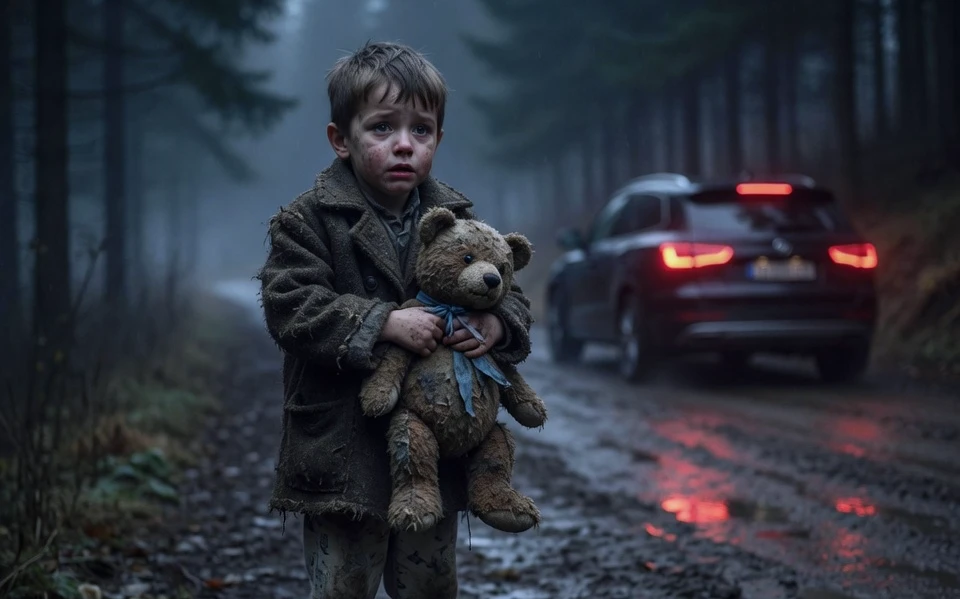
Grant Whitmore got out first. He opened the back door and looked down at his son with the same expression he used when one of his employees had failed him. Noah climbed out carefully, his slippers sinking into the damp leaves because no one had told him to put on shoes before they left the house.
“Stay here,” Grant said.
Noah held his stuffed bear against his chest. The bear had one loose eye and a blue ribbon around its neck. His old nanny, Mrs. Price, had tied that ribbon on after Noah’s last hospital stay so he would “have someone brave with him.”
“Are you coming back?” Noah asked.
Grant looked toward the road instead of at him. His hands were clean, his coat expensive, his jaw tight with impatience. “Do what I said.”
Then he shut the door.
For a moment Noah thought this was a game. His father had never played hide-and-seek with him, but maybe rich fathers played it differently. Maybe this was the part where Noah was supposed to prove he could stand still and be good and not shake, not fall, not embarrass anyone.
The SUV reversed hard, its headlights sweeping across the trees. Noah lifted one hand, small and pale in the cold. “Dad?”
Grant drove away.
Noah stood in the road until the red taillights disappeared between the trunks. Only then did he take one step forward, then another, his slippers slipping over the wet leaves as he tried to follow. The stuffed bear bounced against his chest. His breath came out in small white clouds.
“Dad, wait,” he called.
The mountain swallowed his voice.
That morning, Whitmore House had smelled of polished wood, white lilies, and silver trays being carried through hallways by people who knew how to disappear. It was the kind of house visitors spoke about in soft, admiring voices: the stone mansion outside Greenwich, the sweeping lawn, the glass conservatory, the portraits of dead Whitmore men who had built railroads, banks, charities, and reputations no one was allowed to question.
Noah was not supposed to come downstairs when guests were there. Mrs. Price had told him that twice while buttoning his sweater. She had said it gently, but he had heard the nervous part underneath.
“Your father has important people visiting,” she said. “You can see the lights from the upstairs landing.”
Noah did not want the lights. He wanted his mother.
Elise Whitmore had been different before her belly began to grow. Noah could still remember sitting beside her on the piano bench while she played slow songs after dinner. He remembered the way her fingers had smelled faintly of lavender when she pressed them to his forehead after a seizure. He remembered her whispering, “My sweet boy,” as if the words belonged only to him.
Lately, she spoke to him through doorways.
The doctors had given his condition a name, but the adults rarely used it around him. They said “episodes” and “spells” and “that problem.” Once, when Grant thought Noah was asleep, Noah heard him say the word defective in the hallway.
He did not know what it meant then. He only knew his mother cried afterward, and no one came into his room until morning.
That afternoon, Noah slipped away from Mrs. Price while she was speaking to a housekeeper and crept down the back staircase. He followed the warm sound of voices to the ballroom, where men in dark suits laughed over champagne and women in pearls leaned close to one another with practiced smiles. Grant stood near the fireplace, taller than everyone around him, one hand resting on the shoulder of a senator as if the man were a guest in Grant’s world instead of his own.
Noah hid behind the carved banister. His left hand trembled, so he tucked it under the bear’s soft body. Across the room, Elise stood beside his father in a cream-colored dress, one palm resting over the curve of her stomach.
She saw him.
Noah knew she did. Her eyes found him in the shadows, and for one bright second, his chest filled with hope. He thought she might come over, kneel in front of him, and whisper that he had to go upstairs before his father noticed. He thought she might take his hand.
Instead, Elise looked away.
A woman beside her touched her arm and asked something about the baby. Elise smiled the way people smiled in photographs. Noah stayed very still until Mrs. Price found him and carried him upstairs, murmuring apologies against his hair as if she had failed him instead of the other way around.
That night, the seizure came fast.
Noah remembered the ceiling first, the little cracks in the plaster above his bed. Then he remembered his fingers curling, his legs jerking, Mrs. Price shouting his name, and his mother’s perfume somewhere near the door. He could not make his mouth work. His body belonged to something else, something wild and bright and frightening.
When it stopped, he lay limp under the tangled sheets. Mrs. Price was crying. Elise stood with both hands over her mouth.
Grant watched from the doorway.
Noah searched his father’s face for relief. He would have taken anything: fear, anger, even the kind of sharp command Grant used when something expensive broke. But Grant only stared as if he had been shown proof of a problem he had already decided how to solve.
“We should have handled this before,” he said.
Elise’s voice shook. “Grant, please.”
“You heard Dr. Hanley. It may never fully go away. Do you know what that means for this family?”
“He’s our son.”
Grant’s eyes moved to her stomach. “And we have another child to think about now.”
Noah did not understand all the words. He understood the room. He understood Mrs. Price going quiet, his mother stepping back, his father turning away as if the conversation had already ended.
After that, Noah’s world grew smaller. Meals came on trays. The garden became something he watched through glass. His mother no longer came to his bed unless someone else was in the room, and even then she touched his blanket more often than she touched him.
One evening, he found her alone in the library, standing by the window with the sunset behind her. Noah walked in barefoot, carrying his bear by one paw.
“Can I say hi to the baby?” he asked.
Elise closed her eyes.
Noah reached toward her stomach, careful and hopeful. “Do you think he’ll like me?”
His mother caught his wrist before his fingers touched her dress. Not hard, but fast enough to make him stop. Her face looked tired in a way he had never seen before.
“It’s late, Noah,” she said. “You should go upstairs.”
“I just wanted—”
“Please.”
That was the word that sent him away. Not because it was loud, but because it sounded like he was asking her for something cruel.
The next morning, Grant told him they were going for a drive.
Noah had been so happy at first that he forgot to be afraid. He thought maybe his father was taking him to see the doctor again, or maybe to the park Mrs. Price had promised they would visit when the weather got better. He climbed into the SUV with his bear and pressed his face to the window, watching the estate gates swing open.
Grant did not speak for nearly two hours.
The highways gave way to smaller roads. The smaller roads became roads without painted lines. By the time they reached the mountain, Noah’s excitement had become a quiet stone inside his stomach.
Now, standing alone in the clearing, he held his bear so tightly the loose eye bent sideways.
The cold gathered around him. A few flakes of snow drifted between the branches, too thin to cover the ground but heavy enough to make the forest feel awake. Noah tried walking in the direction the SUV had gone, but the road split twice, and the trees looked the same no matter which way he turned.
His hands began to ache. His teeth clicked together. Once, his knees buckled, and he sat hard in the mud, staring at the brown stains spreading across his pajama pants under his coat. He did not cry. Crying made his head hurt, and crying never brought anyone into his room unless he was already frightening them.
A branch cracked somewhere behind him.
Noah froze.
At first he thought his father had come back. He stood too quickly, dizzy from the cold, and turned toward the sound. There was nothing there except trees and wind and the gray slope of the road.
Then he heard something else.
An engine.
It was not the smooth, fading sound of his father’s SUV. This engine was lower, rougher, waiting somewhere beyond the bend. Headlights appeared through the trees, thin and white at first, then bright enough to make Noah lift one arm over his eyes.
A dark car rolled slowly toward him and stopped several yards away.
Noah backed up, clutching the bear to his chest. The driver sat still behind the windshield, a phone pressed to his ear. He was not looking at the road anymore.
He was looking at Noah.
The man’s face changed, not with surprise exactly, but with the grim certainty of someone who had found the thing he was afraid he would find. He spoke into the phone, his voice low enough that Noah could barely hear it through the running engine.
“Mr. Raines,” the driver said. “He’s here.”
He listened for a moment.
Then his eyes returned to Noah.
“Yes,” he said. “The boy is still alive…”
To read the rest of the story – CLICK the NEXT button 👇👇👇